UPSC Current Affairs
SC verdict on same sex marriages soon: Complete summary of the arguments made during hearing
What the petitioners argued The petitions argued that marriage brings with it several rights, privileges, and obligations “bestowed and protected by the law” Senior Advocate Mukul Rohatgi argued that the right to marry for non-heterosexual couples is implicit… Union of India’ (2018) decriminalising homosexuality by striking off Section 377 IPC, and ‘KS Puttaswamy and Anr. Union of India’ (2017), which upheld the fundamental right to privacy, respectively.
VRAuthor Desk
6 min read
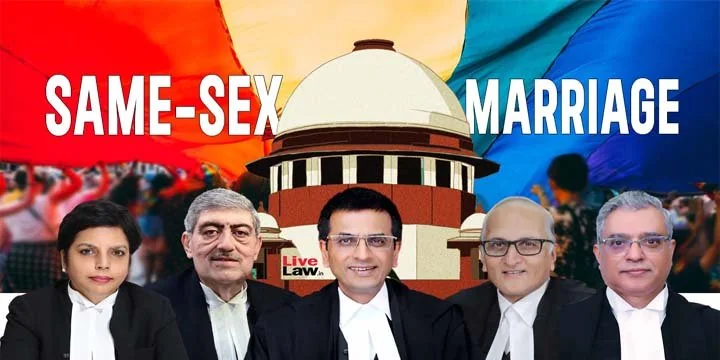
What the petitioners argued The petitions argued that marriage brings with it several rights, privileges, and obligations “bestowed and protected by the law” Senior Advocate Mukul Rohatgi argued that the right to marry for non-heterosexual couples is implicit… Union of India’ (2018) decriminalising homosexuality by striking off Section 377 IPC, and ‘KS Puttaswamy and Anr. Union of India’ (2017), which upheld the fundamental right to privacy, respectively.
What the petitioners argued
- The petitions argued that marriage brings with it several rights, privileges, and obligations “bestowed and protected by the law”
- Senior Advocate Mukul Rohatgi argued that the right to marry for non-heterosexual couples is implicit in Articles 14 (Equality), 15 (Non-Discrimination), 16 (Equality of Opportunity in Public Employment), 19 (Freedom of Speech), and 21 (Right to Life), especially after the SC rulings in ‘Navtej Singh Johar vs. Union of India’ (2018) decriminalising homosexuality by striking off Section 377 IPC, and ‘KS Puttaswamy and Anr. vs. Union of India’ (2017), which upheld the fundamental right to privacy, respectively.
- The Delhi Commission for Protection of Child Rights (DCPCR) advocated for recognition of such marriages and filed an intervention application to assist the court on the impact of those marriages on children.
Special Marriage Act
- Rohatgi’s arguments centred around the interpretation of the SMA, 1954 so that the same is reworded to read marriage as between spouses instead of “man and woman”.
- Besides this, Senior Advocate Menaka Guruswamy added that the right to marry is accompanied by several benefits and rights, such as pensions, provident funds, etc.
- Subsequently, Rohatgi pointed to Section 4, SMA, which refers to a marriage in gender-neutral terms, between ‘any two persons’. However, simply amending the SMA isn’t enough, and a constitutional declaration of marriage is needed, similar to that of the heterogeneous group.
- Additionally, Rohatgi suggested that without an interpretation of the SMA in favour of LGBTQIA+, the court could register marriages under the Registration Act, 1908.
- Senior Advocate Abhishek Manu Singhvi also said that marriage equality must encompass the full spectrum of sexual orientations and not just the gay-lesbian binary. He advocated removing the 30-day notice period under Section 5 of the SMA, which requires parties to give a 30-day public notice of their intention to marry.
- A concern relating to the protection of queer persons from violence within their natal homes was also flagged by advocate Vindra Grover, who also suggested reading ‘atypical marriages’, recognised by the Mental Health Act 2017, within the SMA.
Minimum Marriageable Age
- On the question of the minimum age of marriage for non-heterosexual couples, Singhvi submitted that for lesbian couples, the minimum age could be prescribed as 18 years, while for gay couples, it could be 21 years.
- For transgender couples, the same ages would apply based on the gender they identify with.
Foreign Marriage Act
- Appearing for an Indo-American same-sex couple whose marriage was registered in Texas, USA, Senior Advocate Geetha Luthra argued for recognition of their marriage in India under the FMA, 1969, contending that only a marriage against international law could be denied recognition under the Act.
Recognition of fundamental rights
- Informing the court of the presence of invalid queer marriages that already exist in our society, Senior Advocate Jayna Kothari said that not granting LGBTQIA+ persons the right to marry and have a family would amount to a violation of their right against discrimination on grounds of sex, caste, religion, etc.
- Senior Advocate Saurabh Kirpal contended that the State could not deny marriage equality on grounds of “impracticality” as the discriminatory laws were created by it.
Positive Declaration
- Senior Advocate Raju Ramachandran referred to a situation where the court only makes a declaration and leaves the rest to the legislature.
- Reasoning that there were instances where the majority, as reflected in the institution of the legislature, had no serious problem, he urged the court to walk the full mile and protect the petitioners, who were the “unpopular minority” here.
- Advocate Arundhati Katju also stated that throughout history, the court was responsible for ushering in changes, and then sought a positive declaration from the court to solemnise queer marriages, along with a negative declaration binding the State to not discriminate against them.
Transgender Persons Protection Act
- Asserting that queer persons’ right to marry has already been recognised by the Transgender Persons Protection Act, 2019, flowing from the 2014 NALSA judgement, advocate Karuna Nundy argued that all queer identities are part of this term.
Civil unions are not enough
- On the final day of arguments, Senior Advocate AM Singhvi told the Bench that a civil union, as permitted in some countries, is not a solution to what same-sex couples are asking for.
- Further, he said that this exclusion sends a message that it is legitimate to differentiate between the commitments of heterosexual and non-heterosexual couples, by indicating that the latter’s marriages are not as significant as “real” marriages.
What the respondents argued
- The respondents, including the Central government, the national child rights body NCPCR, and a body of Islamic scholars called the Jamiat-Ulama-i-Hind, opposed the petitions.
On maintainability & SMA
- On the first day, Solicitor General of India Tushar Mehta raised preliminary objections to the court’s jurisdiction to hear this case
- Later, Mehta argued that 160 laws would be impacted in the process of bringing marriage equality. Consequently, he said that Parliament is the only forum to make such laws.
- Adding that the lawmakers had a conscious intent to include only heterosexual marriages under the SMA, Mehta said that the Act’s character and intent cannot be altered.
- He went on to illustrate that under the Act(SMA), a wife could seek divorce on the ground that her husband has, since the solemnisation of the marriage, been guilty of rape, sodomy, or bestiality. But who would be a wife in a queer relationship?
Legitimate state interest in regulating marriages
- Mehta argued the State has a ‘legitimate’ interest in regulating marriages while citing aspects such as the age of consent, prohibition of bigamy, prescription of prohibited degrees of marriage, judicial separation, and divorce.
- The Centre also suggested forming a committee headed by the Cabinet Secretary to address the “human concerns” of same-sex couples without legally recognising their relationship as “marriage”.
Impact on children
- Appearing for the child rights body NCPCR, among others, ASG Aishwarya Bhati submitted that Entire architecture of our laws is to protect the interest and the welfare of children who are naturally born to heterosexual persons, and the State is justified in treating heterosexuals and homosexuals differently.
What the other respondents argued
- The Jamiat-Ulama-i-Hind through Senior Advocate Kapil Sibal argued that it was a “very dangerous proposition” to seek a declaration validating same-sex marriages.
- Senior Advocate Arvind Datar, also for the respondents, argued that if same-sex marriage is declared a fundamental right, future legislation or Parliament will not be able to go back.
Conclusion- While Navtej decriminalized homosexuality by striking off Section 377, the Shafin Jahan ruling recognised the right to choose one’s partner as a facet of the fundamental right to liberty and dignity. The Supreme Court’s upcoming judgment will determine the direction of Queer movement going forward .
Syllabus- GS-2; Fundamental Rights
Source- Indian Express
- Prelims: Key facts, institutions, locations and terminology in the article.
- Mains: Connect the topic with International Relations, Polity & Governance, Health.
- Revision: Use the article headings to prepare concise notes and answer-writing points.
Test your understanding
Questions from this article
Prelims practiceWith reference to SC verdict on same sex marriages soon: Complete summary of the arguments made during hearing, consider the following statements:
- The petitions argued that marriage brings with it several rights, privileges, and obligations “bestowed and protected by the law”
- Senior Advocate Mukul Rohatgi argued that the right to marry for non-heterosexual couples is implicit in Articles 14 (Equality), 15 (Non-Discrimination), 16 (Equality of Opportunity in Public Employment), 19 (Freedom of…
- The Delhi Commission for Protection of Child Rights (DCPCR) advocated for recognition of such marriages and filed an intervention application to assist the court on the impact of those marriages on children.
Which of the statements given above are correct?
- 1 and 2 only
- 2 and 3 only
- 1 and 3 only
- 1, 2 and 3
View answer
Answer: (d) 1, 2 and 3. All three statements are drawn from the article.
Mains practiceDiscuss the background, key issues and significance of SC verdict on same sex marriages soon: Complete summary of the arguments made during hearing for India.
Answer in 250 words.
View answer approach
- Background and context
- Key facts and institutional framework
- Significance and way forward
Frequently asked questionsFrequently asked questions
Why is Sc Verdict On Same Sex Marriages Soon: Complete Summary Of The Arguments Made During Hearing in the news?
What the petitioners argued The petitions argued that marriage brings with it several rights, privileges, and obligations “bestowed and protected by the law” Senior Advocate Mukul Rohatgi argued that the right to marry for non-heterosexual couples is implicit… Union of India’ (2018) decriminalising homosexuality by striking off Section 377 IPC, and ‘KS Puttaswamy and Anr.
What are the key facts about Sc Verdict On Same Sex Marriages Soon: Complete Summary Of The Arguments Made During Hearing?
Union of India’ (2017), which upheld the fundamental right to privacy, respectively. The Delhi Commission for Protection of Child Rights (DCPCR) advocated for recognition of such marriages and filed an intervention application to assist the court on the impact of those marriages on children. Special Marriage Act Rohatgi’s arguments centred around the interpretation of the SMA, 1954 so that the same is reworded to read marriage as between spouses instead of “man and woman”.
Why is Sc Verdict On Same Sex Marriages Soon: Complete Summary Of The Arguments Made During Hearing important for UPSC preparation?
The topic connects current developments with International Relations, Polity & Governance, Health and is relevant for both objective revision and analytical answer writing.