The 26th Shanghai Cooperation Organisation (SCO) Summit was held in Bishkek, Kyrgyzstan, from 31 August to 1 September 2026. The summit was significant as SCO completed its 25 years. Members discussed regional security, peace, connectivity, economic cooperation and other common challenges. Prime Minister of India Narendra Modi represented India at the summit. He highlighted three important areas for SCO cooperation: Security, Connectivity and Opportunity. He also called for stronger and united action against terrorism and stressed that there should be no double standards in dealing with terrorism.
The key highlights of the Bishkek SCO Summit 2026, including PM Modi’s major action points, crucial decisions, and outcomes for India. Read how the summit impacts regional security, trade, connectivity, counter-terrorism, and India’s strategic role. India also supported cooperation in areas such as drug control, energy, climate change, artificial intelligence, disaster management and people-to-people relations. The summit was also important from an economic point of view. India recorded 7.8% real GDP growth in the April-June quarter of FY 2026-27. Strong domestic consumption, investment, manufacturing and services supported the growth despite global uncertainty.
What PM Modi Highlighted at the Bishkek SCO Summit
PM Modi’s address focused on the need for practical cooperation among SCO members. He said that the organisation should move from broad statements to concrete and measurable results. India highlighted security, connectivity and economic opportunities as the three main areas for future cooperation. Security is important because the region faces challenges such as terrorism, organised crime, drug trafficking and other cross-border threats. Connectivity can help improve trade and economic relations, while new opportunities in technology, entrepreneurship and innovation can be beneficial for young people and businesses.
PM Modi also stressed the importance of peace and dialogue. India called for conflicts to be addressed through diplomacy and peaceful means. Another important part of the address was the focus on people. India called for greater participation of youth, entrepreneurs, farmers, scientists and other sections of society in SCO cooperation.
India’s 10-Point Agenda at the SCO Summit
India’s 10-Point Agenda at the SCO Summit highlights a roadmap for stronger regional security, action against terrorism, better connectivity, economic cooperation and shared opportunities. The agenda reflects India’s vision for peace, stability and sustainable prosperity across the SCO region.
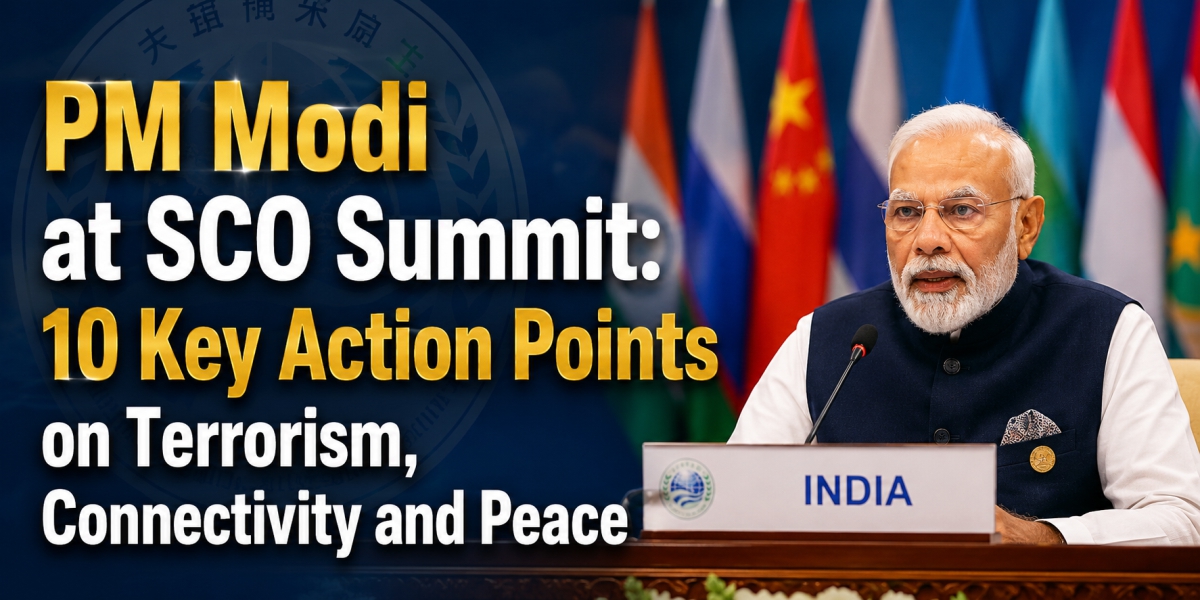
PM Modi highlighted 10 important areas for action during his address:
- Strengthen the three pillars of Security, Connectivity and Opportunity.
- Target the complete ecosystem of terrorism.
- Take a clear stand against state-supported terrorism.
- Promote peace and stability in Afghanistan.
- Use dialogue and diplomacy to resolve conflicts.
- Strengthen the fight against drugs and organised crime.
- Develop reliable and inclusive connectivity.
- Improve trade and logistics networks.
- Give greater importance to people-to-people relations.
- Expand youth, scientific and civilisational exchanges.
These priorities reflect India’s approach towards regional cooperation. The focus is not only on security but also on economic development, technology and greater interaction between people.
India’s Stand on Terrorism and Regional Security
Terrorism was one of the main issues raised by India at the summit. PM Modi called for a comprehensive approach to fighting terrorism. According to India’s position, action should not be limited to individual terrorist organisations. The entire ecosystem supporting terrorism must also be addressed. This includes:
- Terrorist financing
- Recruitment
- Radicalisation
- Safe havens
India also called for zero tolerance towards double standards on terrorism. It stressed that terrorism should not be used as a strategic tool by any country. The SCO provides an important platform for India to discuss these concerns with Central Asian countries, Russia, China and other members. Greater information sharing and cooperation between security and law-enforcement agencies can help countries deal with cross-border security threats.
India’s Approach to Afghanistan and Peace
India also highlighted the importance of peace and stability in Afghanistan. Afghanistan is important for regional security because instability in the country can affect terrorism, extremism, drug trafficking and cross-border crime. India has provided development assistance and humanitarian support to the Afghan people. It has also maintained that the people of Afghanistan should continue to receive support. PM Modi also stressed the importance of dialogue and diplomacy in resolving conflicts. Regional conflicts can have effects beyond the countries directly involved. They can disrupt energy supplies, maritime trade and international supply chains. For India, maintaining peace in the wider region is important for both security and economic interests.
Connectivity and Trade: Key Priorities of India
Connectivity was another major focus of India’s approach at the SCO Summit. India supports reliable, inclusive and efficient connectivity between countries. Better connectivity can improve trade, transport and access to markets. However, India also stressed that connectivity projects should respect the sovereignty and territorial integrity of all countries.
India called for improvements in regional trade and logistics. This includes simpler customs procedures, greater use of digital documentation and more efficient logistics networks. Better trade infrastructure can reduce delays and costs for businesses. It can also help India strengthen its economic links with Central Asia and the wider Eurasian region. For India, connectivity is not only an economic issue. It also has strategic importance because access to reliable trade routes can improve India’s engagement with neighbouring regions.
Youth, Science and Civilisational Cooperation
India also called for greater people-to-people cooperation within the SCO. PM Modi highlighted the importance of youth, entrepreneurship, scientific cooperation and cultural exchanges. Initiatives such as the SCO Start-up Forum, Young Authors’ Conclave and Young Scientists’ Forum can provide opportunities for young people and professionals from member countries to interact. India also proposed an SCO Civilisation Dialogue Forum, with its first session proposed to be held in India. Such initiatives can help build long-term relationships between people of different countries. They can also promote cooperation in research, technology, entrepreneurship and education. For India, civilisational exchanges are particularly relevant because India has long historical and cultural links with Central Asia and other parts of the SCO region.
Major Decisions Taken at the Bishkek SCO Summit
The summit adopted the Bishkek Declaration, which marked the 25th anniversary of the SCO and outlined the organisation’s broad priorities. Several other important decisions and agreements were also adopted.
1. Cooperation Against Security Threats
SCO members approved regulations related to the Universal Centre for Countering Challenges and Threats to the Security of SCO Member States. The mechanism is expected to improve cooperation against terrorism, extremism, organised crime and other transnational threats.
2. Anti-Narcotics Cooperation
Regulations for the Executive Committee of the SCO Anti-Narcotics Centre were approved. The summit also adopted a programme of cooperation to combat drug addiction up to 2030 and another programme to address synthetic drugs and the diversion of chemical precursors.
3. Energy Cooperation
SCO members adopted statements on energy conservation, energy efficiency and cooperation in energy systems. These areas are important for India because energy security is closely linked to economic growth.
4. Climate Change
The SCO governments adopted a memorandum on cooperation in combating climate change. This can encourage the sharing of knowledge, technology and experience related to climate adaptation and mitigation.
5. Disaster Management
A statement was adopted on providing assistance to states affected by emergencies. India can contribute to this area through its experience in disaster management and Humanitarian Assistance and Disaster Relief (HADR).
6. Artificial Intelligence
The SCO governments also adopted a memorandum on cooperation in Artificial Intelligence. For India, this provides an opportunity to share its digital and technology experience while promoting safe, responsible and inclusive use of AI.
What the SCO Outcomes Mean for India
The Bishkek Summit provides India with an important platform to strengthen its engagement with Central Asia and the wider Eurasian region. The focus on counter-terrorism and organised crime is directly relevant to India’s security concerns. Cooperation on drug trafficking can also help address cross-border criminal networks.
Connectivity and trade initiatives can create new opportunities for Indian businesses and exporters. At the same time, cooperation in AI, science and entrepreneurship can support India’s technology and innovation goals. The summit also allows India to strengthen diplomatic and cultural relations with other SCO members. Overall, the outcomes reflect India’s effort to balance security concerns with economic cooperation, technology, connectivity and people-to-people relations.
SCO Summit 2026- Important Facts
The 26th SCO Summit was held in Bishkek, Kyrgyzstan, from 31 August to 1 September 2026. The summit marked the 25th anniversary of the Shanghai Cooperation Organisation. Kyrgyzstan hosted the summit under the chairmanship of President Sadyr Zhaparov. The SCO has 10 member states:
- India
- China
- Russia
- Pakistan
- Iran
- Kazakhstan
- Kyrgyzstan
- Tajikistan
- Uzbekistan
- Belarus
The leaders discussed regional security, economic cooperation, connectivity, peace and development.
India’s Economy Grows 7.8% in Q1 FY2026-27
India’s economy grew by 7.8% in real terms in the April-June quarter of FY 2026-27. The growth was higher than the Reserve Bank of India earlier estimate of 7%. The performance came despite several challenges, including geopolitical tensions, uncertainty in global financial markets, pressure on crude oil prices and concerns about the monsoon. Domestic demand remained an important source of strength. Investment, manufacturing and services also contributed to the growth. Real GVA grew by 8.2% during the quarter. Private consumption grew by 7.1%, while Gross Fixed Capital Formation increased by 11.9%. The strong growth shows that India’s economy has considerable domestic strength. However, external risks remain. Crude oil prices, global demand, food inflation, interest rates and supply-chain disruptions could affect growth in the coming quarters. Therefore, the 7.8% growth rate is a positive sign, but maintaining this momentum will depend on continued investment, consumption and economic reforms.
Watch India’s GDP Grows 7.8%
What Drives India’s Economic Growth?
India’s economic growth is driven by strong domestic consumption, infrastructure development, digital transformation, manufacturing expansion, rising investment, and a young workforce. Government reforms, entrepreneurship, services sector growth, exports, and technological innovation also play a vital role in strengthening productivity and supporting India’s long-term economic development. Lets a look at what drives India’s economic growth:
1. Strong Domestic Consumption
Private Final Consumption Expenditure grew by 7.1% in real terms during Q1 FY27. Strong household demand supports businesses across different sectors. It also gives the Indian economy some protection when global demand is weak. Other indicators of economic activity also remained positive during the period.
2. Services Remained a Major Growth Driver
The services sector continued to play an important role in India’s growth. Financial services, IT, professional services, trade, transport, communication and other service activities contributed to economic activity. India’s services sector is also important for exports and employment.
3. Strong Manufacturing
Manufacturing grew by 9.2% during the quarter. The secondary sector recorded 8.6% growth, while electricity, gas and water supply and construction also expanded. Strong manufacturing growth can help India increase production, support exports and create employment opportunities.
4. Agricultural Stability
Agriculture and allied activities grew by 3.6%. Agriculture remains important for rural incomes and demand. A reasonably good agricultural season can also support food-price stability. However, the sector remains dependent on weather conditions. Therefore, the monsoon will continue to be an important factor for India’s economic outlook.
5. Investment Gained Momentum
Gross Fixed Capital Formation increased by 11.9% in real terms. Investment is important for long-term economic growth because it increases productive capacity and supports infrastructure and industrial development. Maintaining strong private investment will be important for India to create jobs and sustain growth.
6. Growth in Exports
Real exports increased by 12% in Q1 FY27. Engineering, electronics and chemical exports showed strong performance. A diversified export base can help India reduce dependence on a limited number of products and markets. However, global economic conditions will continue to influence India’s export performance.
Growth Was Broad-Based
India’s growth was supported by different parts of the economy. Some important figures for Q1 FY27 were:
- Real GDP growth: 7.8%
- Real GVA growth: 8.2%
- Private consumption growth: 7.1%
- Fixed investment growth: 11.9%
- Real export growth: 12%
This broad-based growth is important because it means that India’s economy is not dependent on one sector alone.
Inflation, FDI and Fiscal Deficit
Inflation, foreign investment and government finances will remain important indicators for India’s economy. Retail inflation stood at 4.45% in July, while core inflation was 4.15%. Gross inward FDI was around USD 30.7 billion during April-June 2026, according to the figures provided. Foreign investment can bring capital, technology and access to global supply chains. It can also support new businesses and investment. The Centre’s fiscal deficit stood at ₹4.55 lakh crore during April-July. This was 26.8% of the FY27 target of ₹16.96 lakh crore. These indicators need to be considered along with GDP growth to get a broader picture of the economy.
Challenges that Could Affect India’s Growth
India has started FY2026-27 with strong GDP growth of 7.8%. However, maintaining this growth rate will not be easy. Several domestic and external factors can affect the economy in the coming quarters. Rising crude oil prices, geopolitical tensions, global demand, inflation and weather conditions are some of the major issues. Recent economic assessments have also highlighted oil prices and the monsoon as important downside risks for India.
1. Crude Oil Prices
India imports a large share of its crude oil requirements. Higher oil prices can increase the import bill and raise transportation and production costs.
2. Global Demand
India is becoming more integrated with the global economy. This creates opportunities for exporters. But a slowdown in major economies can reduce demand for Indian exports.
3. Inflation
Inflation reduces the purchasing power of the people. If everyday expenses such as food, transport and energy become more expensive, higher energy and commodity prices can create fresh inflationary pressure.
4. Geopolitical Tensions
Conflicts and geopolitical tensions can disrupt trade routes, energy supplies and global supply chains. For India, disruption in major trade and energy routes can affect both imports and exports.
What India Needs to Focus on Next
India will need to maintain strong domestic demand while encouraging greater private investment. Manufacturing growth will remain important for employment and exports. India will also need to improve productivity and keep its products competitive in international markets. Creating more productive jobs should remain an important priority. Economic growth becomes more meaningful when it leads to better income opportunities for people.
India will also need to monitor crude oil prices, food inflation and global financial conditions. At the same time, greater diversification of India’s trade and stronger domestic production can help reduce the impact of external shocks. The 7.8% growth recorded in Q1 FY27 provides a strong starting point. The challenge now is to maintain this momentum while managing domestic and global risks.
Conclusion
The Bishkek SCO Summit 2026 was important for India because it provided a platform to discuss terrorism, regional security, connectivity, peace and economic cooperation. Prime Minister of India Narendra Modi’s 10-point agenda focused on practical cooperation and called for stronger action against terrorism, organised crime and drug trafficking. India also highlighted the importance of connectivity, trade, technology, youth and cultural exchanges. The summit also resulted in several important decisions covering energy, climate change, disaster management, drug control and artificial intelligence. At the economic level, India’s 7.8% GDP growth in Q1 FY2026-27 shows strong domestic momentum. Consumption, investment, manufacturing, services and exports all supported growth. However, risks from crude oil prices, global demand, inflation and geopolitical tensions remain. For India, the next challenge is to maintain high growth while creating jobs, improving productivity and strengthening its position in global trade.