UPSC Current Affairs
Russia may pull out of CTBT: How the treaty tried — and failed — to stop nuclear testing
The United States conducted the world’s first successful nuclear weapons test in July 1945. Four years later, the Soviet Union tested their first nuclear weapon. These tests triggered a decades-long arms race between the two superpowers.
VRAuthor Desk
2 min read
The United States conducted the world’s first successful nuclear weapons test in July 1945. Four years later, the Soviet Union tested their first nuclear weapon. These tests triggered a decades-long arms race between the two superpowers.
How did CTBT come into being?
- The United States conducted the world’s first successful nuclear weapons test in July 1945. Four years later, the Soviet Union tested their first nuclear weapon. These tests triggered a decades-long arms race between the two superpowers.
- Between 1945 and 1996, more than 2,000 nuclear tests were carried out — 1,032 of them by the United States and 715 of them by the Soviet Union, according to the UN. Britain carried out 45 tests, France 210 and China 45.
- The radioactive fallout from those tests drew criticism from around the globe. The international community’s concern about the effects on health and the environment continued to grow
- The 1963 Limited Nuclear Test-Ban Treaty (LTBT) was one of the first such attempts. It prohibited nuclear testing in the atmosphere, outer space, and underwater, but underground tests were still permitted.
- To tackle the limitations of LTBT, a comprehensive test ban was discussed during the negotiation of the Nuclear Nonproliferation Treaty in 1968. However, no agreement was reached on the issue.
- Six years later, the US and Soviet Union agreed to sign the Threshold Test Ban Treaty (TTBT), which established a nuclear “threshold” by banning the two countries from conducting tests that would produce a yield exceeding 150 kilotons (equivalent to 150,000 tons of TNT).
- A major breakthrough only came after the Cold War ended around 1990 and the disintegration of the Soviet Union. As the geopolitical tensions simmered down, the UN took advantage of the situation and adopted the CTBT, which put a blanket ban on the explosive testing of nuclear weapons, on September 10, 1996, and it opened for signature on September 24, 1996.
Did the CTBT stop nuclear testing?
Since the CTBT, 10 nuclear tests have taken place. India conducted two in 1998, Pakistan also two in 1998, and North Korea conducted tests in 2006, 2009, 2013, 2016 (twice) and 2017, according to the United Nations
Which key countries haven’t ratified CTBT?
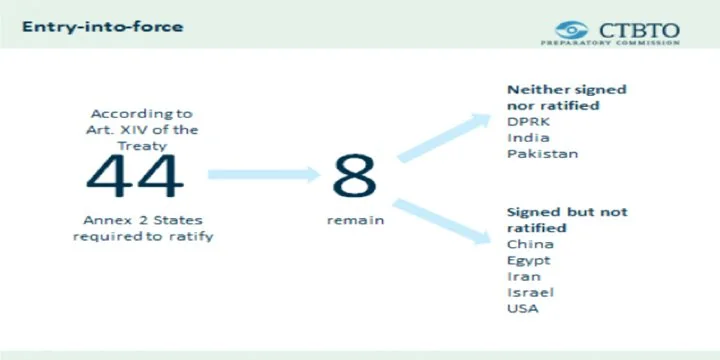
Notably, for the treaty to enter into force, it must be signed and ratified by 44 specific nuclear technology holder countries, eight of which have yet to ratify the agreement: China, Egypt, India, Iran, Israel, North Korea, Pakistan and the United States, according to the UN.
Syllabus- Prelims; Current Affairs
Source- Indian Express
- Prelims: Key facts, institutions, locations and terminology in the article.
- Mains: Connect the topic with International Relations, Polity & Governance, Health.
- Revision: Use the article headings to prepare concise notes and answer-writing points.
Test your understanding
Questions from this article
Prelims practiceWith reference to Russia may pull out of CTBT: How the treaty tried — and failed — to stop nuclear testing, consider the following statements:
- The United States conducted the world’s first successful nuclear weapons test in July 1945. Four years later, the Soviet Union tested their first nuclear weapon. These tests triggered a decades-long arms race between the…
- Between 1945 and 1996, more than 2,000 nuclear tests were carried out — 1,032 of them by the United States and 715 of them by the Soviet Union, according to the UN. Britain carried out 45 tests, France 210 and China 45.
- The radioactive fallout from those tests drew criticism from around the globe. The international community’s concern about the effects on health and the environment continued to grow
Which of the statements given above are correct?
- 1 and 2 only
- 2 and 3 only
- 1 and 3 only
- 1, 2 and 3
View answer
Answer: (d) 1, 2 and 3. All three statements are drawn from the article.
Mains practiceDiscuss the background, key issues and significance of Russia may pull out of CTBT: How the treaty tried — and failed — to stop nuclear testing for India.
Answer in 250 words.
View answer approach
- How did CTBT come into being?
- Background and context
- Key facts and institutional framework
- Significance and way forward
Frequently asked questionsFrequently asked questions
Why is Russia May Pull Out Of Ctbt: How The Treaty Tried — And Failed — To Stop Nuclear Testing in the news?
The United States conducted the world’s first successful nuclear weapons test in July 1945. Four years later, the Soviet Union tested their first nuclear weapon.
What are the key facts about Russia May Pull Out Of Ctbt: How The Treaty Tried — And Failed — To Stop Nuclear Testing?
These tests triggered a decades-long arms race between the two superpowers. Between 1945 and 1996, more than 2,000 nuclear tests were carried out — 1,032 of them by the United States and 715 of them by the Soviet Union, according to the UN. Britain carried out 45 tests, France 210 and China 45.
Why is Russia May Pull Out Of Ctbt: How The Treaty Tried — And Failed — To Stop Nuclear Testing important for UPSC preparation?
The topic connects current developments with International Relations, Polity & Governance, Health and is relevant for both objective revision and analytical answer writing.