UPSC Current Affairs
Questions in Parliament
Context: Trinamool Congress MP Mahua Moitra said she welcomes answering questions from the Central Bureau of Investigation (CBI) and the Lok Sabha Ethics Committee pertaining to ‘cash for query’ allegations against her. ABOUT QUESTION HOUR: Question Houris the first hour of a sitting session of the Lok Sabha devoted to questions that Members of Parliament raise about any aspect of administrative The concerned Minister is obliged to answer to the Parliament, either orally or… Questions are one of the ways Parliament can hold the Executive It is very useful for the Government.
VRAuthor Desk
5 min read
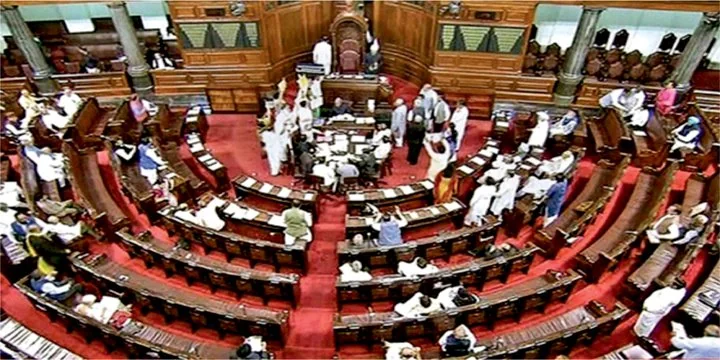
Context: Trinamool Congress MP Mahua Moitra said she welcomes answering questions from the Central Bureau of Investigation (CBI) and the Lok Sabha Ethics Committee pertaining to ‘cash for query’ allegations against her. ABOUT QUESTION HOUR: Question Houris the first hour of a sitting session of the Lok Sabha devoted to questions that Members of Parliament raise about any aspect of administrative The concerned Minister is obliged to answer to the Parliament, either orally or… Questions are one of the ways Parliament can hold the Executive It is very useful for the Government.
Context:
- Trinamool Congress MP Mahua Moitra said she welcomes answering questions from the Central Bureau of Investigation (CBI) and the Lok Sabha Ethics Committee pertaining to ‘cash for query’ allegations against her.
ABOUT QUESTION HOUR:
- Question Houris the first hour of a sitting session of the Lok Sabha devoted to questions that Members of Parliament raise about any aspect of administrative
- The concerned Minister is obliged to answer to the Parliament, either orally or in writing, depending on the type of question raised.
- Questions are one of the ways Parliament can hold the Executive It is very useful for the Government.
What is the procedure for raising the questions?
- The procedure for raising questions is governed by Rules 32 to 54 of the “Rules of Procedure and Conduct of Business in Lok Sabha” and Directions 10 to 18 of the “Directions by the Speaker, Lok Sabha?.
- To ask a question, an MP has to first give a notice addressed to the lower house’s Secretary-General, intimating their intention to ask a question.
- The notice usually contains the text of the question, the official designation of the Minister to whom the question is addressed, the date on which the answer is desired, and the order of preference, in case the MP tables more than one notice of questions for the same day.
- A Member is allowed to give not more than five notices of questions, both for oral and written answers, in all, for any day.
- Notices received in excess of five from a Member for a day, are considered for the subsequent day(s) concerning that Minister(s) during the period of that session only.
- Usually, the period of notice of a question isn’t less than 15 days.
- There are two ways through which MPs can submit the notices of their questions.
- First, through an online ‘Member’s Portal’, where they have to enter their ID and password to get access.
- Second, through the printed forms available in the Parliamentary Notice Office.
- The next stage is when the Speaker of Lok Sabha examines the notices of the questions in the light of the laid out rules. It is the Speaker, who decides if a question, or a part thereof, is or isn’t admissible.
What are the conditions for the admissibility of questions?
- There are numerous rules that govern the admissibility of a question raised by an MP.
- For example, questions shall not ordinarily contain more than 150 words.
- They shouldn’t contain arguments, defamatory statements, refer to the character or conduct of any person except in their official or public capacity.
- Queries raising larger issues of policy are not allowed, for it is not possible to enunciate policies within the limited compass of an answer to a question.
- Besides these, a question isn’t admissible if its subject matter is pending judgment before any court of law or any other tribunal or body set up under law or is under consideration before a Parliamentary Committee.
- A query also can’t seek information on matters which may weaken the unity and integrity of the country.
What are the different types of questions?
- There are four different types of questions: starred, unstarred, short-notice questions and questions addressed to private Members.
- A starred question is asked by an MP and answered orally by the Minister-in-charge.
- Each MP is allowed to ask one starred question per day. Starred questions have to be submitted at least 15 days in advance (so that the Minister-in-charge has the time to prepare the answers) and only 20 questions can be listed for oral answers on a day.
- When a question is answered orally, supplementary questions can be asked thereon.
- An unstarred question receives a written reply from the Ministry.
- These also need to be submitted at least 15 days in advance. Only 230 questions can be listed for written answers in a day.
- Unlike starred questions, unstarred questions don’t permit any follow-up questions.
- While starred questions are better suited to inquire about the government’s views on issues and its policy inclination, unstarred questions are more conducive for getting answers to queries related to data or information.
- Short notice questions are ones pertaining to a matter of urgent public importance.
- They can be asked with less than 10 days’ notice, with reasons for the short notice.
- Like a starred question, they are answered orally, followed by supplementary questions.
- The question to a private Member is addressed to the MP themselves.
- It is asked when the subject matter pertains to any Bill, Resolution or any matter relating to the Business of the House for which that MP is responsible.
- For such questions, the same procedure is followed as in the case of questions addressed to a Minister with such variations as the Speaker may consider necessary or convenient.
What is the importance of raising questions?
- Asking questions is an “inherent and unfettered” parliamentary right of an MP, according to the ‘Question Hour in Lok Sabha’ document.
- The exercise is meant to act as a parliamentary device to practise legislative control over executive actions.
- It can be used to get information on aspects of administration and government activity, criticise government policies and schemes, throw light on government lapses, and push ministers to take substantive steps for the common good.
- On the other hand, the government can use these questions to gauge public reaction to their policies and administration.
- At times, questions lead to the formation of a parliamentary commission, a court of enquiry or even the enactment of a legislation.
Syllabus: Prelims + Mains; GS II – Polity and Governance
- Prelims: Key facts, institutions, locations and terminology in the article.
- Mains: Connect the topic with Economy, Defence, Polity & Governance.
- Revision: Use the article headings to prepare concise notes and answer-writing points.
Test your understanding
Questions from this article
Prelims practiceWith reference to Questions in Parliament, consider the following statements:
- Trinamool Congress MP Mahua Moitra said she welcomes answering questions from the Central Bureau of Investigation (CBI) and the Lok Sabha Ethics Committee pertaining to ‘cash for query’ allegations against her.
- Question Houris the first hour of a sitting session of the Lok Sabha devoted to questions that Members of Parliament raise about any aspect of administrative
- The concerned Minister is obliged to answer to the Parliament, either orally or in writing, depending on the type of question raised.
Which of the statements given above are correct?
- 1 and 2 only
- 2 and 3 only
- 1 and 3 only
- 1, 2 and 3
View answer
Answer: (d) 1, 2 and 3. All three statements are drawn from the article.
Mains practiceDiscuss the background, key issues and significance of Questions in Parliament for India.
Answer in 250 words.
View answer approach
- Context:
- ABOUT QUESTION HOUR:
- What is the procedure for raising the questions?
- What are the conditions for the admissibility of questions?
- What are the different types of questions?
Frequently asked questionsFrequently asked questions
Why is Questions In Parliament in the news?
Context: Trinamool Congress MP Mahua Moitra said she welcomes answering questions from the Central Bureau of Investigation (CBI) and the Lok Sabha Ethics Committee pertaining to ‘cash for query’ allegations against her. ABOUT QUESTION HOUR: Question Houris the first hour of a sitting session of the Lok Sabha devoted to questions that Members of Parliament raise about any aspect of administrative The concerned Minister is obliged to answer to the Parliament, either orally or…
What are the key facts about Questions In Parliament?
Questions are one of the ways Parliament can hold the Executive It is very useful for the Government. What is the procedure for raising the questions? The procedure for raising questions is governed by Rules 32 to 54 of the “Rules of Procedure and Conduct of Business in Lok Sabha” and Directions 10 to 18 of the “Directions by the Speaker, Lok Sabha?.
Why is Questions In Parliament important for UPSC preparation?
The topic connects current developments with Economy, Defence, Polity & Governance and is relevant for both objective revision and analytical answer writing.