UPSC Current Affairs
Nuclear Briefcase
Context: During Russian President Vladimir Putin’s recent visit to China, he was seen with officers carrying what is known as the “nuclear briefcase”. Also known as the ‘Cheget’, named after a mountain in Russia, the briefcase is part of a larger system in place for authorising the launch of nuclear strikes. It’s part of a secured communication setup, meant to convey orders for a nuclear strike to the rocket forces of the country.
VRAuthor Desk
2 min read
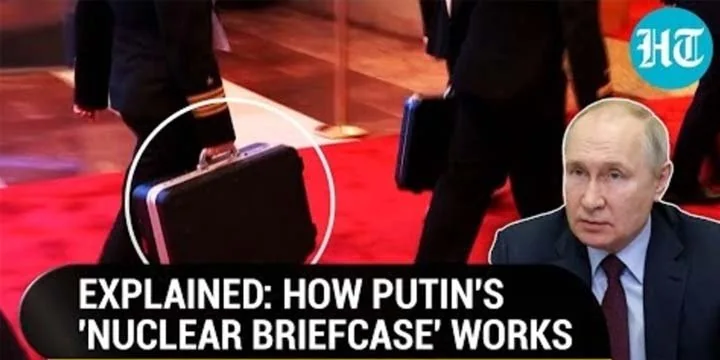
Context: During Russian President Vladimir Putin’s recent visit to China, he was seen with officers carrying what is known as the “nuclear briefcase”. Also known as the ‘Cheget’, named after a mountain in Russia, the briefcase is part of a larger system in place for authorising the launch of nuclear strikes. It’s part of a secured communication setup, meant to convey orders for a nuclear strike to the rocket forces of the country.
Context:
- During Russian President Vladimir Putin’s recent visit to China, he was seen with officers carrying what is known as the “nuclear briefcase”.
What is the ‘nuclear briefcase’?
- Also known as the ‘Cheget’, named after a mountain in Russia, the briefcase is part of a larger system in place for authorising the launch of nuclear strikes.
- It’s part of a secured communication setup, meant to convey orders for a nuclear strike to the rocket forces of the country.
- The communication among the forces is done via the ‘Kazbek’ electronic command-and-control network. Kazbek supports another system, known as ‘Kavkaz’.
- Apart from the Russian President, the Defence Minister and the Chief of General Staff have a briefcase each, and the three are supposed to coordinate in case of a potential order to strike.
- The President takes the briefcase on his visits abroad as well.
Has the nuclear briefcase ever come close to being used?
- According to the US-based Center for Arms Control and Non-Proliferation (CACNP), the first and only known instance of a nuclear briefcase being “opened” during a crisis was in 1995.
- The briefcases were first put into service just around the time Russian President Mikhail Gorbachev took office (1990-91).
How does the system work, exactly?
- Once radar operators sent out alerts of possible enemy action, the Russian electronic command-and-control networks were activated.
- The duty general receives the information from the radar operator on a special notification terminal, Krokus.
- He then passes it to the Kavkaz, a complex network of cables, radio signals, satellites and relays that is at the heart of the Russian command and control.
- The alert then reached the three nuclear briefcases.
- A Russian TV outlet showed the inside of the older briefcases in 2019.
- It had several buttons, including a white one to give the go-ahead to launch a strike and a red one to stop the order.
Do other countries have such a briefcase?
- The American President has a similar briefcase officially called the Presidential Emergency Satchel.
- It was nicknamed the ‘football’ after a 1960s mission called ‘Dropkick’ (a term related to American football).
- It is thought to have begun in the era of John F Kennedy.
- He was concerned about how in the era of a Cold War between the two superpowers of the time (the US and USSR), orders for a nuclear strike would be verified quickly.
Syllabus: Prelims
- Prelims: Key facts, institutions, locations and terminology in the article.
- Mains: Connect the topic with Defence, Polity & Governance.
- Revision: Use the article headings to prepare concise notes and answer-writing points.
Test your understanding
Questions from this article
Prelims practiceWith reference to Nuclear Briefcase, consider the following statements:
- During Russian President Vladimir Putin’s recent visit to China, he was seen with officers carrying what is known as the “nuclear briefcase”.
- Also known as the ‘Cheget’, named after a mountain in Russia, the briefcase is part of a larger system in place for authorising the launch of nuclear strikes.
- It’s part of a secured communication setup, meant to convey orders for a nuclear strike to the rocket forces of the country.
Which of the statements given above are correct?
- 1 and 2 only
- 2 and 3 only
- 1 and 3 only
- 1, 2 and 3
View answer
Answer: (d) 1, 2 and 3. All three statements are drawn from the article.
Mains practiceDiscuss the background, key issues and significance of Nuclear Briefcase for India.
Answer in 250 words.
View answer approach
- Context:
- What is the ‘nuclear briefcase’?
- Has the nuclear briefcase ever come close to being used?
- How does the system work, exactly?
- Do other countries have such a briefcase?
Frequently asked questionsFrequently asked questions
Why is Nuclear Briefcase in the news?
Context: During Russian President Vladimir Putin’s recent visit to China, he was seen with officers carrying what is known as the “nuclear briefcase”. Also known as the ‘Cheget’, named after a mountain in Russia, the briefcase is part of a larger system in place for authorising the launch of nuclear strikes.
What are the key facts about Nuclear Briefcase?
It’s part of a secured communication setup, meant to convey orders for a nuclear strike to the rocket forces of the country. The communication among the forces is done via the ‘Kazbek’ electronic command-and-control network. Kazbek supports another system, known as ‘Kavkaz’.
Why is Nuclear Briefcase important for UPSC preparation?
The topic connects current developments with Defence, Polity & Governance and is relevant for both objective revision and analytical answer writing.