UPSC Current Affairs
Nobel Prize in Physics 2023: What the three scientists have been awarded for
What exactly have the scientists done? An atom, a tiny unit into which matter can be divided, is composed of a nucleus of protons and neutrons, and electrons that travel around this nucleus. Electrons move so fast that it is impossible to observe them in real time.
VRAuthor Desk
2 min read
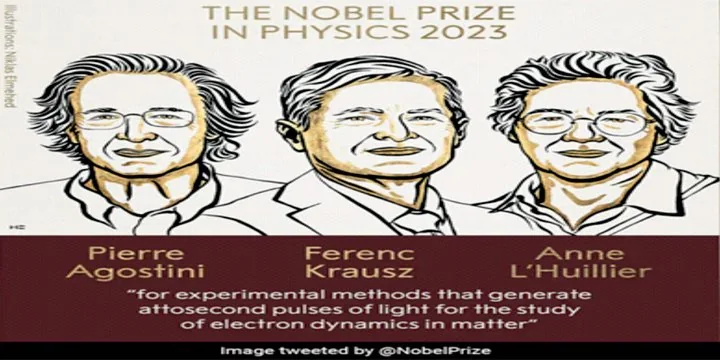
What exactly have the scientists done? An atom, a tiny unit into which matter can be divided, is composed of a nucleus of protons and neutrons, and electrons that travel around this nucleus. Electrons move so fast that it is impossible to observe them in real time.
What exactly have the scientists done?
- An atom, a tiny unit into which matter can be divided, is composed of a nucleus of protons and neutrons, and electrons that travel around this nucleus. Electrons move so fast that it is impossible to observe them in real time.
- The work of L’Huillier, Agostini, and Krausz has brought humanity closer to observing and studying the movement of electrons, by producing pulses of light that last only attoseconds, which is 1×10-18 of a second.
- Roughly, this can be compared to a high-shutter-speed camera. If a normal camera is used to capture a moving train, the image will be blurred. But a high shutter-speed camera can freeze motion and capture a clear image of the train.
How did they do this?
- All three worked in the field for years.
- In 2001, Pierre Agostini succeeded in producing and investigating a series of consecutive light pulses [or flashes of light], in which each pulse lasted just 250 attoseconds. At the same time, Ferenc Krausz was working with another type of experiment, one that made it possible to isolate a single light pulse that lasted 650 attoseconds
Why is this work important?
- “We can now open the door to the world of electrons. Attosecond physics gives us the opportunity to understand mechanisms that are governed by electrons. The next step will be utilising them,” said Eva Olsson, Chair of the Nobel Committee for Physics.
- One possible application is to study molecular-level changes in blood, to identify diseases.
- A better understanding of how electrons move and transmit energy can also help in creating more efficient electronic gadgets.
Who are the scientists?
- Anne L’Huillier was born 1958 in Paris, France. She got her PhD in 1986 from University Pierre and Marie Curie, Paris. She is currently a Professor at Lund University, Sweden.
- Pierre Agostini got his PhD in 1968 from Aix-Marseille University, France.He is a Professor at The Ohio State University, Columbus, USA.
- Ferenc Krausz was born 1962 in Mór, Hungary. He got his PhD in 1991 from Vienna University of Technology, Austria. He is the Director at Max Planck Institute of Quantum Optics, Garching, and Professor at Ludwig-Maximilians-Universität München, Germany.
Conclusion- The discovery opens wide avenues of research and development in areas ranging from health, technology, semiconductors etc. However, more funding and autonomy to research institutions should be ensured in the first place.
Syllabus- GS-3; Science and Tech
Source- Indian Express
- Prelims: Key facts, institutions, locations and terminology in the article.
- Mains: Connect the topic with Economy, International Relations, Polity & Governance.
- Revision: Use the article headings to prepare concise notes and answer-writing points.
Test your understanding
Questions from this article
Prelims practiceWith reference to Nobel Prize in Physics 2023: What the three scientists have been awarded for, consider the following statements:
- An atom, a tiny unit into which matter can be divided, is composed of a nucleus of protons and neutrons, and electrons that travel around this nucleus. Electrons move so fast that it is impossible to observe them in real…
- The work of L’Huillier, Agostini, and Krausz has brought humanity closer to observing and studying the movement of electrons, by producing pulses of light that last only attoseconds, which is 1×10-18 of a second.
- Roughly, this can be compared to a high-shutter-speed camera. If a normal camera is used to capture a moving train, the image will be blurred. But a high shutter-speed camera can freeze motion and capture a clear image…
Which of the statements given above are correct?
- 1 and 2 only
- 2 and 3 only
- 1 and 3 only
- 1, 2 and 3
View answer
Answer: (d) 1, 2 and 3. All three statements are drawn from the article.
Mains practiceDiscuss the background, key issues and significance of Nobel Prize in Physics 2023: What the three scientists have been awarded for for India.
Answer in 250 words.
View answer approach
- What exactly have the scientists done?
- How did they do this?
- Why is this work important?
- Who are the scientists?
Frequently asked questionsFrequently asked questions
Why is Nobel Prize In Physics 2023: What The Three Scientists Have Been Awarded For in the news?
What exactly have the scientists done? An atom, a tiny unit into which matter can be divided, is composed of a nucleus of protons and neutrons, and electrons that travel around this nucleus.
What are the key facts about Nobel Prize In Physics 2023: What The Three Scientists Have Been Awarded For?
Electrons move so fast that it is impossible to observe them in real time. The work of L’Huillier, Agostini, and Krausz has brought humanity closer to observing and studying the movement of electrons, by producing pulses of light that last only attoseconds, which is 1×10-18 of a second. Roughly, this can be compared to a high-shutter-speed camera.
Why is Nobel Prize In Physics 2023: What The Three Scientists Have Been Awarded For important for UPSC preparation?
The topic connects current developments with Economy, International Relations, Polity & Governance and is relevant for both objective revision and analytical answer writing.