UPSC Current Affairs
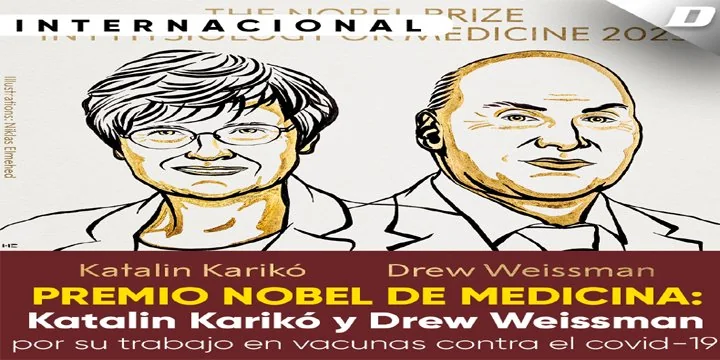
Nobel Prize in Medicine 2023: How Katalin Kariko and Drew Weissman’s work helped develop Covid vaccines
What are mRNA vaccines, why they were crucial during Covid Traditionally, vaccines have depended on introducing dead or weakened viruses into the human body, so it can develop antibodies against them. Thus, when the actual virus infects someone, their body is prepared to fight it. As technology evolved, instead of the whole virus, just a part of the viral genetic code, instead of the whole virus, began to be introduced through vaccines.
VRAuthor Desk
3 min read
What are mRNA vaccines, why they were crucial during Covid Traditionally, vaccines have depended on introducing dead or weakened viruses into the human body, so it can develop antibodies against them. Thus, when the actual virus infects someone, their body is prepared to fight it. As technology evolved, instead of the whole virus, just a part of the viral genetic code, instead of the whole virus, began to be introduced through vaccines.
What are mRNA vaccines, why they were crucial during Covid
- Traditionally, vaccines have depended on introducing dead or weakened viruses into the human body, so it can develop antibodies against them. Thus, when the actual virus infects someone, their body is prepared to fight it.
- As technology evolved, instead of the whole virus, just a part of the viral genetic code, instead of the whole virus, began to be introduced through vaccines. But the large-scale development of such vaccines requires cell culture (growing of cells under controlled conditions) and takes time.
- During the Covid-19 outbreak, time was of the essence in finding a weapon against the deadly and fast-spreading virus. This is where mRNA technology proved crucial.
- This technology had been known since the 1980s, but had not been perfected enough to create vaccines at a viable scale. Basically, instead of putting an inactivated virus in the body to activate an immune response, vaccines using this technology use messenger Ribonucleic Acid, or mRNA, to deliver a message to the immune system.
- Genetically engineered mRNA can instruct cells to make the protein needed to fight a particular virus.
What Kariko and Weissman did
- According to the Nobel Prize website, Karikó and Weissman realised that the problem with lab-grown genetically engineered mRNA is that the body’s dendritic cells [which have important functions in immune surveillance and the activation of vaccine-induced immune response] recognise them as a foreign substance, and release inflammatory signaling molecules against them.
- Karikó and Weissman produced different variants of mRNA, each with unique chemical alterations in their bases, which they delivered to dendritic cells. The results were striking: The inflammatory response was almost abolished when base modifications were included in the mRNA
- These results were published in 2005, and the two further built on their work in 2008 and 2010. Thanks to these findings, work on mRNA vaccines was already underway, and this turned out to be really helpful when the scramble for a Covid vaccine was on.
Kariko and Weissman before the Nobel
- According to the Nobel website, “Katalin Karikó was born in 1955 in Szolnok, Hungary. She received her PhD from Szeged’s University in 1982 and performed postdoctoral research at the Hungarian Academy of Sciences in Szeged until 1985. In 1989, she was appointed Assistant Professor at the University of Pennsylvania
- After that, she became vice president and later senior vice president at BioNTech RNA Pharmaceuticals. Since 2021, she has been a Professor at Szeged University
- Drew Weissman “was born in 1959 in Lexington, Massachusetts, USA. He received his MD, PhD degrees from Boston University in 1987. He did his clinical training at Beth Israel Deaconess Medical Center at Harvard Medical School and postdoctoral research at the National Institutes of Health.”
Conclusion- mRNA vaccines work by introducing a piece of mRNA that corresponds to a viral protein, usually a small piece of a protein found on the virus’s outer membrane. (Individuals who get an mRNA vaccine are not exposed to the virus, nor can they become infected with the virus by the vaccine.) By using this mRNA, cells can produce the viral protein. As part of a normal immune response, the immune system recognizes that the protein is foreign and produces specialized proteins called antibodies.
Syllabus- GS-3; Science and Tech
Source- Indian Express
- Prelims: Key facts, institutions, locations and terminology in the article.
- Mains: Connect the topic with Economy, International Relations, Polity & Governance.
- Revision: Use the article headings to prepare concise notes and answer-writing points.
Test your understanding
Questions from this article
Prelims practiceWith reference to Nobel Prize in Medicine 2023: How Katalin Kariko and Drew Weissman’s work helped develop Covid vaccines, consider the following statements:
- Traditionally, vaccines have depended on introducing dead or weakened viruses into the human body, so it can develop antibodies against them. Thus, when the actual virus infects someone, their body is prepared to fight…
- As technology evolved, instead of the whole virus, just a part of the viral genetic code, instead of the whole virus, began to be introduced through vaccines. But the large-scale development of such vaccines requires…
- During the Covid-19 outbreak, time was of the essence in finding a weapon against the deadly and fast-spreading virus. This is where mRNA technology proved crucial.
Which of the statements given above are correct?
- 1 and 2 only
- 2 and 3 only
- 1 and 3 only
- 1, 2 and 3
View answer
Answer: (d) 1, 2 and 3. All three statements are drawn from the article.
Mains practiceDiscuss the background, key issues and significance of Nobel Prize in Medicine 2023: How Katalin Kariko and Drew Weissman’s work helped develop Covid vaccines for India.
Answer in 250 words.
View answer approach
- Background and context
- Key facts and institutional framework
- Significance and way forward
Frequently asked questionsFrequently asked questions
Why is Nobel Prize In Medicine 2023: How Katalin Kariko And Drew Weissman’S Work Helped Develop Covid Vaccines in the news?
What are mRNA vaccines, why they were crucial during Covid Traditionally, vaccines have depended on introducing dead or weakened viruses into the human body, so it can develop antibodies against them. Thus, when the actual virus infects someone, their body is prepared to fight it.
What are the key facts about Nobel Prize In Medicine 2023: How Katalin Kariko And Drew Weissman’S Work Helped Develop Covid Vaccines?
As technology evolved, instead of the whole virus, just a part of the viral genetic code, instead of the whole virus, began to be introduced through vaccines. But the large-scale development of such vaccines requires cell culture (growing of cells under controlled conditions) and takes time. During the Covid-19 outbreak, time was of the essence in finding a weapon against the deadly and fast-spreading virus.
Why is Nobel Prize In Medicine 2023: How Katalin Kariko And Drew Weissman’S Work Helped Develop Covid Vaccines important for UPSC preparation?
The topic connects current developments with Economy, International Relations, Polity & Governance and is relevant for both objective revision and analytical answer writing.