UPSC Current Affairs
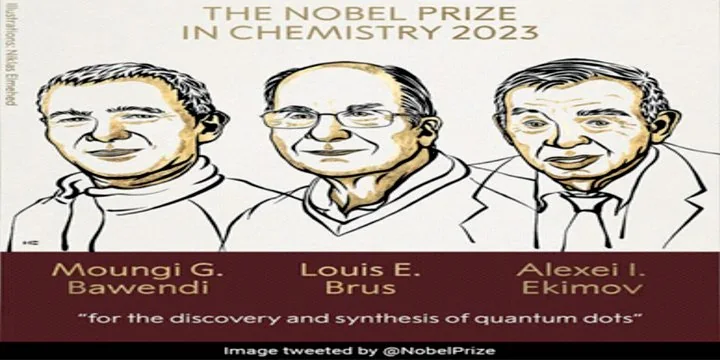
Nobel Prize in Chemistry for 2023: What exactly have the three scientists been honoured for?
The properties of any element depends on how many electrons it has. However, when matter is really tiny, of nano-dimensions, its properties depend on its size. The smaller a particle, the more its electrons are squeezed together, and that affects its properties.
VRAuthor Desk
4 min read
The properties of any element depends on how many electrons it has. However, when matter is really tiny, of nano-dimensions, its properties depend on its size. The smaller a particle, the more its electrons are squeezed together, and that affects its properties.
What are quantum dots?
- The properties of any element depends on how many electrons it has. However, when matter is really tiny, of nano-dimensions, its properties depend on its size.
- The smaller a particle, the more its electrons are squeezed together, and that affects its properties. Such particles, whose size determines their behaviour, are called quantum dots.
- While in theory, scientists had known for long that such particles could exist, the three Nobel laureates, through their work over decades — Bawendi did his postdoctoral research under Brus — succeeded in creating quantum dots of a high quality, which could be put to practical use.
What did Ekimov, Brus, and Bawendi do?
- The first person to make notable discoveries in this field was Ekimov, but since he was working in the Soviet Union at the time (he has since moved to the US), his research, published in 1981, was not accessible beyond the Iron Curtain.
- By the 1970s, scientists had realised that the same substance could impart a different colour to glass, depending on the size of the substance’s particles forming inside the glass, which in turn depended on how the molten glass was heated and cooled in the colouring process. For example, a mixture of cadmium selenide and cadmium sulphide could make glass turn either yellow or red.
- Ekimov wanted to find out why this happened, so he started using copper chloride to colour glass, in different heating and cooling scenarios. “Interestingly, it turned out that the glass’ light absorption was affected by the size of the particles.
- Brus was working in the US, unaware of Ekimov’s work, and trying to make chemical reactions happen using solar energy. For this, he was using particles of cadmium sulphide, which can capture light and drive reactions. The particles were in a solution and Brus made them very small, to maximise the surface area available for a chemical reaction.
- Bawendi improved upon Brus’s methods of creating tiny particles, by using different solvents, temperatures, and techniques.
- “The nanocrystals that Bawendi produced were almost perfect, giving rise to distinct quantum effects. Because the production method was easy to use, it was revolutionary – more and more chemists started working with nanotechnology and began to investigate the unique properties of quantum dots,” the Nobel academy said.
What can quantum dots be used in?
- According to the Nobel academy on its website, “The luminous properties of quantum dots are utilised in computer and television screens based on QLED technology, where the Q stands for quantum dot. Similarly, quantum dots are used in some LED lamps to adjust the cold light of the diodes. The light can then become as energising as daylight or as calming as the warm glow from a dimmed bulb.”
- The light from quantum dots can also be used in biochemistry and medicine.
- “Biochemists attach quantum dots to biomolecules to map cells and organs. Doctors have begun investigating the potential use of quantum dots to track tumour tissue in the body. Chemists instead use the catalytic properties of quantum dots to drive chemical reactions,” the website adds.
Who are the three scientists?
- Alexei Ekimov was born in 1945 in the former USSR. He got his PhD in 1974 from Ioffe Physical-Technical Institute, Saint Petersburg, Russia. He was formerly the Chief Scientist at Nanocrystals Technology Inc., New York, USA.
- Louis Brus was born in 1943 in Cleveland, USA. He got his PhD in 1969 from Columbia University, New York, where is a professor.
- Moungi Bawendi was born in 1961 in Paris and grew up in France, Tunisia, and the US. He got his PhD in 1988 from the University of Chicago, USA. He is a professor at the Massachusetts Institute of Technology (MIT), USA.
Conclusion- Governments across the world now need to work towards narrowing the gap between science and society . More funds for Research and development means a better future for humanity.
Syllabus- GS-3; Science and Tech
Source- Indian Express
- Prelims: Key facts, institutions, locations and terminology in the article.
- Mains: Connect the topic with Polity & Governance, Health, Science & Technology.
- Revision: Use the article headings to prepare concise notes and answer-writing points.
Test your understanding
Questions from this article
Prelims practiceWith reference to Nobel Prize in Chemistry for 2023: What exactly have the three scientists been honoured for?, consider the following statements:
- The properties of any element depends on how many electrons it has. However, when matter is really tiny, of nano-dimensions, its properties depend on its size.
- The smaller a particle, the more its electrons are squeezed together, and that affects its properties. Such particles, whose size determines their behaviour, are called quantum dots.
- While in theory, scientists had known for long that such particles could exist, the three Nobel laureates, through their work over decades — Bawendi did his postdoctoral research under Brus — succeeded in creating…
Which of the statements given above are correct?
- 1 and 2 only
- 2 and 3 only
- 1 and 3 only
- 1, 2 and 3
View answer
Answer: (d) 1, 2 and 3. All three statements are drawn from the article.
Mains practiceDiscuss the background, key issues and significance of Nobel Prize in Chemistry for 2023: What exactly have the three scientists been honoured for? for India.
Answer in 250 words.
View answer approach
- What are quantum dots?
- What did Ekimov, Brus, and Bawendi do?
- What can quantum dots be used in?
- Who are the three scientists?
Frequently asked questionsFrequently asked questions
Why is Nobel Prize In Chemistry For 2023: What Exactly Have The Three Scientists Been Honoured For in the news?
The properties of any element depends on how many electrons it has. However, when matter is really tiny, of nano-dimensions, its properties depend on its size.
What are the key facts about Nobel Prize In Chemistry For 2023: What Exactly Have The Three Scientists Been Honoured For?
The smaller a particle, the more its electrons are squeezed together, and that affects its properties. Such particles, whose size determines their behaviour, are called quantum dots. While in theory, scientists had known for long that such particles could exist, the three Nobel laureates, through their work over decades — Bawendi did his postdoctoral research under Brus — succeeded in creating quantum dots of a high quality, which could be…
Why is Nobel Prize In Chemistry For 2023: What Exactly Have The Three Scientists Been Honoured For important for UPSC preparation?
The topic connects current developments with Polity & Governance, Health, Science & Technology and is relevant for both objective revision and analytical answer writing.