UPSC Current Affairs
Nagorno-Karabakh standoff
Context: Recently, Azerbaijan claimed full control over the contentious NagornoKarabakh region after local forces, mostly Armenians, agreed to disarm and disband. Hundreds of local Armenians fled the area overnight, fearing ethnic cleansing by Azerbaijan. While the disputed region is home to a majority population of ethnic Armenians and an Azeri minority, it is internationally recognised as a part of Azerbaijan.
VRAuthor Desk
2 min read
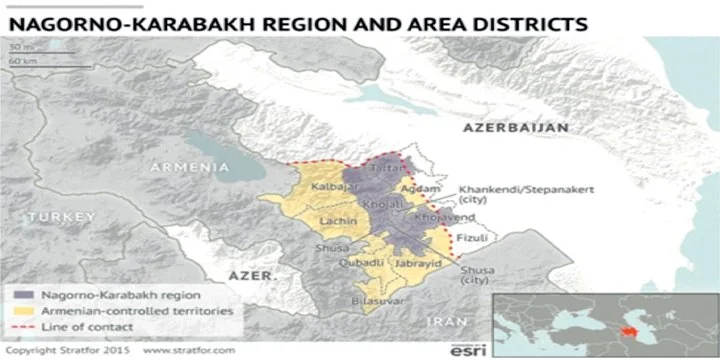
Context: Recently, Azerbaijan claimed full control over the contentious NagornoKarabakh region after local forces, mostly Armenians, agreed to disarm and disband. Hundreds of local Armenians fled the area overnight, fearing ethnic cleansing by Azerbaijan. While the disputed region is home to a majority population of ethnic Armenians and an Azeri minority, it is internationally recognised as a part of Azerbaijan.
Context:
- Recently, Azerbaijan claimed full control over the contentious NagornoKarabakh region after local forces, mostly Armenians, agreed to disarm and disband.
- Hundreds of local Armenians fled the area overnight, fearing ethnic cleansing by Azerbaijan.
- While the disputed region is home to a majority population of ethnic Armenians and an Azeri minority, it is internationally recognised as a part of Azerbaijan.
What happened?
- A fresh round of violence broke out in September when Azerbaijan launched an attack against ethnic Armenian forces in NagornoKarabakh.
- The fighting lasted one day, and a ceasefire was announced a day later.
What is the history of the conflict?
- NagornoKarabakh is located within the international borders of Azerbaijan.
- It is in the South Caucasus region between eastern Europe and western Asia, spanning the southern part of the Caucasus mountains that roughly includes modernday Armenia, Azerbaijan, and Georgia.
- The conflict between Azeris and Armenians goes back a century, when the Ottomans attacked the South Caucasus during World War I with the help of Azeris.
- They targeted ethnic Armenians during this attack, and the conflict between Azerbaijan and Armenia descended into a fullblown war in 1920.
- This war incorporated the region into the Azerbaijan Democratic Republic.
- Soon after, both countries became part of the Soviet Republic, and NagornoKarabakh was made an autonomous Oblast (administrative region) in Azerbaijan’s territory.
- When the Soviet Union disintegrated in 1991, fullscale fighting again broke out between the countries as Armenian rebels declared NagornoKarabakh an independent territory.
- The war lasted till 1994 and killed around 30,000 people. In 1994, Azerbaijan and Armenia entered a ceasefire brokered by Russia, but international borders for the countries were not demarcated.
- A fourday war again broke out between the two countries in 2016, with no resolution being arrived at.
Syllabus: Prelims
- Prelims: Key facts, institutions, locations and terminology in the article.
- Mains: Connect the topic with UPSC Current Affairs.
- Revision: Use the article headings to prepare concise notes and answer-writing points.
Test your understanding
Questions from this article
Prelims practiceWith reference to Nagorno-Karabakh standoff, consider the following statements:
- Recently, Azerbaijan claimed full control over the contentious NagornoKarabakh region after local forces, mostly Armenians, agreed to disarm and disband.
- Hundreds of local Armenians fled the area overnight, fearing ethnic cleansing by Azerbaijan.
- While the disputed region is home to a majority population of ethnic Armenians and an Azeri minority, it is internationally recognised as a part of Azerbaijan.
Which of the statements given above are correct?
- 1 and 2 only
- 2 and 3 only
- 1 and 3 only
- 1, 2 and 3
View answer
Answer: (d) 1, 2 and 3. All three statements are drawn from the article.
Mains practiceDiscuss the background, key issues and significance of Nagorno-Karabakh standoff for India.
Answer in 250 words.
View answer approach
- Context:
- What happened?
- What is the history of the conflict?
Frequently asked questionsFrequently asked questions
Why is Nagorno-Karabakh Standoff in the news?
Context: Recently, Azerbaijan claimed full control over the contentious NagornoKarabakh region after local forces, mostly Armenians, agreed to disarm and disband. Hundreds of local Armenians fled the area overnight, fearing ethnic cleansing by Azerbaijan.
What are the key facts about Nagorno-Karabakh Standoff?
While the disputed region is home to a majority population of ethnic Armenians and an Azeri minority, it is internationally recognised as a part of Azerbaijan. A fresh round of violence broke out in September when Azerbaijan launched an attack against ethnic Armenian forces in NagornoKarabakh. The fighting lasted one day, and a ceasefire was announced a day later.
Why is Nagorno-Karabakh Standoff important for UPSC preparation?
The topic connects current developments with UPSC Current Affairs and is relevant for both objective revision and analytical answer writing.