UPSC Current Affairs
Latest All India Survey of Higher Education (AISHE)
Female enrolment greater than male The AISHE 2021-22 report indicates that female enrollment in higher education institutes has seen a steady increase. From 1.5 crore in 2014-15, the number of women enrolled has risen by 32% to 2.07 crores in 2021-22. Over the last five years, there has been an 18.7% increase from 1.74 crore in 2017-18.
VRAuthor Desk
4 min read
Female enrolment greater than male The AISHE 2021-22 report indicates that female enrollment in higher education institutes has seen a steady increase. From 1.5 crore in 2014-15, the number of women enrolled has risen by 32% to 2.07 crores in 2021-22. Over the last five years, there has been an 18.7% increase from 1.74 crore in 2017-18.
Here are five key takeaways.
Female enrolment greater than male
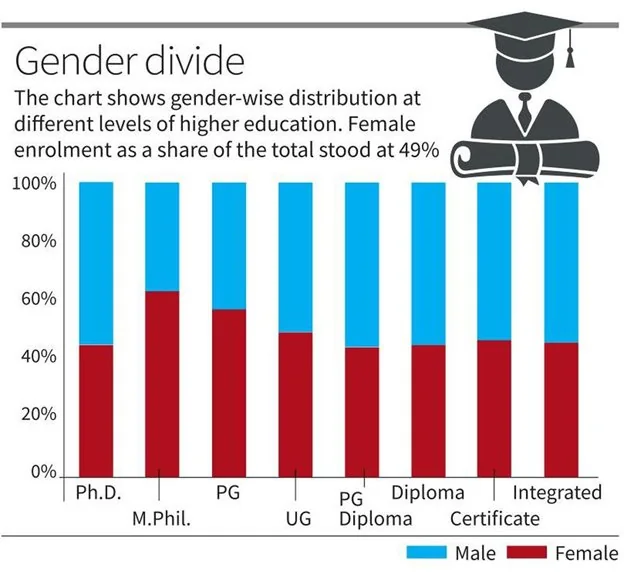
- The AISHE 2021-22 report indicates that female enrollment in higher education institutes has seen a steady increase. From 1.5 crore in 2014-15, the number of women enrolled has risen by 32% to 2.07 crores in 2021-22. Over the last five years, there has been an 18.7% increase from 1.74 crore in 2017-18.
- The most significant increase was observed at the PhD level, where out of the total 2.12 lakh enrolments in 2021-22, 98,636 were women. This is a substantial increase from eight years ago when only 47,717 women were enrolled in PhD programmes.
- Furthermore, the proportion of women in higher education compared to men has also increased. Of the 91 lakh additional students who joined higher education institutes in 2021-22 (compared to 2014-15), 55% were women.
- The highest proportion of women is seen at the postgraduate level, where 55.4% of students are female.
GER and Gender Parity
- The Gross Enrollment Ratio (GER), which indicates the number of students in the higher education system for the age group 18-23 years in India, is estimated to be 28.4.
- In terms of state-wise data, Chandigarh has the highest GER at 64.8%, followed by Puducherry at 61.5%, Delhi at 49%, and Tamil Nadu at 47%.
- The Gender Parity Index (GPI), which shows the ratio of the female GER to male GER, is used to measure gender disparity. A GPI of 1 indicates parity between genders, a number between 0 and 1 shows a disparity in favour of males, and a GPI greater than 1 indicates a disparity in favour of females.
- The survey found that in 26 states and Union Territories, the GER is in favour of women. At the all-India level, the GPI is 1.01, and for SC and ST categories, the GPI is 1.01 and 0.98 respectively, indicating near parity.
Arts over the sciences in graduation, PG
- The Bachelor of Arts (BA) programme has the highest enrolment with 1.13 crore students, accounting for 34.2% of total undergraduate enrolment across India. In total, 3.41 crore students are enrolled in undergraduate programmes.
- Among disciplines at the undergraduate level in 2021-22, enrolment is highest in Arts (34.2%), followed by Science (14.8%), Commerce (13.3%), and Engineering and Technology (11.8%). BA(Hons) accounts for 20.4 lakh students (6.2%).
- The Social Science stream has the highest number of postgraduate students enrolled at 10.8 lakh. The Master of Arts (MA) programme has the highest enrolment, with 20.9 lakh students, which is 40.7% of total postgraduate enrolment.
- At the PhD level, Social Sciences is in the third spot after Engineering and Science. While 52,748 students are pursuing a PhD in Engineering, and 45,324 in Science, 26,057 students are pursuing a PhD in the Social Sciences.
Primacy of government institutions
- A majority of students, 73.7%, attend government universities, which constitute only 58.6% of all universities.
- In the government sector, state public universities have the largest share of enrolment, accounting for around 31% of the total enrolment for universities.
- In terms of actual numbers, government-owned universities have an enrolment of 71.06 lakh, while privately managed universities have an enrolment of 25.32 lakh.
- Despite the higher number of private universities, students show a preference for government educational institutions.
Demographics of students graduating
- During the 2021-22 academic year, an estimated 1.07 crore students graduated from various programmes, with women making up roughly 50.8% or 54.6 lakh of these graduates.
- In terms of categories, around 35% of the students belong to Other Backward Classes (OBC), 13% are from the Scheduled Caste (SC) community, and 5.7% of the graduates are from the Scheduled Tribe (ST) community.
- The graduation rate in arts and social sciences streams is higher than in other streams. At the undergraduate level, the BA degree has been awarded to the highest number of students, 24.16 lakh. Similarly, at the postgraduate level, the MA programme has the highest number of graduates with 7.02 lakh degrees awarded in 2021-22.
- At the PhD level, the highest number of graduates are in the science stream with 7,408, followed by engineering and technology with 6,270 graduating students.
Conclusion- The All India Survey of Higher Education (AISHE) 2021-22 report provides a comprehensive overview of the current state of higher education in India. It highlights the steady increase in student enrollment, particularly among women, and the preference for government institutions despite the higher number of private universities. The report also reveals a significant rise in the number of graduates across various disciplines, with arts and social sciences leading at the undergraduate and postgraduate levels. However, at the PhD level, science and engineering take the lead.
The data underscores the progress made in higher education in India, reflecting the country’s commitment to fostering educational growth and gender parity. Nevertheless, it also points to the areas that need further attention to ensure inclusive and quality higher education for all.
- Prelims: Key facts, institutions, locations and terminology in the article.
- Mains: Connect the topic with Polity & Governance, Science & Technology.
- Revision: Use the article headings to prepare concise notes and answer-writing points.
Test your understanding
Questions from this article
Prelims practiceWith reference to Latest All India Survey of Higher Education (AISHE), consider the following statements:
- The AISHE 2021-22 report indicates that female enrollment in higher education institutes has seen a steady increase. From 1.5 crore in 2014-15, the number of women enrolled has risen by 32% to 2.07 crores in 2021-22.…
- The most significant increase was observed at the PhD level, where out of the total 2.12 lakh enrolments in 2021-22, 98,636 were women. This is a substantial increase from eight years ago when only 47,717 women were…
- Furthermore, the proportion of women in higher education compared to men has also increased. Of the 91 lakh additional students who joined higher education institutes in 2021-22 (compared to 2014-15), 55% were women.
Which of the statements given above are correct?
- 1 and 2 only
- 2 and 3 only
- 1 and 3 only
- 1, 2 and 3
View answer
Answer: (d) 1, 2 and 3. All three statements are drawn from the article.
Mains practiceDiscuss the background, key issues and significance of Latest All India Survey of Higher Education (AISHE) for India.
Answer in 250 words.
View answer approach
- Background and context
- Key facts and institutional framework
- Significance and way forward
Frequently asked questionsFrequently asked questions
Why is Latest All India Survey Of Higher Education (Aishe) in the news?
Female enrolment greater than male The AISHE 2021-22 report indicates that female enrollment in higher education institutes has seen a steady increase. From 1.5 crore in 2014-15, the number of women enrolled has risen by 32% to 2.07 crores in 2021-22.
What are the key facts about Latest All India Survey Of Higher Education (Aishe)?
Over the last five years, there has been an 18.7% increase from 1.74 crore in 2017-18. The most significant increase was observed at the PhD level, where out of the total 2.12 lakh enrolments in 2021-22, 98,636 were women. This is a substantial increase from eight years ago when only 47,717 women were enrolled in PhD programmes.
Why is Latest All India Survey Of Higher Education (Aishe) important for UPSC preparation?
The topic connects current developments with Polity & Governance, Science & Technology and is relevant for both objective revision and analytical answer writing.