UPSC Current Affairs
Interim budget mentions blue economy 2.0: What this means
The term ‘blue economy’ primarily refers to the sustainable economic activities associated with oceans, seas, and coasts. It encompasses a broad spectrum of interconnected established and emerging sectors. The European Commission defines it as all economic activities related to oceans, seas, and coasts, while the World Bank describes it as the sustainable use of ocean resources for economic growth, improved livelihoods, and jobs, all while preserving the health…
VRAuthor Desk
2 min read

The term ‘blue economy’ primarily refers to the sustainable economic activities associated with oceans, seas, and coasts. It encompasses a broad spectrum of interconnected established and emerging sectors. The European Commission defines it as all economic activities related to oceans, seas, and coasts, while the World Bank describes it as the sustainable use of ocean resources for economic growth, improved livelihoods, and jobs, all while preserving the health…
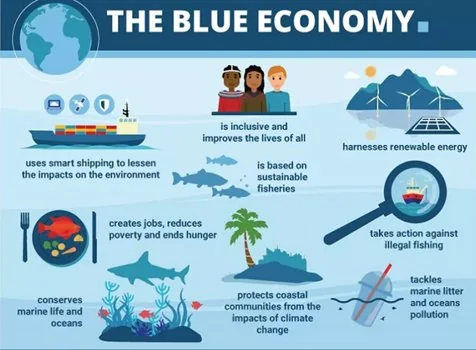
What is blue economy?
- The term ‘blue economy’ primarily refers to the sustainable economic activities associated with oceans, seas, and coasts. It encompasses a broad spectrum of interconnected established and emerging sectors.
- The European Commission defines it as all economic activities related to oceans, seas, and coasts, while the World Bank describes it as the sustainable use of ocean resources for economic growth, improved livelihoods, and jobs, all while preserving the health of the ocean ecosystem.
- For a country like India, which has a long coastline, diverse marine life, and numerous tourism opportunities, the blue economy holds significant importance.
What does the Interim Budget propose to do about blue economy?
- Finance Minister Nirmala Sitharaman announced the launch of a scheme for restoration and adaptation measures, and coastal aquaculture and mariculture with an integrated and multi-sectoral approach. This scheme aims to protect ocean health while conducting economic activities.
- Aquaculture, the farming of aquatic plants and animals, and mariculture, the rearing and harvesting of marine creatures in salt water, will be key components of this scheme. Additionally, five integrated aquaparks will be established.
- The Pradhan Mantri Matsya Sampada Yojana (PMMSY) will be enhanced to increase aquaculture productivity from three to five tonnes per hectare, double exports to Rs 1 lakh crore, and generate 55 lakh employment opportunities in the near future.
Does India have a blue economy policy?
- The Budget document introduced the concept of ‘blue economy 2.0’. A draft policy framework on India’s Blue Economy was initially released in July 2022, which included key recommendations on various aspects such as National Accounting Framework for Blue Economy and Ocean Governance, Coastal Marine Spatial Planning, Tourism Priority, Marine Fisheries, Aquaculture and Fish Processing, and more.
- During the G20 summit hosted in New Delhi under India’s presidency, the Comptroller & Auditor General of India (CAG) led the Engagement Group for Supreme Audit Institutions (SAIs) of the member countries in June 2023.
- The two main priorities for the SAI20 discussions were the blue economy and responsible Artificial Intelligence.
- Prelims: Key facts, institutions, locations and terminology in the article.
- Mains: Connect the topic with Economy, Polity & Governance, Health.
- Revision: Use the article headings to prepare concise notes and answer-writing points.
Test your understanding
Questions from this article
Prelims practiceWith reference to Interim budget mentions blue economy 2.0: What this means, consider the following statements:
- The term ‘blue economy’ primarily refers to the sustainable economic activities associated with oceans, seas, and coasts. It encompasses a broad spectrum of interconnected established and emerging sectors.
- The European Commission defines it as all economic activities related to oceans, seas, and coasts, while the World Bank describes it as the sustainable use of ocean resources for economic growth, improved livelihoods…
- For a country like India, which has a long coastline, diverse marine life, and numerous tourism opportunities, the blue economy holds significant importance.
Which of the statements given above are correct?
- 1 and 2 only
- 2 and 3 only
- 1 and 3 only
- 1, 2 and 3
View answer
Answer: (d) 1, 2 and 3. All three statements are drawn from the article.
Mains practiceDiscuss the background, key issues and significance of Interim budget mentions blue economy 2.0: What this means for India.
Answer in 250 words.
View answer approach
- What is blue economy?
- What does the Interim Budget propose to do about blue economy?
- Does India have a blue economy policy?
Frequently asked questionsFrequently asked questions
Why is Interim Budget Mentions Blue Economy 2.0: What This Means in the news?
The term ‘blue economy’ primarily refers to the sustainable economic activities associated with oceans, seas, and coasts. It encompasses a broad spectrum of interconnected established and emerging sectors.
What are the key facts about Interim Budget Mentions Blue Economy 2.0: What This Means?
The European Commission defines it as all economic activities related to oceans, seas, and coasts, while the World Bank describes it as the sustainable use of ocean resources for economic growth, improved livelihoods, and jobs, all while preserving the health… For a country like India, which has a long coastline, diverse marine life, and numerous tourism opportunities, the blue economy holds significant importance. What does the Interim Budget propose to do about blue economy?
Why is Interim Budget Mentions Blue Economy 2.0: What This Means important for UPSC preparation?
The topic connects current developments with Economy, Polity & Governance, Health and is relevant for both objective revision and analytical answer writing.