UPSC Current Affairs
How food inflation in India has been de-globalised, what factors can drive prices now
Context- The UN Food and Agriculture Organization’s (FAO) food price index, which is a trade-weighted average of global prices for a basket of food commodities, averaged 143.7 points in 2022 and 125.7 points in 2021, compared to 98.1 and 95.1 in the two… However, this index fell by 13.7% to 124 points in 2023. The decline is even more pronounced at 25.8% when comparing the latest monthly value of 118.5 points for December 2023 with the all-time high of 159.7 points reached in March 2022, right after the Russia Ukraine war began.
VRAuthor Desk
4 min read
Context- The UN Food and Agriculture Organization’s (FAO) food price index, which is a trade-weighted average of global prices for a basket of food commodities, averaged 143.7 points in 2022 and 125.7 points in 2021, compared to 98.1 and 95.1 in the two… However, this index fell by 13.7% to 124 points in 2023. The decline is even more pronounced at 25.8% when comparing the latest monthly value of 118.5 points for December 2023 with the all-time high of 159.7 points reached in March 2022, right after the Russia Ukraine war began.
Context- The UN Food and Agriculture Organization’s (FAO) food price index, which is a trade-weighted average of global prices for a basket of food commodities, averaged 143.7 points in 2022 and 125.7 points in 2021, compared to 98.1 and 95.1 in the two previous years. However, this index fell by 13.7% to 124 points in 2023. The decline is even more pronounced at 25.8% when comparing the latest monthly value of 118.5 points for December 2023 with the all-time high of 159.7 points reached in March 2022, right after the Russia Ukraine war began.
The contrast with domestic inflation
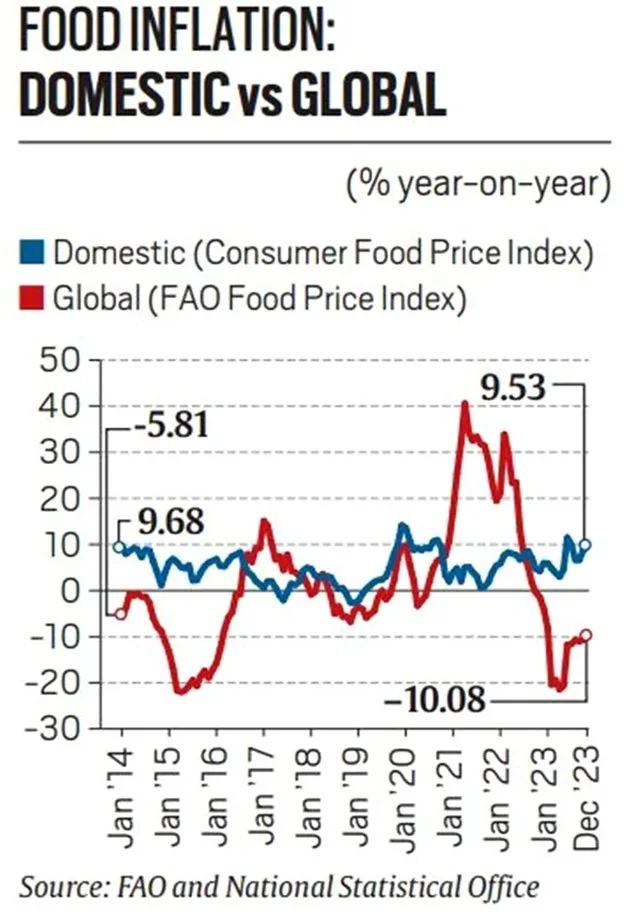
- Globally, food inflation has been negative since November 2022, according to the FAO index. However, in India, the consumer food price index inflation has remained high, at 9.5% in December 2023.
- International food price increases have shown more volatility than domestic inflation in India. Over the last three years, global food inflation has varied from a high of 40.6% to a low of -21.5%, while domestic food inflation in India has remained between 0.7% and 11.5%.
- One reason for this divergence is the limited impact of international prices on food inflation or deflation in India, which typically occurs through imports and exports. For example, India imports over 60% of its annual consumption requirement of vegetable oils.
- Global supply disruptions due to Covid and the Russia-Ukraine conflict led to a significant increase in domestic retail edible oil inflation from around June 2020 through mid-2022. High global prices also caused inflation in cereals, particularly wheat, from mid-2022 by making exports attractive and exacerbating domestic shortages.
- However, the transmission of global inflation to domestic prices in India is largely limited to two agri-commodities where the country is significantly import-dependent: edible oils and pulses.
- For most other commodities, including cereals, sugar, dairy, poultry, fruits, and vegetables, India is not only self-sufficient but also an exporter.
- In the current environment, the Indian government has banned the export of wheat, non-basmati white rice, sugar, and onion, effectively eliminating the potential for export-led inflation.
Global cues
- The food inflation in India is now de-globalized, largely due to the policies of the Modi government, which include export restrictions and low import duties on major pulses and crude edible oils until March 31, 2025.
- Low global prices, such as Russian wheat at $240-245 per tonne and Indonesian crude palm oil at $940 per tonne, have virtually eliminated the threat of imported inflation.
- While there are disruptions in vessel movements due to attacks by Yemen’s Houthi militants in the Red Sea, the impact on India’s import of major food items is currently minimal.
- Imports of certain pulses do not use the disrupted Suez waterway-Red Sea route, and the Houthi attacks are not expected to halt imports of palm oil from Indonesia and Malaysia or soybean from Argentina and Brazil.
- The only significant disruption is to vessels carrying sunflower oil from Russia and Ukraine, which are being forced to take a longer route around the African continent, adding to voyage time and freight cost.
- However, sunflower oil makes up only a small portion of India’s total edible oil imports. There are also reports of Houthi rebels sparing Russian cargo ships that continue to use the shorter Black Sea-Mediterranean-Red Sea route.
 Domestic factors
- In the coming months, food inflation in India will be more influenced by domestic production factors than global ones. The primary crops of concern are cereals, pulses, and sugar.
- Inflation for these commodities has been higher than the overall food inflation, with pulses inflation in double digits since June 2023 and cereals for 15 consecutive months from September 2022 to November 2023.
- The area sown under wheat has surpassed previous years, indicating a potential bumper harvest. However, wheat is sensitive to heat stress, and any sudden temperature spikes can lead to yield loss through premature ripening.
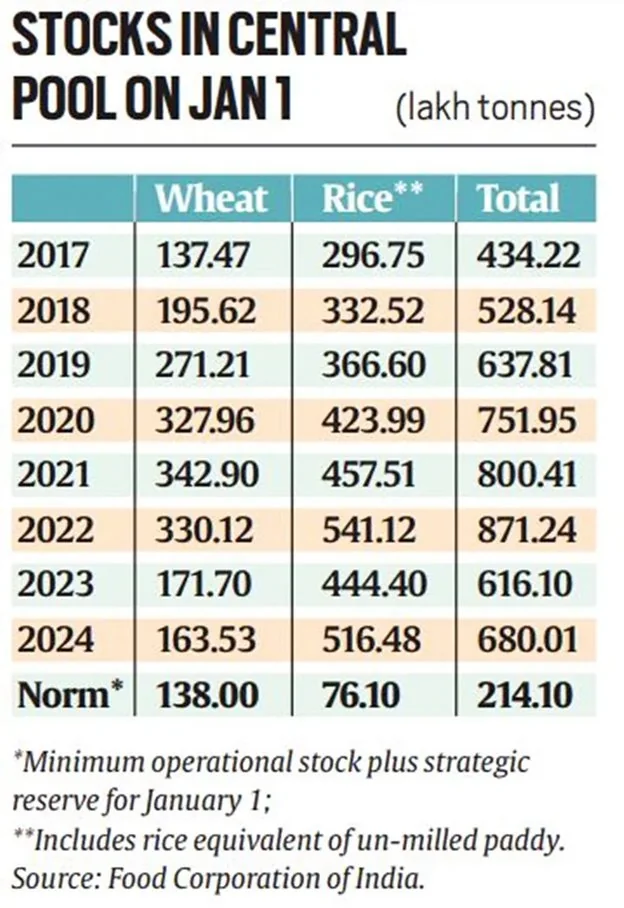
- Unseasonal heavy rain can also put pressure on cereal stocks, which are already at a seven-year low. Sugar mills started the new season with six-year-low stocks and uncertainty about actual production.
- Pulses prices remain high due to reduced planting this season. The drivers of food inflation are now more domestic than global.
Conclusion- The dynamics of food inflation in India have become largely decoupled from global trends, and are now primarily influenced by domestic factors. Key commodities such as cereals, pulses, and sugar are experiencing inflation rates higher than the overall food inflation. While the area sown under wheat has increased, potential threats from weather conditions and reduced stocks could impact future prices. Similarly, reduced planting of pulses and low stocks of sugar could keep their prices elevated.
Therefore, domestic production factors, rather than global influences, will likely dictate the course of food inflation in India in the coming months.
- Prelims: Key facts, institutions, locations and terminology in the article.
- Mains: Connect the topic with Environment, Economy, Polity & Governance.
- Revision: Use the article headings to prepare concise notes and answer-writing points.
Test your understanding
Questions from this article
Prelims practiceWith reference to How food inflation in India has been de-globalised, what factors can drive prices now, consider the following statements:
- Globally, food inflation has been negative since November 2022, according to the FAO index. However, in India, the consumer food price index inflation has remained high, at 9.5% in December 2023.
- International food price increases have shown more volatility than domestic inflation in India. Over the last three years, global food inflation has varied from a high of 40.6% to a low of -21.5%, while domestic food…
- One reason for this divergence is the limited impact of international prices on food inflation or deflation in India, which typically occurs through imports and exports. For example, India imports over 60% of its annual…
Which of the statements given above are correct?
- 1 and 2 only
- 2 and 3 only
- 1 and 3 only
- 1, 2 and 3
View answer
Answer: (d) 1, 2 and 3. All three statements are drawn from the article.
Mains practiceDiscuss the background, key issues and significance of How food inflation in India has been de-globalised, what factors can drive prices now for India.
Answer in 250 words.
View answer approach
- Background and context
- Key facts and institutional framework
- Significance and way forward
Frequently asked questionsFrequently asked questions
Why is How Food Inflation In India Has Been De-Globalised, What Factors Can Drive Prices Now in the news?
Context- The UN Food and Agriculture Organization’s (FAO) food price index, which is a trade-weighted average of global prices for a basket of food commodities, averaged 143.7 points in 2022 and 125.7 points in 2021, compared to 98.1 and 95.1 in the two… However, this index fell by 13.7% to 124 points in 2023.
What are the key facts about How Food Inflation In India Has Been De-Globalised, What Factors Can Drive Prices Now?
The decline is even more pronounced at 25.8% when comparing the latest monthly value of 118.5 points for December 2023 with the all-time high of 159.7 points reached in March 2022, right after the Russia Ukraine war began. The contrast with domestic inflation Globally, food inflation has been negative since November 2022, according to the FAO index. However, in India, the consumer food price index inflation has remained high, at 9.5% in December 2023.
Why is How Food Inflation In India Has Been De-Globalised, What Factors Can Drive Prices Now important for UPSC preparation?
The topic connects current developments with Environment, Economy, Polity & Governance and is relevant for both objective revision and analytical answer writing.