UPSC Current Affairs
Have we lost the fight against climate change
Emissions still rising According to the Intergovernmental Panel on Climate Change (IPCC), global greenhouse gas emissions need to be cut by at least 43% from the 2019 levels by 2030, to retain any realistic chances of keeping the rise in global temperatures… That means that global emissions, around 56 billion tonnes of CO2 equivalent in 2019, would have to come down to about 32 billion tonnes by 2030. But as revealed by the latest Emissions Gap Report, emissions are rissing.
VRAuthor Desk
5 min read
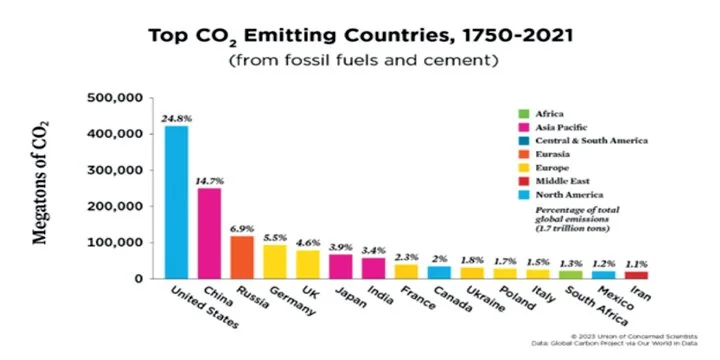
Emissions still rising According to the Intergovernmental Panel on Climate Change (IPCC), global greenhouse gas emissions need to be cut by at least 43% from the 2019 levels by 2030, to retain any realistic chances of keeping the rise in global temperatures… That means that global emissions, around 56 billion tonnes of CO2 equivalent in 2019, would have to come down to about 32 billion tonnes by 2030. But as revealed by the latest Emissions Gap Report, emissions are rissing.
Emissions still rising
- According to the Intergovernmental Panel on Climate Change (IPCC), global greenhouse gas emissions need to be cut by at least 43% from the 2019 levels by 2030, to retain any realistic chances of keeping the rise in global temperatures within 1.5 degree Celsius from pre-industrial averages. That means that global emissions, around 56 billion tonnes of CO2 equivalent in 2019, would have to come down to about 32 billion tonnes by 2030.
- But as revealed by the latest Emissions Gap Report, emissions are rissing. Global emissions in 2022 were at least a billion tonnes higher than in 2019. In fact, annual emissions have never shown a decline except in 2020, the Covid pandemic year.
- Meeting the 2030 target would now mean ensuring a reduction of almost 9% every year on an average . This is almost impossible. As a sort of comparison, even a disruption as big as Covid could cut emissions by just 4.7%.
- Current levels of climate actions are projected to result in a reduction of just 2% emissions, or just about a billion tonnes, by 2030 from 2019 levels.
Struggling to adapt
- With temperatures continuing to rise, countries need to learn to survive in a warmer environment, and deal with the consequences of climate change.
- For this, some countries, like the small island states threatened by rising sea levels, would want to build sea-walls, others would like to make their infrastructure more resilient, still others would want to set up early warning systems, or invest in temperature-resilient agriculture or water resources.
- All this requires large sums of money. After putting in what they can, developing countries were expecting, as they are entitled to under the Paris Agreement, to receive financial help from the rich nations.
- At the Glasgow climate conference in 2021, rich countries had agreed to double the amount of money going towards adaptation projects by 2025. That would have increased international adaptation finance from about US$ 20 billion to US$ 40 billion.
- However, the latest UN report suggests that the availability of adaptation money has actually declined by almost 15% last year. In the meanwhile, combined requirements of developing countries is estimated to be at least US$ 215 billion every year, more than 10 times the current level of flows.
Empty loss and damage fund
- Along with mitigation and adaptation, ‘Loss and Damage’ is the third important pillar of the fight against climate change. After a long and painful struggle, developing countries managed to get a loss and damage fund established at the Sharm el-Shaikh conference last year.
- The fund is meant to provide financial help to countries struck by climate disasters. But it is empty right now.
- It is expected that some money would flow in this year, but it is likely to be inconsequential compared to the estimated need of US$ 400 billion every year.
Money the biggest barrier
- Much of the fight against climate change rests on the premise that the rich and developed countries would take the lead, not just in making emission cuts, but also in providing money to developing countries.
- Despite having almost complete control over the international financial flows, they have not even been able to channelise private, development or aid money to the right places.
- The US$ 100 billion annual flow, something that the developed countries had promised way back in 2009, has become so dated, it does not seem to matter any more.
So, have we lost the fight?
- If it is about meeting 2030 emission reduction targets, consistent with 1.5 or even 2 degree Celsius pathways, the fight is as good as over. Governments, international bodies, and even scientists, would like to focus on the theoretical possibilities that are still open, but it is extremely improbable that these targets would be met. Even historically, no climate target has ever been met.
- As mentioned in the Emissions Gap Report, there have been 86 days already this year when daily temperatures exceeded pre-industrial averages by more than 1.5 degree Celsius. And now, at least two days have been more than 2 degrees warmer.
- The year 2023 is set to emerge as the warmest ever, surpassing the record of 2016, and it would not be surprising if it breaches the 1.5 degree threshold for the annual average.
- There are still possibilities of a pull-back through technological interventions like carbon dioxide removal, though these technologies are far from becoming mainstream and economical.
- But every climate scenario beyond 2040 relies heavily on these technologies to reduce the concentrations of greenhouse gases in the atmosphere and bring down temperatures rapidly.
Conclusion- Crossing the 1.5 degree threshold does not necessarily spell doom. It would not be a very different world from the one we are living in. But there is no doubt that, progressively, life would get tougher for more and more people. Eventually, countries would learn to minimise loss of lives in disasters, at least from the predictable events, but there would be more frequent disruptions, loss of livelihoods, supply chain shocks, and communication outages.
Syllabus- GS-3; Climate Change
Source- Indian Express
- Prelims: Key facts, institutions, locations and terminology in the article.
- Mains: Connect the topic with Environment, Economy, International Relations.
- Revision: Use the article headings to prepare concise notes and answer-writing points.
Test your understanding
Questions from this article
Prelims practiceWith reference to Have we lost the fight against climate change, consider the following statements:
- According to the Intergovernmental Panel on Climate Change (IPCC), global greenhouse gas emissions need to be cut by at least 43% from the 2019 levels by 2030, to retain any realistic chances of keeping the rise in…
- But as revealed by the latest Emissions Gap Report, emissions are rissing. Global emissions in 2022 were at least a billion tonnes higher than in 2019. In fact, annual emissions have never shown a decline except in 2020…
- Meeting the 2030 target would now mean ensuring a reduction of almost 9% every year on an average . This is almost impossible. As a sort of comparison, even a disruption as big as Covid could cut emissions by just 4.7%.
Which of the statements given above are correct?
- 1 and 2 only
- 2 and 3 only
- 1 and 3 only
- 1, 2 and 3
View answer
Answer: (d) 1, 2 and 3. All three statements are drawn from the article.
Mains practiceDiscuss the background, key issues and significance of Have we lost the fight against climate change for India.
Answer in 250 words.
View answer approach
- So, have we lost the fight?
- Background and context
- Key facts and institutional framework
- Significance and way forward
Frequently asked questionsFrequently asked questions
Why is Have We Lost The Fight Against Climate Change in the news?
Emissions still rising According to the Intergovernmental Panel on Climate Change (IPCC), global greenhouse gas emissions need to be cut by at least 43% from the 2019 levels by 2030, to retain any realistic chances of keeping the rise in global temperatures… That means that global emissions, around 56 billion tonnes of CO2 equivalent in 2019, would have to come down to about 32 billion tonnes by 2030.
What are the key facts about Have We Lost The Fight Against Climate Change?
But as revealed by the latest Emissions Gap Report, emissions are rissing. Global emissions in 2022 were at least a billion tonnes higher than in 2019. In fact, annual emissions have never shown a decline except in 2020, the Covid pandemic year.
Why is Have We Lost The Fight Against Climate Change important for UPSC preparation?
The topic connects current developments with Environment, Economy, International Relations and is relevant for both objective revision and analytical answer writing.