UPSC Current Affairs
GRAP Stage 4 implemented in Delhi-NCR amid severe air pollution: What does it mean?
What is the Graded Response Action Plan? GRAP is a set of emergency measures that kick in to prevent further deterioration of air quality once it reaches a certain threshold in the Delhi-NCR region. Approved by the Supreme Court in 2016 and notified in 2017, the plan was formulated after several meetings that the Environment Pollution (Prevention and Control) Authority (EPCA) held with state government representatives and experts.
VRAuthor Desk
3 min read
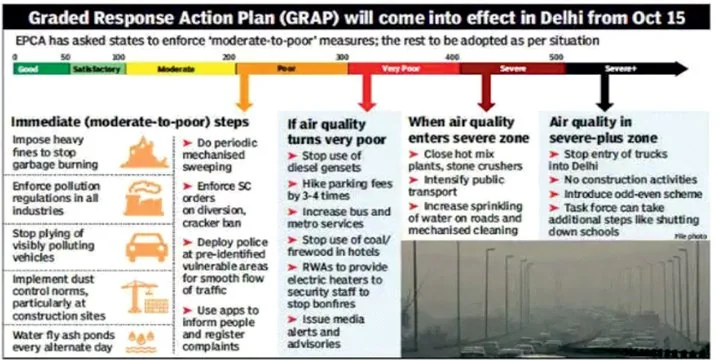
What is the Graded Response Action Plan? GRAP is a set of emergency measures that kick in to prevent further deterioration of air quality once it reaches a certain threshold in the Delhi-NCR region. Approved by the Supreme Court in 2016 and notified in 2017, the plan was formulated after several meetings that the Environment Pollution (Prevention and Control) Authority (EPCA) held with state government representatives and experts.
What is the Graded Response Action Plan?
- GRAP is a set of emergency measures that kick in to prevent further deterioration of air quality once it reaches a certain threshold in the Delhi-NCR region.
- Approved by the Supreme Court in 2016 and notified in 2017, the plan was formulated after several meetings that the Environment Pollution (Prevention and Control) Authority (EPCA) held with state government representatives and experts. The result was a plan that institutionalised measures to be taken when air quality deteriorates.
- GRAP is incremental in nature and thus, when the air quality dips from ‘poor’ to ‘very poor,’ measures listed under both sections have to be followed.
- Stage 1 of GRAP is activated when the AQI is in the ‘poor’ category (201 to 300), Stage 2 is when it’s in the ‘Very poor’ category (301-400), Stage 3 is when the AQI is the ‘Severe’ category (401-450) and finally Stage 4 is when it rises to the ‘Severe +’ category (more than 450).
What measures does GRAP Stage 4 entail?
- As the AQI in NCR dipped to the ‘severe’ category last week, stage 4 of GRAP was set in motion. A central panel directed authorities to prohibit the use of diesel four-wheelers that are not BS-VI compliant, as well as the entry of trucks in Delhi. Petrol cars can continue to ply as usual.
- The BS or Bharat Stage emission standards are instituted by the government to regulate the output of air pollutants from motor vehicles from internal combustion engine equipment. The BS-VI fuel was estimated to bring around an 80% reduction of sulphur, from 50 parts per million to 10 ppm.
- The ban on diesel four-wheelers, except BS-VI vehicles and those used for essential and emergency services, will be applicable in Delhi and NCR districts bordering the capital, according to the order. All Delhi-registered diesel medium and heavy goods vehicles are also prohibited from plying in Delhi, except those used for essential or emergency services.
- Additionally, construction and demolition activities, including those on linear public projects like highways, roads, flyovers, pipelines and power lines, which were previously allowed to continue, will also be banned.
- According to the order, the state governments in the NCR may decide to discontinue physical classes for classes 6 to 9 and class 11, and conduct lessons online. Moreover, the governments may also decide on whether to allow public, private, and municipal offices to work on 50% strength while the rest of the employees work from home.
- State governments may also consider other emergency measures like closure of colleges and other educational institutions, and closure of non-emergency commercial activities, permitting vehicles to run on an odd-even basis.
- The central government may make an appropriate decision on permitting work from home for employees working in central government offices.
Way Forward- The measures were taken considering the likelihood that pollution levels would rise after Diwali. However, if wind speeds improve it may help in dispersing the pollutants.
Syllabus- GS-3; Environment
Source- Indian Express
- Prelims: Key facts, institutions, locations and terminology in the article.
- Mains: Connect the topic with Polity & Governance.
- Revision: Use the article headings to prepare concise notes and answer-writing points.
Test your understanding
Questions from this article
Prelims practiceWith reference to GRAP Stage 4 implemented in Delhi-NCR amid severe air pollution: What does it mean?, consider the following statements:
- GRAP is a set of emergency measures that kick in to prevent further deterioration of air quality once it reaches a certain threshold in the Delhi-NCR region.
- Approved by the Supreme Court in 2016 and notified in 2017, the plan was formulated after several meetings that the Environment Pollution (Prevention and Control) Authority (EPCA) held with state government…
- GRAP is incremental in nature and thus, when the air quality dips from ‘poor’ to ‘very poor,’ measures listed under both sections have to be followed.
Which of the statements given above are correct?
- 1 and 2 only
- 2 and 3 only
- 1 and 3 only
- 1, 2 and 3
View answer
Answer: (d) 1, 2 and 3. All three statements are drawn from the article.
Mains practiceDiscuss the background, key issues and significance of GRAP Stage 4 implemented in Delhi-NCR amid severe air pollution: What does it mean? for India.
Answer in 250 words.
View answer approach
- What is the Graded Response Action Plan?
- What measures does GRAP Stage 4 entail?
- Background and context
- Key facts and institutional framework
- Significance and way forward
Frequently asked questionsFrequently asked questions
Why is Grap Stage 4 Implemented In Delhi-Ncr Amid Severe Air Pollution: What Does It Mean in the news?
What is the Graded Response Action Plan? GRAP is a set of emergency measures that kick in to prevent further deterioration of air quality once it reaches a certain threshold in the Delhi-NCR region.
What are the key facts about Grap Stage 4 Implemented In Delhi-Ncr Amid Severe Air Pollution: What Does It Mean?
Approved by the Supreme Court in 2016 and notified in 2017, the plan was formulated after several meetings that the Environment Pollution (Prevention and Control) Authority (EPCA) held with state government representatives and experts. The result was a plan that institutionalised measures to be taken when air quality deteriorates. GRAP is incremental in nature and thus, when the air quality dips from ‘poor’ to ‘very poor,’ measures listed under both sections have to be followed.
Why is Grap Stage 4 Implemented In Delhi-Ncr Amid Severe Air Pollution: What Does It Mean important for UPSC preparation?
The topic connects current developments with Polity & Governance and is relevant for both objective revision and analytical answer writing.