UPSC Current Affairs
Glacial lake outburst flood kills 14 in Sikkim, 102 people missing: What is GLOF?
Glacial lakes, like the South Lhonak Lake, are large bodies of water that sit in front of, on top of, or beneath a melting glacier. As they grow larger, they become more dangerous because glacial lakes are mostly dammed by unstable ice or sediment composed of loose rock and debris. In case the boundary around them breaks, huge amounts of water rush down the side of the mountains, which could cause flooding in the downstream areas.
VRAuthor Desk
3 min read
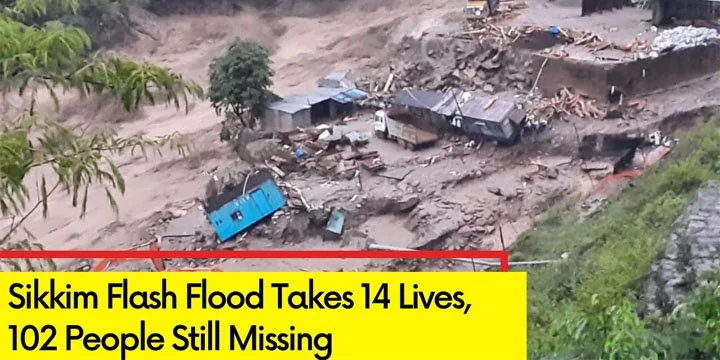
Glacial lakes, like the South Lhonak Lake, are large bodies of water that sit in front of, on top of, or beneath a melting glacier. As they grow larger, they become more dangerous because glacial lakes are mostly dammed by unstable ice or sediment composed of loose rock and debris. In case the boundary around them breaks, huge amounts of water rush down the side of the mountains, which could cause flooding in the downstream areas.
What is GLOF?
- Glacial lakes, like the South Lhonak Lake, are large bodies of water that sit in front of, on top of, or beneath a melting glacier. As they grow larger, they become more dangerous because glacial lakes are mostly dammed by unstable ice or sediment composed of loose rock and debris.
- In case the boundary around them breaks, huge amounts of water rush down the side of the mountains, which could cause flooding in the downstream areas. This is called glacial lake outburst floods or GLOF.
- GLOF can be triggered by several reasons, including earthquakes, extremely heavy rains and ice avalanches.
- These lakes are also often found in steep, mountainous regions, which means landslides or ice avalanches can sometimes fall directly into the lakes and displace the water, causing it to over-top the natural dam and flood downstream.
- In 2013, one such event took place in Uttarakhand’s Kedarnath when the region witnessed flash floods along with a GLOF caused by the Chorabari Tal glacial lake, killing thousands of people.
How did South Lhonak Lake become susceptible to GLOF?
- With the rising global temperatures, glaciers in Sikkim Himalayan have been melting rapidly, giving rise to many glacier lakes and expanding the already existing ones in the region.
- There are currently more than 300 glacial lakes in Sikkim Himalayan, according to the Sikkim State Disaster Management Authority, a 2020 report by Mongabay said. Out of these, 10 have been identified as vulnerable to outburst floods.
- One of them is the South Lhonak Lake. The glacier lake has been under observation by government authorities for years now. A report published by the Sikkim Forest and Environment Department found that the lake’s area had significantly increased in the past five decades.
Did the Sikkim government take any action to tackle the expanding South Lhonak Lake?
- Yes, it did. In 2016, members of the Sikkim State Disaster Management Authority and Sikkim’s Department of Science and Technology and Climate Change, among others, decided to syphon off lake water from the South Lhonak Lake.
- The technique was implemented under the supervision of innovator Sonam Wangchuk. Authorities installed three eight-inch wide and 130-140 metres long High Density Polyethylene (HDPE) pipes in the lake to take out the water. They syphoned off 150 litres of water per sec, according to the Sikkim SDMA.
Conclusion- Glacial lake outburst floods present a significant threat to lives and property particularly in mountainous terrain. Risk recognition, mapping and mitigation should be carried out on priority to address the issue.
Syllabus- GS-3; Disaster Management
Source- Indian Express
- Prelims: Key facts, institutions, locations and terminology in the article.
- Mains: Connect the topic with Environment, Polity & Governance, Science & Technology.
- Revision: Use the article headings to prepare concise notes and answer-writing points.
Test your understanding
Questions from this article
Prelims practiceWith reference to Glacial lake outburst flood kills 14 in Sikkim, 102 people missing: What is GLOF?, consider the following statements:
- Glacial lakes, like the South Lhonak Lake, are large bodies of water that sit in front of, on top of, or beneath a melting glacier. As they grow larger, they become more dangerous because glacial lakes are mostly dammed…
- In case the boundary around them breaks, huge amounts of water rush down the side of the mountains, which could cause flooding in the downstream areas. This is called glacial lake outburst floods or GLOF.
- GLOF can be triggered by several reasons, including earthquakes, extremely heavy rains and ice avalanches.
Which of the statements given above are correct?
- 1 and 2 only
- 2 and 3 only
- 1 and 3 only
- 1, 2 and 3
View answer
Answer: (d) 1, 2 and 3. All three statements are drawn from the article.
Mains practiceDiscuss the background, key issues and significance of Glacial lake outburst flood kills 14 in Sikkim, 102 people missing: What is GLOF? for India.
Answer in 250 words.
View answer approach
- What is GLOF?
- How did South Lhonak Lake become susceptible to GLOF?
- Did the Sikkim government take any action to tackle the expanding South Lhonak Lake?
Frequently asked questionsFrequently asked questions
Why is Glacial Lake Outburst Flood Kills 14 In Sikkim, 102 People Missing: What Is Glof in the news?
Glacial lakes, like the South Lhonak Lake, are large bodies of water that sit in front of, on top of, or beneath a melting glacier. As they grow larger, they become more dangerous because glacial lakes are mostly dammed by unstable ice or sediment composed of loose rock and debris.
What are the key facts about Glacial Lake Outburst Flood Kills 14 In Sikkim, 102 People Missing: What Is Glof?
In case the boundary around them breaks, huge amounts of water rush down the side of the mountains, which could cause flooding in the downstream areas. This is called glacial lake outburst floods or GLOF. GLOF can be triggered by several reasons, including earthquakes, extremely heavy rains and ice avalanches.
Why is Glacial Lake Outburst Flood Kills 14 In Sikkim, 102 People Missing: What Is Glof important for UPSC preparation?
The topic connects current developments with Environment, Polity & Governance, Science & Technology and is relevant for both objective revision and analytical answer writing.