UPSC Current Affairs
Fiscal Deficit and Fiscal Consolidation
Context: In the recently announced Union Budget by Union Finance Minister Nirmala Sitharaman informed that the Centre would reduce its fiscal deficit to 5.1% of gross domestic product (GDP) in 202425. She also noted that the fiscal deficit would be pared to below 4.5% of GDP by 2025 The government’s revised estimates also lowered the fiscal deficit projection for 202324 to 5.8% of GDP from initial 5.9% of GDP. About fiscal deficit: Fiscal deficit generally refers to the shortfall in a government’s revenue when compared to its expenditure.
VRAuthor Desk
5 min read
Context: In the recently announced Union Budget by Union Finance Minister Nirmala Sitharaman informed that the Centre would reduce its fiscal deficit to 5.1% of gross domestic product (GDP) in 202425. She also noted that the fiscal deficit would be pared to below 4.5% of GDP by 2025 The government’s revised estimates also lowered the fiscal deficit projection for 202324 to 5.8% of GDP from initial 5.9% of GDP. About fiscal deficit: Fiscal deficit generally refers to the shortfall in a government’s revenue when compared to its expenditure.
Context:
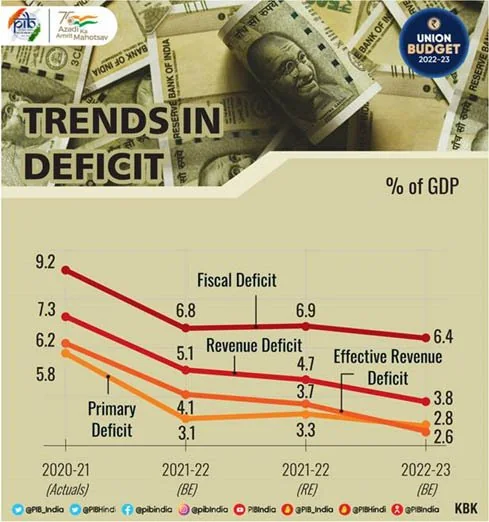
- In the recently announced Union Budget by Union Finance Minister Nirmala Sitharaman informed that the Centre would reduce its fiscal deficit to 5.1% of gross domestic product (GDP) in 202425.
- She also noted that the fiscal deficit would be pared to below 4.5% of GDP by 2025
- The government’s revised estimates also lowered the fiscal deficit projection for 202324 to 5.8% of GDP from initial 5.9% of GDP.
About fiscal deficit:
- Fiscal deficit generally refers to the shortfall in a government’s revenue when compared to its expenditure.
- Normally when a government’s expenditure exceeds its revenues, the government will have to borrow money or have to sell assets to fund the deficit.
- On the other hand when a government runs a fiscal surplus its revenues exceed expenditure.
- However it is quite rare for governments to run a surplus.
- Most governments of the world today focus on keeping the fiscal deficit under control rather than on generating a fiscal surplus or on balancing the budget.
- However it is important to note that the fiscal deficit should not be confused with the national debt.
- The national debt refers to the total amount of money that the government of a country owes its lenders at a particular point in time.
- The national debt is usually the amount of debt that a government has accumulated over the years of running fiscal deficits and borrowing to bridge the same.
- The fiscal deficit is normally expressed as a percentage of a country’s GDP since it is believed that the figure shows how easily the government will be able to pay its lenders.
- In other words, the higher a government’s fiscal deficit as a share of GDP, the less likely is the government debts will be paid back without trouble.
- However it is observed that countries with larger economies can run higher fiscal deficits.
Funding of the fiscal deficit :
- In order to bridge its fiscal deficit, the government mainly borrows money from the bond market where lenders compete to lend to the government by purchasing bonds which are issued by the government.
- It should be noted that central banks such as the Reserve Bank of India (RBI) are also major players in the credit market even though they may not always directly purchase government bonds.
- The RBI may still purchase government bonds in the secondary market that is from private lenders who have already purchased bonds from the government.
- So, when a government borrows from the bond market, it not only borrows from private lenders but also indirectly from the central bank of the country.
- The RBI purchases these bonds through what are called ‘open market operations’ by creating fresh money.
- This fresh money in turn can lead to higher money supply and also higher prices in the wider economy over the time.
- Government bonds are generally considered to be riskfree as the government can under the worstcase scenario get help from the central bank which can create fresh currency to pay off the lenders of the government.
- So governments generally do not find it difficult to borrow money from the market.
- The bigger problem is the rate at which the government are able to borrow the money.
- As a government’s finances worsen demand for the government’s bonds begins to drop which forces the government to offer to pay a higher interest rate to lenders, and leading to higher borrowing costs for the government.
- Monetary policy also plays a crucial role in deciding how much it costs governments to borrow money from the market.
- Central bank lending rates which were near zero in many countries before the pandemic have risen sharply in the aftermath of the pandemic across the globe.
- This makes it more expensive for governments to borrow money and this may be one reason why the Centre is keen to bring down its fiscal deficit.
Importance of Fiscal Deficit:
- The fiscal deficit is important for several reasons.
- There is a strong direct relationship between the government’s fiscal deficit and inflation in the country.
- When a country’s government runs a persistently high fiscal deficit this can eventually lead to higher inflation as the government will be forced to use fresh money issued by the central bank to bridge its fiscal deficit.
- The fiscal deficit recently reached a high of 9.17% of GDP during the pandemic and has since improved significantly and is projected to drop to 5.8% currently.
- The fiscal deficit also signals to the market the degree of fiscal discipline which is maintained by the government.
- A lower fiscal deficit will help improve the ratings assigned to the Indian government’s bonds.
- When the government is able to fund more of its spending through tax revenues and borrow less it gives more confidence to lenders and drives down the government’s borrowing cost.
- A high fiscal deficit also adversely affect the ability of the government to manage its overall public debt.
- In December, the International Monetary Fund warned that India’s public debt could rise to more than 100% of GDP in the medium term due to risks although the Centre disagreed with the assessment.
- It is also worth mentioning that the Centre has been keen on tapping the international bond market.
- A lower fiscal deficit may help the government to more easily sell its bonds overseas and also access cheaper credit.
- Prelims: Key facts, institutions, locations and terminology in the article.
- Mains: Connect the topic with Economy.
- Revision: Use the article headings to prepare concise notes and answer-writing points.
Test your understanding
Questions from this article
Prelims practiceWith reference to Fiscal Deficit and Fiscal Consolidation, consider the following statements:
- In the recently announced Union Budget by Union Finance Minister Nirmala Sitharaman informed that the Centre would reduce its fiscal deficit to 5.1% of gross domestic product (GDP) in 202425.
- She also noted that the fiscal deficit would be pared to below 4.5% of GDP by 2025
- The government’s revised estimates also lowered the fiscal deficit projection for 202324 to 5.8% of GDP from initial 5.9% of GDP.
Which of the statements given above are correct?
- 1 and 2 only
- 2 and 3 only
- 1 and 3 only
- 1, 2 and 3
View answer
Answer: (d) 1, 2 and 3. All three statements are drawn from the article.
Mains practiceDiscuss the background, key issues and significance of Fiscal Deficit and Fiscal Consolidation for India.
Answer in 250 words.
View answer approach
- Context:
- About fiscal deficit:
- Funding of the fiscal deficit :
- Importance of Fiscal Deficit:
Frequently asked questionsFrequently asked questions
Why is Fiscal Deficit And Fiscal Consolidation in the news?
Context: In the recently announced Union Budget by Union Finance Minister Nirmala Sitharaman informed that the Centre would reduce its fiscal deficit to 5.1% of gross domestic product (GDP) in 202425. She also noted that the fiscal deficit would be pared to below 4.5% of GDP by 2025 The government’s revised estimates also lowered the fiscal deficit projection for 202324 to 5.8% of GDP from initial 5.9% of GDP.
What are the key facts about Fiscal Deficit And Fiscal Consolidation?
About fiscal deficit: Fiscal deficit generally refers to the shortfall in a government’s revenue when compared to its expenditure. Normally when a government’s expenditure exceeds its revenues, the government will have to borrow money or have to sell assets to fund the deficit. On the other hand when a government runs a fiscal surplus its revenues exceed expenditure.
Why is Fiscal Deficit And Fiscal Consolidation important for UPSC preparation?
The topic connects current developments with Economy and is relevant for both objective revision and analytical answer writing.