first tranche of data on electoral bonds
disclosed by the Election Commission of India on March 14, 2024, under the directions of the Supreme Court,
provides an incomplete picture of the transactions that have taken place between various companies and individuals on the one hand and registered political parties on the other, between April 12, 2019 and January 24, 2024.
WHAT NOW?
The apex court has now
directed the State Bank of India (SBI) to ensure
“complete disclosure of all details in its possession” by
March 21, 2024 including
“the alphanumeric number and serial number of the Electoral Bonds which were purchased and redeemed”.
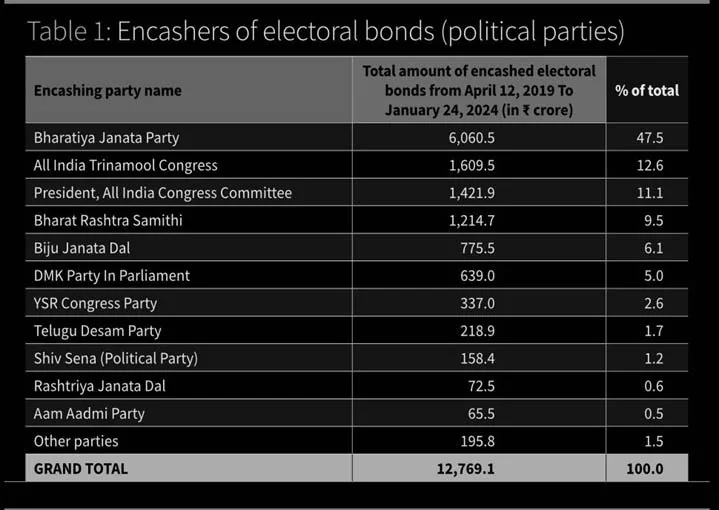
HOW MUCH AMOUNT WAS ENCASHED BY PARTIES?
 WHY ALPHANUMERIC DETAILS ARE IMPORTANT?
The SBI has recorded every detail of
18,871 purchases and 20,421 encashments of electoral bonds between
April 2019 and January 2024. However, in the
absence of the unique alphanumeric numbers,
only the total amount of electoral bonds purchased by
each company or individual can be estimated as also the total amount of electoral bonds each political party has encashed; but it is
impossible to establish who has paid whom and when.
 IS THERE INFORMATION ASYMMETRY?
The
Union Government, as the owner of the
SBI, is already
in possession of the entire electoral bond database, which implies that the
ruling party has access to complete information in this regard. Both the Opposition parties and the electorate, however, do not.
Each political party other than the ruling party, knows about its own transactions only. The
voters have no information beyond what has been disclosed by the Election Commission of India. This information asymmetry provides the ruling party with an undeserved advantage by virtue of its being the ruling incumbent.
THE DATA
The data disclosed so far
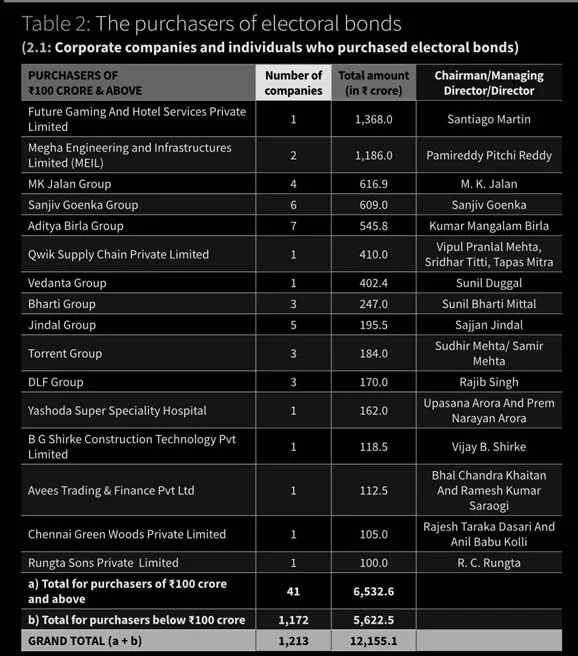
provides ample grounds for suspecting malfeasance. Table provides a list of companies and corporate groups who have purchased electoral bonds worth over
₹100 crore.
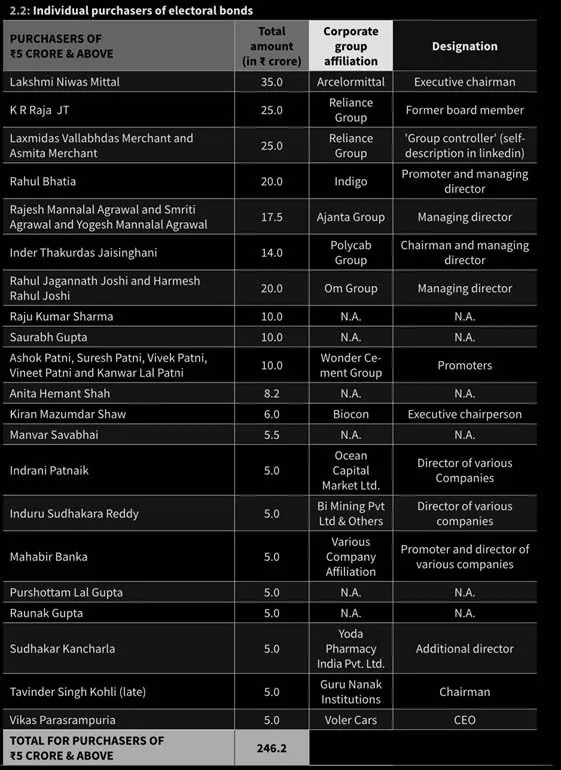
Thus list contains
individuals who have purchased bonds worth
Rs. 5 crore and above.
THE ANALYSIS
(A) Some of the largest purchasers of electoral bonds are
under investigation by central agencies such as the
Enforcement Directorate (ED), Central Bureau of Investigation (CBI) and/or the Income Tax (IT) Department.
(B) If the
bulk of the electoral bonds purchased by these companies, which are under investigation by central agencies like ED, CBI or IT department,
are found to have been redeemed by the party in power, it would
imply serious conflict of interest issues and probable quid pro quo.
(C) The
largest individual purchasers of electoral bonds are either heads of corporate groups and companies or their employees. It is clear that corporate houses and
companies have tried to conceal their identities by deploying individual frontmen or making large donations in multiple small tranches.
This generates suspicion of
large scale bribery, money laundering and other forms of quid pro quo, like award of lucrative project contracts and policy changes in exchange for party donations.
Test your understanding
Questions from this article
Prelims practiceWith reference to ELECTORAL BONDS DATA, consider the following statements:
- first tranche of data on electoral bonds disclosed by the Election Commission of India on March 14, 2024, under the directions of the Supreme Court, provides an incomplete picture of the transactions that have taken place between various companies and…
- The apex court has now directed the State Bank of India (SBI) to ensure “complete disclosure of all details in its possession” by March 21, 2024 including “the alphanumeric number and serial number of the Electoral Bonds which were purchased and redeemed”.
- HOW MUCH AMOUNT WAS ENCASHED BY PARTIES?
Which of the statements given above are correct?
- 1 and 2 only
- 2 and 3 only
- 1 and 3 only
- 1, 2 and 3
View answer
Answer: (d) 1, 2 and 3. All three statements are drawn from the article.
Mains practiceDiscuss the background, key issues and significance of ELECTORAL BONDS DATA for India.
Answer in 250 words.
View answer approach
- HOW MUCH AMOUNT WAS ENCASHED BY PARTIES?
- THE ANALYSIS
- Background and context
- Key facts and institutional framework
- Significance and way forward
Frequently asked questionsFrequently asked questions
Why is Electoral Bonds Data in the news?
first tranche of data on electoral bonds disclosed by the Election Commission of India on March 14, 2024, under the directions of the Supreme Court, provides an incomplete picture of the transactions that have taken place between various companies and… The apex court has now directed the State Bank of India (SBI) to ensure “complete disclosure of all details in its possession” by March 21, 2024 including “the alphanumeric number and serial number of the Electoral Bonds which were purchased and redeemed”.
What are the key facts about Electoral Bonds Data?
HOW MUCH AMOUNT WAS ENCASHED BY PARTIES? WHY ALPHANUMERIC DETAILS ARE IMPORTANT? The SBI has recorded every detail of 18,871 purchases and 20,421 encashments of electoral bonds between April 2019 and January 2024.
Why is Electoral Bonds Data important for UPSC preparation?
The topic connects current developments with Economy, Polity & Governance and is relevant for both objective revision and analytical answer writing.