UPSC Current Affairs
Earthquakes in Afghanistan
Context: An earthquake of magnitude 6.3 struck western Afghanistan on October 15, barely a few days after multiple earthquakes of similar strength killed at least a thousand people in the Herat province. Multiple earthquakes have destroyed entire villages in the country. The UN’s humanitarian office had said earlier that around 1,300 people died, the report added.
VRAuthor Desk
3 min read
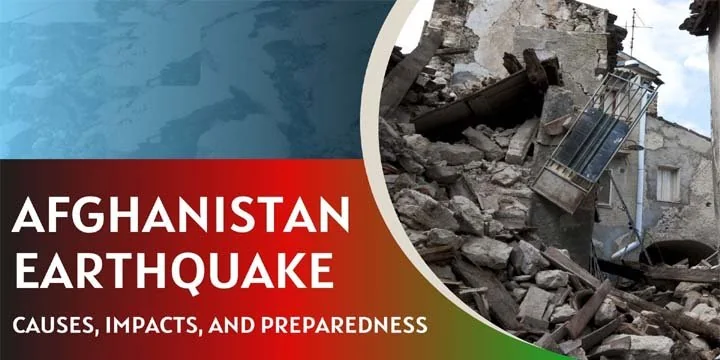
Context: An earthquake of magnitude 6.3 struck western Afghanistan on October 15, barely a few days after multiple earthquakes of similar strength killed at least a thousand people in the Herat province. Multiple earthquakes have destroyed entire villages in the country. The UN’s humanitarian office had said earlier that around 1,300 people died, the report added.
Context:
- An earthquake of magnitude 6.3 struck western Afghanistan on October 15, barely a few days after multiple earthquakes of similar strength killed at least a thousand people in the Herat province.
- Multiple earthquakes have destroyed entire villages in the country.
- The UN’s humanitarian office had said earlier that around 1,300 people died, the report added.
How do earthquakes occur?
- The earth is made up of chunks of solid rocks called tectonic plates.
- Discontinuities in these rock masses, along which they have moved, are called fault lines.
- These fractures are a result of tectonic forces and stress that builds up in the earth’s lithosphere, causing the rocks to break and slip.
- An earthquake occurs when blocks of lithosphere suddenly slip past one another, releasing energy and sending seismic waves through the ground.
- The surface where the lithosphere chunks slip becomes a fault plane.
- The point within the earth where the fault rupture starts and produces an earthquake is called the focus or the hypocentre.
- The point on the surface of the earth directly above it is called the epicentre.
- Tectonic plates are slow moving but are always in motion, mostly due to the heat energy generated inside the earth.
- The edges of these plates are called plate boundaries and consist of faults— this is where most earthquakes occur.
Why do frequent earthquakes occur in Afghanistan?
- Afghanistan is located over multiple fault lines in the region where the Indian and the Eurasian tectonic plates meet.
- These plates collide often, leading to significant tectonic activity.
- Afghanistan is located on the Eurasian plate.
- Towards western Afghanistan, the Arabian plate subducts northward under Eurasia, and towards eastern Afghanistan the Indian plate does the same.
- In southern Afghanistan, the Arabian and Indian plates adjoin and both subduct northward under the Eurasian plate.
- The Hindu Kush mountain range and the Pamir Knot are geologically complex regions where tectonic plates meet.
- The collision and convergence of the Indian Plate and the Eurasian Plate result in the folding and faulting of the Earth’s crust.
- This geological complexity contributes to the occurrence of earthquakes in the region.
- The ongoing northward movement of the Indian Plate towards the Eurasian Plate also results in compression, leading to the uplift of the Himalayas and the transmission of tectonic stress across the entire region, including Afghanistan.
- The compression causes the crust to deform, and creates faults and fractures that can slip and generate earthquakes.
- These interactions at plate boundaries generate significant tectonic stresses and result in earthquakes.
- Afghanistan is also crisscrossed by various active fault systems like the Chaman Fault and the Main Pamir Thrust.
- These faults are the sources of many earthquakes in the region.
Syllabus: Prelims + Mains; GS 1 – Geography
- Prelims: Key facts, institutions, locations and terminology in the article.
- Mains: Connect the topic with Environment, Defence, Polity & Governance.
- Revision: Use the article headings to prepare concise notes and answer-writing points.
Test your understanding
Questions from this article
Prelims practiceWith reference to Earthquakes in Afghanistan, consider the following statements:
- An earthquake of magnitude 6.3 struck western Afghanistan on October 15, barely a few days after multiple earthquakes of similar strength killed at least a thousand people in the Herat province.
- Multiple earthquakes have destroyed entire villages in the country.
- The UN’s humanitarian office had said earlier that around 1,300 people died, the report added.
Which of the statements given above are correct?
- 1 and 2 only
- 2 and 3 only
- 1 and 3 only
- 1, 2 and 3
View answer
Answer: (d) 1, 2 and 3. All three statements are drawn from the article.
Mains practiceDiscuss the background, key issues and significance of Earthquakes in Afghanistan for India.
Answer in 250 words.
View answer approach
- Context:
- How do earthquakes occur?
- Why do frequent earthquakes occur in Afghanistan?
Frequently asked questionsFrequently asked questions
Why is Earthquakes In Afghanistan in the news?
Context: An earthquake of magnitude 6.3 struck western Afghanistan on October 15, barely a few days after multiple earthquakes of similar strength killed at least a thousand people in the Herat province. Multiple earthquakes have destroyed entire villages in the country.
What are the key facts about Earthquakes In Afghanistan?
The UN’s humanitarian office had said earlier that around 1,300 people died, the report added. The earth is made up of chunks of solid rocks called tectonic plates. Discontinuities in these rock masses, along which they have moved, are called fault lines.
Why is Earthquakes In Afghanistan important for UPSC preparation?
The topic connects current developments with Environment, Defence, Polity & Governance and is relevant for both objective revision and analytical answer writing.