found in all living organisms and many minerals. It is
fundamental to life on earth and plays a crucial role in various processes, including
photosynthesis, respiration, and the carbon cycle.
Farming is the practice of cultivating land, raising crops, and/or livestock for food, fibre, fuel, or other resources. It encompasses a wide range of activities, from
planting and harvesting crops to managing livestock and maintaining agricultural infrastructure.
WHAT IS CARBON FARMING?
Carbon farming
combines these two concepts by
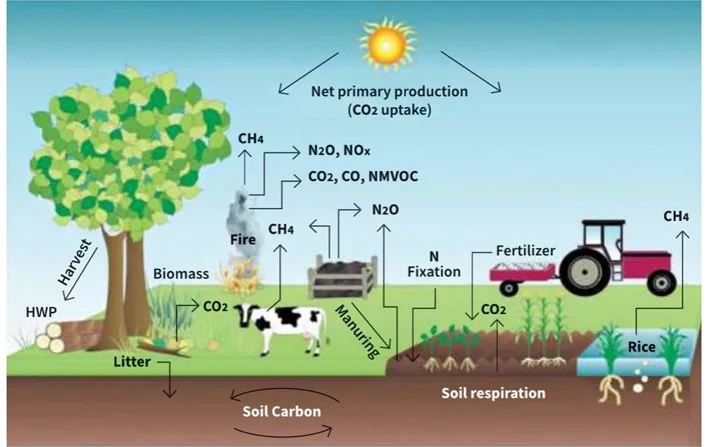
implementing regenerative agricultural practices that restore ecosystem health while improving agricultural productivity and soil health, and mitigating climate change by enhancing carbon storage in agricultural landscapes and reducing greenhouse gas emissions.
The practice is
easy to adopt across various agro-climatic zones. It can also help ameliorate soil degradation, water scarcity, and challenges related to climate variability.
 HOW CAN CARBON FARMING HELP?
A simple implementation of carbon farming is
rotational grazing. Others include
- Agroforestry: including silvopasture and alley cropping — can further diversify farm income by sequestering carbon in trees and shrubs.
- Conservation agriculture: techniques such as zero tillage, crop rotation, cover cropping, and crop residue management (stubble retention and composting) can help minimise soil disturbance and enhance organic content, particularly in places with other intense agricultural activities.
- Integrated nutrient management: Integrated nutrient management practices promote soil fertility and reduce emissions by using organic fertilizers and compost.
- Agro-ecology: crop diversification and intercropping have benefits for ecosystem resilience.
- Livestock management: rotational grazing, optimising feed quality, and managing animal waste can reduce methane emissions and increase the amount of carbon stored away in pasture lands
- land restoration.
FACTORS IMPACTING EFFECTIVITY OF CARBON FARMING
While carbon farming does offer numerous benefits, its effectiveness varies depending on multiple factors —
- Geographical location,
- Soil type,
- Crop selection,
- Water availability,
- Biodiversity, and
- Farm size and scale
- Land management practices
- Sufficient policy support
- Community engagement.
Regions with
long growing seasons,
sufficient rainfall, and
substantial irrigation are best suited to practise carbon farming because they provide the best conditions in which to sequester carbon, through vegetation growth.
CHALLENGES IN CARBON FARMING
- Limited Water Availability: Limited water availability can hinder the growth of plants, thus restricting the potential for sequestration through photosynthesis.
- Lack of adequate knowledge & understanding: Selecting which plants to grow also becomes crucial because not all species trap and store carbon in the same amounts or in an equally effectively manner. Fast-growing trees and deep-rooted perennial grasses tend to be better at this task — but on the flip side, these types of plants may not be well-suited to arid environments.
- Lack of financial assistance: Further, the adoption of carbon farming practices may require financial assistance for farmers to overcome the costs of implementing them.
- Small-scale farmers may lack the resources to invest in sustainable land management practices and environmental services.
GLOBAL PRACTICES
- In recent years, the practice of carbon trading in the agriculture sector has become important around the world, but especially in theS., Australia, New Zealand, and Canada, where voluntary carbon markets have emerged.
- Initiatives like the Chicago Climate Exchange and the Carbon Farming Initiative in Australia demonstrate efforts to incentivise carbon mitigation activities in agriculture.
- Initiatives like Kenya’s Agricultural Carbon Project, which has the World Bank’s support, also highlight the potential for carbon farming to address climate mitigation and adaptation and food security challenges in economically developing countries.
- 4 per thousand initiative: The launch of the ‘4 per 1000’ initiative during the COP21 climate talks in 2015 in Paris highlights the particular role of sinks in mitigating greenhouse-gas emissions. As the oceans and the atmosphere are filled with carbon, and they approach their saturation points, we must manage the remaining carbon budget of 390 billion tonnes or so wisely.
WHAT IS 4 PER THOUSAND INITIATIVE?
Increasing soil carbon worldwide by just
0.4% yearly could
offset that year’s new growth in CO2 emissions from fossil fuel emissions.
It
emphasizes the role of carbon sinks, including those created through
carbon farming practices, in mitigating greenhouse gas emissions.
CARBON FARMING IN INDIA
- Regions with extensive agricultural land, such as
- The Indo-Gangetic plains and the Deccan Plateau, are well suited to adopt carbon farming.
- The mountainous terrain of the Himalayan region is less so.
- Coastal areas are prone to salinisation and have limited access to resources, thus limited the adoption of traditional farming practices.
- Carbon credit systems can incentivise farmers by providing additional income through environmental services.
- Studies have shown agricultural soils can absorb 3-8 billion tonnes of CO2-equivalent every year over 20-30 years. This capacity can bridge the gap between feasible emissions reductions and the indispensable stabilisation of the climate.
Test your understanding
Questions from this article
Prelims practiceWith reference to Carbon Farming, consider the following statements:
- Agroforestry: including silvopasture and alley cropping — can further diversify farm income by sequestering carbon in trees and shrubs.
- Conservation agriculture: techniques such as zero tillage, crop rotation, cover cropping, and crop residue management (stubble retention and composting) can help minimise soil disturbance and enhance organic content…
- Integrated nutrient management: Integrated nutrient management practices promote soil fertility and reduce emissions by using organic fertilizers and compost.
Which of the statements given above are correct?
- 1 and 2 only
- 2 and 3 only
- 1 and 3 only
- 1, 2 and 3
View answer
Answer: (d) 1, 2 and 3. All three statements are drawn from the article.
Mains practiceDiscuss the background, key issues and significance of Carbon Farming for India.
Answer in 250 words.
View answer approach
- CHALLENGES IN CARBON FARMING
- GLOBAL PRACTICES
- CARBON FARMING IN INDIA
Frequently asked questionsFrequently asked questions
Why is Carbon Farming in the news?
found in all living organisms and many minerals. It is fundamental to life on earth and plays a crucial role in various processes, including photosynthesis, respiration, and the carbon cycle.
What are the key facts about Carbon Farming?
Farming is the practice of cultivating land, raising crops, and/or livestock for food, fibre, fuel, or other resources. It encompasses a wide range of activities, from planting and harvesting crops to managing livestock and maintaining agricultural infrastructure. Carbon farming combines these two concepts by implementing regenerative agricultural practices that restore ecosystem health while improving agricultural productivity and soil health, and mitigating climate change by enhancing carbon storage in agricultural…
Why is Carbon Farming important for UPSC preparation?
The topic connects current developments with Environment, Economy, Polity & Governance and is relevant for both objective revision and analytical answer writing.