UPSC Current Affairs
Agriculture Imports & Exports
agricultural exports fell 8.2% in the fiscal year ended March 31, 2024 on the back of shipment curbs on a host of commodities, from cereals and sugar to onions. The value of farm exports totaled $48.82 billion in 2023-24, down from the record $53.15 billion of 2022-23 and $50.24 billion for 2021-22. MAIN DRIVER OF FALLING EXPORTS The fall in exports to have been led primarily by sugar and non-basmati rice.
VRAuthor Desk
3 min read
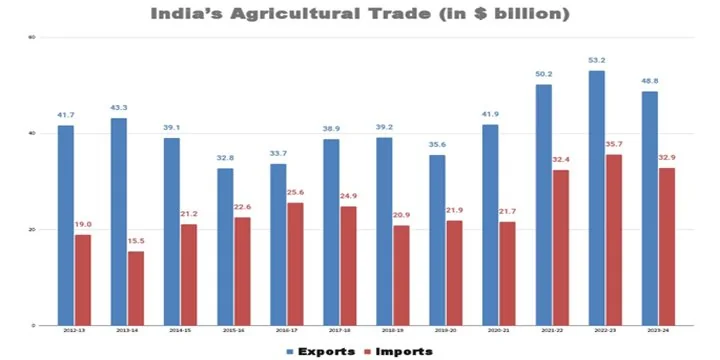
agricultural exports fell 8.2% in the fiscal year ended March 31, 2024 on the back of shipment curbs on a host of commodities, from cereals and sugar to onions. The value of farm exports totaled $48.82 billion in 2023-24, down from the record $53.15 billion of 2022-23 and $50.24 billion for 2021-22. MAIN DRIVER OF FALLING EXPORTS The fall in exports to have been led primarily by sugar and non-basmati rice.
agricultural exports fell 8.2% in the fiscal year ended March 31, 2024 on the back of
shipment curbs on a host of commodities, from cereals and sugar to onions.
WHAT WAS THE VALUE OF EXPORTS?
The value of farm exports totaled
$48.82 billion in 2023-24, down from the record
$53.15 billion of 2022-23 and
$50.24 billion for 2021-22.
MAIN DRIVER OF FALLING EXPORTS
The fall in exports to have been led primarily by
sugar and non-basmati rice.
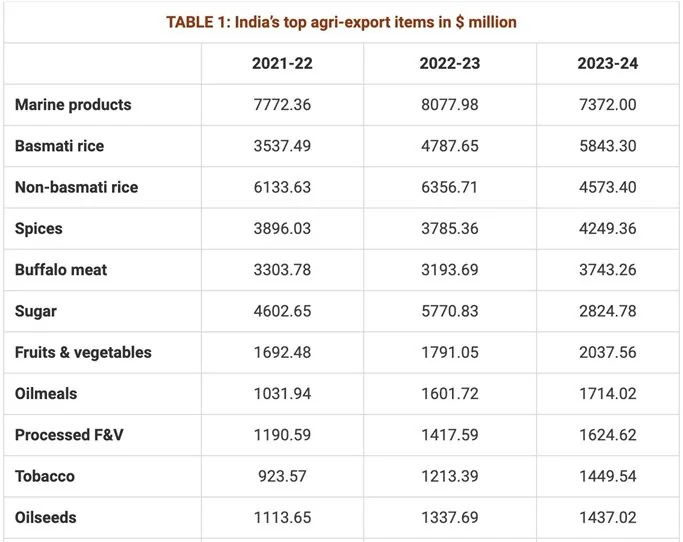
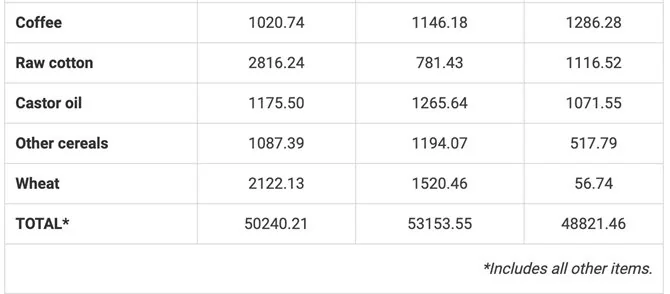
- The government hasn’t allowed any sugar to go out of the country during the current production year from October 2023. Not surprisingly, exports of the sweetener were valued at only $2.82 billion in 2023-24, after peaking at $5.77 billion and $4.60 billion in the preceding fiscals.
- Concerns over domestic availability and food inflation have similarly triggered a ban on exports of all white non-basmati rice since July 2023. Currently, only parboiled grain shipments are being permitted within the non-basmati segment, while also attracting a 20% duty. These restrictions have pulled down overall non-basmati exports from a record $6.36 billion in 2023-23 to $4.57 billion in 2023-24.
OTHER ITEMS OF EXPORT
Most of the other major agri export items —
barring marine products,
castor oil and other cereals (mainly maize) — have posted growth.
- Basmati rice exports fetched $5.84 billion in 2023-24, surpassing the previous high of $4.86 billion achieved back in 2013-14.
- Spices exports, too, crossed the $4 billion mark for the first time.
- On the other hand, exports of buffalo meat, oil meals and raw cotton, even while up over 2022-23, were far from their corresponding records of $4.78 billion, $3.04 billion and $4.33 billion touched in 2014-15, 2012-13 and 2011-12 respectively.
INDIA’S AGRI EXPORTS
 THE REDUCING IMPORTS
The 7.9% dip in overall agri imports during 2023-24 was largely due to a single commodity:
edible oils.
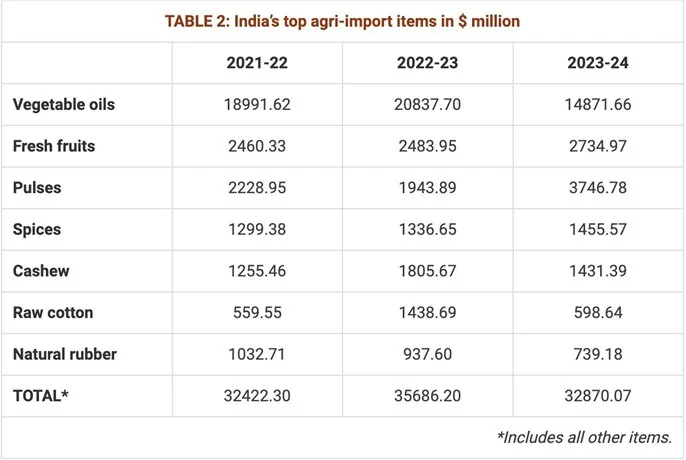
- India’s imports of vegetable fats topped $20 billion in 2022-23. That was the year immediately after the Russia-Ukraine war.
- Lower global prices, in turn, brought down the vegetable oil import bill to below $15 billion during last fiscal.
But even as the
foreign exchange outflow on account of
cooking oil has reduced,
imports of pulses almost doubled to $3.75 billion in 2023-24, the highest since the $3.90 billion and $4.24 billion levels of 2015-16 and 2016-17 respectively.
INDIA’S AGRI IMPORTS
 WAY FORWARD
Farmers and agri-traders, like all businessmen, want policy stability and predictability.
The government taking over post the elections may have to come out with a more rational export-import policy, balancing the interests of producers and consumers as well as the short- and long-term goals for the farm sector.
- Prelims: Key facts, institutions, locations and terminology in the article.
- Mains: Connect the topic with Environment, Economy, International Relations.
- Revision: Use the article headings to prepare concise notes and answer-writing points.
Test your understanding
Questions from this article
Prelims practiceWith reference to Agriculture Imports & Exports, consider the following statements:
- The government hasn’t allowed any sugar to go out of the country during the current production year from October 2023. Not surprisingly, exports of the sweetener were valued at only $2.82 billion in 2023-24, after…
- Concerns over domestic availability and food inflation have similarly triggered a ban on exports of all white non-basmati rice since July 2023. Currently, only parboiled grain shipments are being permitted within the…
- Basmati rice exports fetched $5.84 billion in 2023-24, surpassing the previous high of $4.86 billion achieved back in 2013-14.
Which of the statements given above are correct?
- 1 and 2 only
- 2 and 3 only
- 1 and 3 only
- 1, 2 and 3
View answer
Answer: (d) 1, 2 and 3. All three statements are drawn from the article.
Mains practiceDiscuss the background, key issues and significance of Agriculture Imports & Exports for India.
Answer in 250 words.
View answer approach
- INDIA’S AGRI EXPORTS
- INDIA’S AGRI IMPORTS
- Background and context
- Key facts and institutional framework
- Significance and way forward
Frequently asked questionsFrequently asked questions
Why is Agriculture Imports & Exports in the news?
agricultural exports fell 8.2% in the fiscal year ended March 31, 2024 on the back of shipment curbs on a host of commodities, from cereals and sugar to onions. The value of farm exports totaled $48.82 billion in 2023-24, down from the record $53.15 billion of 2022-23 and $50.24 billion for 2021-22.
What are the key facts about Agriculture Imports & Exports?
MAIN DRIVER OF FALLING EXPORTS The fall in exports to have been led primarily by sugar and non-basmati rice. The government hasn’t allowed any sugar to go out of the country during the current production year from October 2023. Not surprisingly, exports of the sweetener were valued at only $2.82 billion in 2023-24, after peaking at $5.77 billion and $4.60 billion in the preceding fiscals.
Why is Agriculture Imports & Exports important for UPSC preparation?
The topic connects current developments with Environment, Economy, International Relations and is relevant for both objective revision and analytical answer writing.