UPSC Current Affairs
Why is Whale Vomit Worth Millions ?
Ambergris, a waxy substance produced by sperm whales, is a highly expensive natural material. Often referred to as "floating gold," it's a substance that goes from being a byproduct of whale digestion to an ingredient in high-end perfumes. This unique journey and its rarity contribute to its multi-million dollar value.
VRAuthor Desk
3 min read
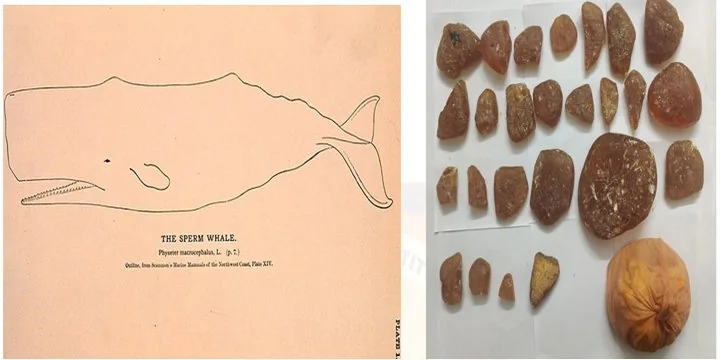
Ambergris, a waxy substance produced by sperm whales, is a highly expensive natural material. Often referred to as "floating gold," it's a substance that goes from being a byproduct of whale digestion to an ingredient in high-end perfumes. This unique journey and its rarity contribute to its multi-million dollar value.
- Ambergris, a waxy substance produced by sperm whales, is a highly expensive natural material.
- Often referred to as "floating gold," it's a substance that goes from being a byproduct of whale digestion to an ingredient in high-end perfumes.
- This unique journey and its rarity contribute to its multi-million dollar value.
WHAT IS AMBERGRIS AND WHERE DOES IT COME FROM?
Ambergris: The ‘Floating Gold’
- Ambergris, meaning "grey amber" in French, is a waxy substance that originates in the digestive system of protected sperm whales.
- It is often wrongly referred to as whale vomit, though it is not the result of vomiting.
- Sperm whales consume large quantities of squid and cuttlefish, much of which cannot be digested.
- While some of this indigestible matter is expelled through vomiting, a portion binds together in the whale's intestines, eventually forming ambergris.
- Occasionally, ambergris is excreted and found floating in the sea.
- However, it can sometimes grow so large that it ruptures the whale's intestines, leading to the whale’s death
FROM SOFT WAXY TO ROCK LIKE TREASURE
- Freshly expelled ambergris: Soft, waxy, and greasy consistency.
- Transformation over time: Exposed to sunlight, saltwater, and air, it undergoes weathering and oxidation.
- Hardened form: Outer layers become crusty and rock-like, while the inside may retain some of its softer, waxier texture. This is the form typically found washed ashore.
WHY IS AMBERGRIS SO EXPENSIVE?
- Ambergris is a rare substance that is highly sought after in the perfume industry.
- It is used as a fixative, which means that it helps to make fragrances last longer on the skin.
- This ability to enhance and prolong scent makes it a highly desirable ingredient in high-end perfumes, which drives its price up significantly.
- Depending on its quality, ambergris can fetch prices up to $40,000 per kilogram.
LEGAL COMPLICATIONS
- Legal Status:
- Legal in some countries (e.g., United Kingdom, New Zealand, France, Switzerland, and Maldives).
- Illegal in others, including India.
- India: Sale and trade of ambergris are strictly prohibited under the Wildlife Protection Act, 1972.
- Reason for prohibition: Sperm whales, the source of ambergris, are an endangered species protected by law. They were declared endangered in 1970 due to hunting and environmental threats.
- Purpose of the ban: To protect sperm whales and discourage any activity that could harm or endanger the whale population.
ABOUT SPERM WHALES
- Sperm whales, also known as cachalots, are the largest of the toothed whale species.
- The name "sperm whale" derives from spermaceti, a waxy substance found in their heads that helps them to focus sound waves, playing a key role in their deep-sea hunting strategies.
- Distribution: found in almost all marine regions.
- Habitat: They inhabit deep marine waters (generally deeper than 1000 meters).
- Threats: Major threats to sperm whales include fishing activities and marine pollution.
CONSERVATION STATUS
- IUCN Red List: Vulnerable
- CITES: Appendix I (prohibits international trade)
- Indian Wildlife Protection Act, 1972: Schedule II (protected species)
- CMS: Appendix I (listed under the Convention on Migratory Species)
- Prelims: Key facts, institutions, locations and terminology in the article.
- Mains: Connect the topic with Polity & Governance.
- Revision: Use the article headings to prepare concise notes and answer-writing points.
Test your understanding
Questions from this article
Prelims practiceWith reference to Why is Whale Vomit Worth Millions ?, consider the following statements:
- Ambergris, a waxy substance produced by sperm whales, is a highly expensive natural material.
- Often referred to as "floating gold," it's a substance that goes from being a byproduct of whale digestion to an ingredient in high-end perfumes.
- This unique journey and its rarity contribute to its multi-million dollar value.
Which of the statements given above are correct?
- 1 and 2 only
- 2 and 3 only
- 1 and 3 only
- 1, 2 and 3
View answer
Answer: (d) 1, 2 and 3. All three statements are drawn from the article.
Mains practiceDiscuss the background, key issues and significance of Why is Whale Vomit Worth Millions ? for India.
Answer in 250 words.
View answer approach
- WHAT IS AMBERGRIS AND WHERE DOES IT COME FROM?
- FROM SOFT WAXY TO ROCK LIKE TREASURE
- WHY IS AMBERGRIS SO EXPENSIVE?
- LEGAL COMPLICATIONS
- ABOUT SPERM WHALES
Frequently asked questionsFrequently asked questions
Why is Why Is Whale Vomit Worth Millions ? in the news?
Ambergris, a waxy substance produced by sperm whales, is a highly expensive natural material. Often referred to as "floating gold," it's a substance that goes from being a byproduct of whale digestion to an ingredient in high-end perfumes.
What are the key facts about Why Is Whale Vomit Worth Millions ??
This unique journey and its rarity contribute to its multi-million dollar value. WHAT IS AMBERGRIS AND WHERE DOES IT COME FROM? Ambergris: The ‘Floating Gold’ Ambergris, meaning "grey amber" in French, is a waxy substance that originates in the digestive system of protected sperm whales.
Why is Why Is Whale Vomit Worth Millions ? important for UPSC preparation?
The topic connects current developments with Polity & Governance and is relevant for both objective revision and analytical answer writing.