UPSC Current Affairs
Why Iraq Is Slowly Sinking ?
The northern region of Iraq, especially around the Zagros Mountains, is slowly sinking. This is due to tectonic processes occurring deep beneath the Earth’s surface, a result of the movement of tectonic plates. The process is gradual, taking millions of years, and while not immediately noticeable, it has significant long-term implications.
VRAuthor Desk
3 min read
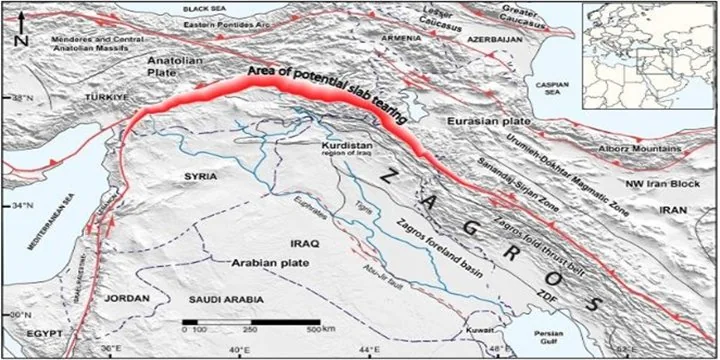
The northern region of Iraq, especially around the Zagros Mountains, is slowly sinking. This is due to tectonic processes occurring deep beneath the Earth’s surface, a result of the movement of tectonic plates. The process is gradual, taking millions of years, and while not immediately noticeable, it has significant long-term implications.
- The northern region of Iraq, especially around the Zagros Mountains, is slowly sinking.
- This is due to tectonic processes occurring deep beneath the Earth’s surface, a result of the movement of tectonic plates.
- The process is gradual, taking millions of years, and while not immediately noticeable, it has significant long-term implications.
WHAT IS HAPPENING GEOLOGICALLY?
- Plate Tectonics and the Neotethys Slab: The sinking of northern Iraq is caused by plate tectonics, the movement of large sections of Earth's surface.
- The region is impacted by the Neotethys slab, an oceanic plate that once formed the floor of an ancient ocean.
- This slab is sinking into the Earth’s mantle due to the collision of the Arabian Plate and the Eurasian Plate.
- Tectonic Collision: The two plates, Arabian and Eurasian, are pushing against each other.
- This collision is causing the Neotethys slab to tear and sink.
- As the slab sinks, the surface above it, including northern Iraq, is gradually pulled downward.
- This process, although slow, leads to the depression of land, which is why the region around the Zagros Mountains has deeper valleys than expected.
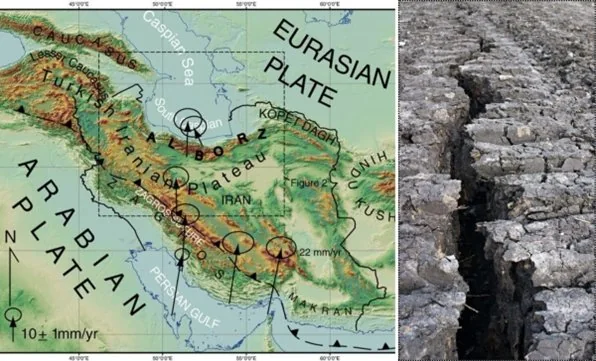
SLOW PROCESS
- Gradual Change: The movement of the Neotethys slab and the sinking of the land above it happen over millions of years.
- The effects of this process are not immediate or noticeable on a human timescale.
- It’s a slow geological event, and its full impact will only be seen over a long period.
HOW THIS SINKING COULD HELP PREDICT EARTHQUAKES
- Earthquakes and Tectonics: The sinking of the Neotethys slab is directly linked to earthquake activity.
- Earthquakes occur when rocks shift along fault lines due to tectonic movements.
- By studying the geological processes beneath the surface, scientists can better understand where and how earthquakes are likely to happen.
- Improved Geological Models: The study of the sinking slab helps scientists create more accurate models of Earth’s interior.
- These models can improve earthquake predictions, allowing scientists to determine the location, depth, and strength of future earthquakes.
- This is especially important for the Middle East, a region prone to earthquakes.
- Relevance to the Region: The research is important for countries like Turkey and Syria, which have experienced devastating earthquakes in recent years.
- Better understanding of tectonic movements could improve early-warning systems and help with disaster preparedness.
GEOTHERMAL ENERGY POTENTIAL
- Geothermal Gradients: The sinking of the Neotethys slab also has implications for geothermal energy.
- The geothermal gradient refers to the increase in Earth’s temperature with depth.
- In areas where the temperature rises quickly, there is potential for geothermal energy production.
- By understanding how the Earth’s surface is changing, scientists can identify regions where geothermal energy might be harnessed to generate electricity. This could provide a sustainable energy source for the region.
CONCLUSION
The slow sinking of northern Iraq is caused by tectonic activity beneath the
Zagros Mountains, a process that will unfold over millions of years. While the effects are not immediately noticeable, the research provides valuable insights into earthquake prediction and geothermal energy.
- Prelims: Key facts, institutions, locations and terminology in the article.
- Mains: Connect the topic with Environment, Economy, Polity & Governance.
- Revision: Use the article headings to prepare concise notes and answer-writing points.
Test your understanding
Questions from this article
Prelims practiceWith reference to Why Iraq Is Slowly Sinking ?, consider the following statements:
- The northern region of Iraq, especially around the Zagros Mountains, is slowly sinking.
- This is due to tectonic processes occurring deep beneath the Earth’s surface, a result of the movement of tectonic plates.
- The process is gradual, taking millions of years, and while not immediately noticeable, it has significant long-term implications.
Which of the statements given above are correct?
- 1 and 2 only
- 2 and 3 only
- 1 and 3 only
- 1, 2 and 3
View answer
Answer: (d) 1, 2 and 3. All three statements are drawn from the article.
Mains practiceDiscuss the background, key issues and significance of Why Iraq Is Slowly Sinking ? for India.
Answer in 250 words.
View answer approach
- WHAT IS HAPPENING GEOLOGICALLY?
- SLOW PROCESS
- HOW THIS SINKING COULD HELP PREDICT EARTHQUAKES
- GEOTHERMAL ENERGY POTENTIAL
Frequently asked questionsFrequently asked questions
Why is Why Iraq Is Slowly Sinking ? in the news?
The northern region of Iraq, especially around the Zagros Mountains, is slowly sinking. This is due to tectonic processes occurring deep beneath the Earth’s surface, a result of the movement of tectonic plates.
What are the key facts about Why Iraq Is Slowly Sinking ??
The process is gradual, taking millions of years, and while not immediately noticeable, it has significant long-term implications. Plate Tectonics and the Neotethys Slab: The sinking of northern Iraq is caused by plate tectonics, the movement of large sections of Earth's surface. The region is impacted by the Neotethys slab, an oceanic plate that once formed the floor of an ancient ocean.
Why is Why Iraq Is Slowly Sinking ? important for UPSC preparation?
The topic connects current developments with Environment, Economy, Polity & Governance and is relevant for both objective revision and analytical answer writing.