UPSC Current Affairs
US SANCTIONS ON RUSSIAN OIL MAJORS
Rosneft and Lukoil — as part of escalating efforts to cut off funding for Russia’s ongoing war in Ukraine. The move has implications for global oil markets, India’s energy strategy, and the India–U.S. BACKGROUND The Russia–Ukraine war, now in its fourth year, continues to strain global diplomacy and energy markets.
VRAuthor Desk
3 min read
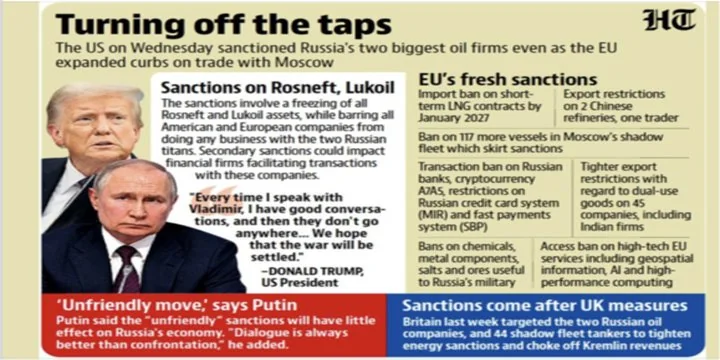
Rosneft and Lukoil — as part of escalating efforts to cut off funding for Russia’s ongoing war in Ukraine. The move has implications for global oil markets, India’s energy strategy, and the India–U.S. BACKGROUND The Russia–Ukraine war, now in its fourth year, continues to strain global diplomacy and energy markets.
Rosneft and Lukoil — as part of escalating efforts to cut off funding for Russia’s ongoing war in Ukraine.
The move has implications for global oil markets, India’s energy strategy, and the India–U.S. relationship.
BACKGROUND
- The Russia–Ukraine war, now in its fourth year, continues to strain global diplomacy and energy markets.
- The new U.S. sanctions target Rosneft and Lukoil, responsible for over 5% of global oil output, contributing over 5 million barrels per day (mbd) globally, including 2 mbd in seaborne exports.
- The U.S. Treasury has given companies time till November 21 to wind down transactions with these entities, to curb Russia’s oil revenue, which funds nearly one-fourth of its federal budget and sustains the war effort.
INDIA’S POSITION & COMPLIANCE
- India’s position:
- India, the second-largest buyer of Russian crude after China (with over 35% of total imports sourced from Russia in 2025), faces pressure to reduce imports.
- Historically, India avoided oil imports from Iran and Venezuela after similar U.S. sanctions, signalling a possible precedent.
- President Trump claimed India has agreed to reduce oil purchases from Russia to “almost nothing” by year-end.
- The Indian PM has reportedly assured cooperation while balancing India’s energy security needs.
- Private refiners’ response:
- Reliance Industries, operating the world’s largest refinery at Jamnagar, plans to halt or reduce imports, including its long-term deal with Rosneft (approx. 500,000 barrels/day).
- Nayara Energy, partly owned by Rosneft, has remained silent but is expected to adjust supply chains.
- Public sector refiners’ review:
- IOC, BPCL, and HPCL are reassessing trade documents to ensure no direct dealings with sanctioned firms.
- However, some oil may still enter India via intermediaries, highlighting challenges in total disengagement.
ECONOMIC & DIPLOMATIC FALLOUT
- Trade tensions:
- The U.S. has doubled tariffs on Indian goods to 50%, adding a 25% punitive duty on Russian crude imports.
- India termed the move “unfair, unjustified, and unreasonable.”
- Negotiations are underway for a bilateral trade deal that could reduce tariffs in exchange for reduced Russian oil imports.
- Impact on global oil markets:
- Oil prices surged 3% following the sanctions.
- The sanctions could disrupt global supply chains, particularly in Asia, where demand remains high.
INTERNATIONAL REACTIONS
- Russia dismissed the sanctions, claiming “immunity” to Western restrictions and pointing out that its revenue comes mainly from taxing output rather than exports.
- Ukraine’s President Volodymyr Zelenskyy welcomed the move but urged for stronger measures to pressure Moscow into a ceasefire.
- The European Union is considering using frozen Russian assets to fund a €140 billion loan for Kyiv’s reconstruction.
STRATEGIC IMPLICATIONS FOR INDIA
- India faces a policy dilemma - balancing strategic autonomy, energy security, and geopolitical alignment.
- The shift could push India to diversify oil imports from Middle Eastern and African suppliers.
- Maintaining stable ties with both Washington and Moscow will test India’s multi-alignment diplomacy.
WHAT SHOULD INDIA DO?
- Diversification of energy sources: Strengthen ties with Gulf nations, the U.S., and Africa for stable supplies.
- Negotiated flexibility: India should seek exemptions or phased compliance from U.S. sanctions.
- Strategic oil reserves: Enhance domestic reserves to cushion against supply disruptions.
- Diplomatic balancing: Continue pursuing strategic autonomy within frameworks like QUAD, SCO and BRICS.
- Prelims: Key facts, institutions, locations and terminology in the article.
- Mains: Connect the topic with Economy, International Relations, Polity & Governance.
- Revision: Use the article headings to prepare concise notes and answer-writing points.
Test your understanding
Questions from this article
Prelims practiceWith reference to US SANCTIONS ON RUSSIAN OIL MAJORS, consider the following statements:
- The Russia–Ukraine war, now in its fourth year, continues to strain global diplomacy and energy markets.
- The new U.S. sanctions target Rosneft and Lukoil, responsible for over 5% of global oil output, contributing over 5 million barrels per day (mbd) globally, including 2 mbd in seaborne exports.
- The U.S. Treasury has given companies time till November 21 to wind down transactions with these entities, to curb Russia’s oil revenue, which funds nearly one-fourth of its federal budget and sustains the war effort.
Which of the statements given above are correct?
- 1 and 2 only
- 2 and 3 only
- 1 and 3 only
- 1, 2 and 3
View answer
Answer: (d) 1, 2 and 3. All three statements are drawn from the article.
Mains practiceDiscuss the background, key issues and significance of US SANCTIONS ON RUSSIAN OIL MAJORS for India.
Answer in 250 words.
View answer approach
- BACKGROUND
- INDIA’S POSITION & COMPLIANCE
- ECONOMIC & DIPLOMATIC FALLOUT
- INTERNATIONAL REACTIONS
- STRATEGIC IMPLICATIONS FOR INDIA
Frequently asked questionsFrequently asked questions
Why is Us Sanctions On Russian Oil Majors in the news?
Rosneft and Lukoil — as part of escalating efforts to cut off funding for Russia’s ongoing war in Ukraine. The move has implications for global oil markets, India’s energy strategy, and the India–U.S.
What are the key facts about Us Sanctions On Russian Oil Majors?
BACKGROUND The Russia–Ukraine war, now in its fourth year, continues to strain global diplomacy and energy markets. sanctions target Rosneft and Lukoil, responsible for over 5% of global oil output, contributing over 5 million barrels per day (mbd) globally, including 2 mbd in seaborne exports. Treasury has given companies time till November 21 to wind down transactions with these entities, to curb Russia’s oil revenue, which funds nearly one-fourth of its federal budget and sustains the war effort.
Why is Us Sanctions On Russian Oil Majors important for UPSC preparation?
The topic connects current developments with Economy, International Relations, Polity & Governance and is relevant for both objective revision and analytical answer writing.