UPSC Current Affairs
Uniform Civil Code Of Uttarakhand
On January 27, 2025, Uttarakhand became the first Indian state post-Independence to implement the Uniform Civil Code (UCC) for all residents, excluding Scheduled Tribes and natives who have migrated out of the state. A 5 member expert committee, led by Former Supreme Court Justice Ranjana Prakash Desai, was formed to draft the legislation. The final report was submitted to Uttarakhand Chief Minister Pushkar Singh Dhami on February 2, 2024.
VRAuthor Desk
4 min read
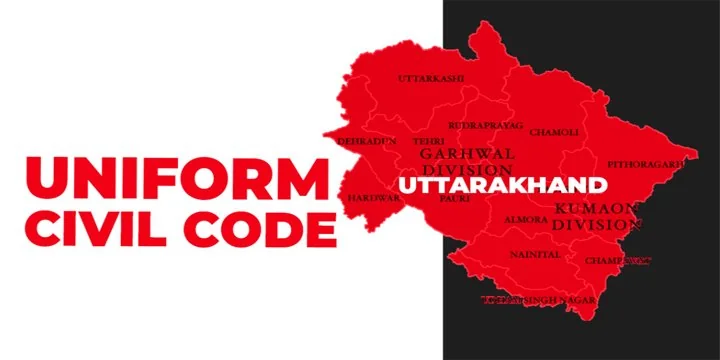
On January 27, 2025, Uttarakhand became the first Indian state post-Independence to implement the Uniform Civil Code (UCC) for all residents, excluding Scheduled Tribes and natives who have migrated out of the state. A 5 member expert committee, led by Former Supreme Court Justice Ranjana Prakash Desai, was formed to draft the legislation. The final report was submitted to Uttarakhand Chief Minister Pushkar Singh Dhami on February 2, 2024.
- On January 27, 2025, Uttarakhand became the first Indian state post-Independence to implement the Uniform Civil Code (UCC) for all residents, excluding Scheduled Tribes and natives who have migrated out of the state.
- A 5 member expert committee, led by Former Supreme Court Justice Ranjana Prakash Desai, was formed to draft the legislation.
- The final report was submitted to Uttarakhand Chief Minister Pushkar Singh Dhami on February 2, 2024.
- After that, the UCC Bill was passed in the Uttarakhand Assembly during the February 2024
- However, Goa remains the only state in India where a UCC is already in force, based on the Portuguese Civil Code of 1867.
WHAT IS A UNIFORM CIVIL CODE?
- The Uniform Civil Code (UCC) refers to a single set of laws that govern personal matters like marriage, divorce, inheritance, and adoption for all citizens, regardless of their religion.
- It is mentioned in Article 44 of the Indian Constitution as a Directive Principle of State Policy (DPSP).
- However, the implementation of UCC is not legally enforceable by the courts.
HISTORICAL CONTEXT
- British Era: The British introduced uniform criminal laws but allowed communities to follow their own personal laws.
- Constituent Assembly Debates: Proponents of the UCC, including R. Ambedkar, argued that it was essential to promote equality, while some Muslim leaders expressed concerns about its impact on their personal laws.
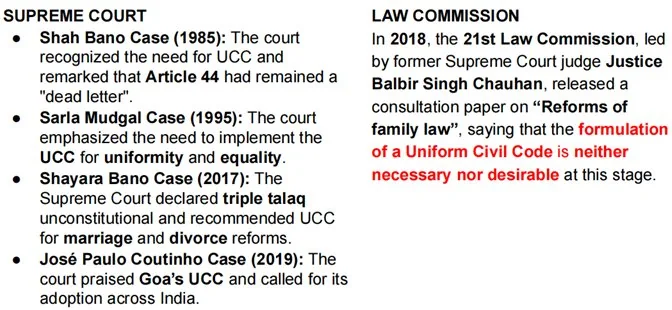
SUPREME COURT’S & LAW COMMISSION’S STANCE OF UCC
KEY FEATURES OF THE UTTARAKHAND UCC
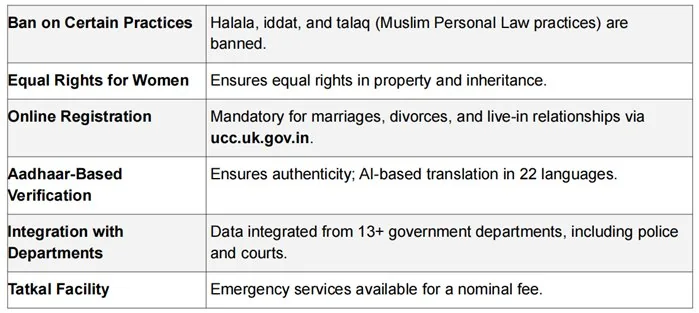
- Halala: a practice in which a woman is required to marry another man and then divorce him before she can remarry her previous husband.
- Iddat: a period of waiting for a woman after divorce or widowhood before she can remarry.
- Talaq: a form of divorce in Muslim Personal Law where a husband can divorce his wife by pronouncing the word "talaq" 3 times.
- In August, 2017, the Supreme Court of India declared the practice of Triple Talaq unconstitutional.
- Following that, in 2019, the Parliament passed the "Muslim Women (Protection of Rights on Marriage) Act, 2019", making it a punishable offense effective from August 1, 2019.
IMPLEMENTATION TIMELINE
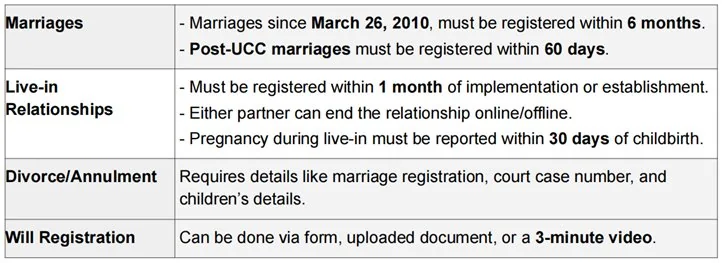
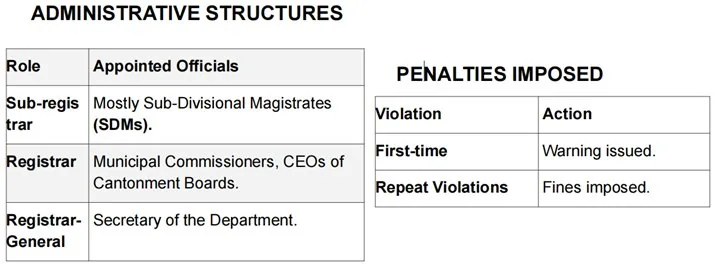
- Applications are examined within 15 days (or 3 days in emergencies).
- Appeals against rejections can be made to the registrar within 30 days, and further to the registrar-general within 30 days.
SIGNIFICANCE OF UCC
- Unity and Belonging: The UCC would help unite all citizens and promote a sense of belonging.
- Reducing Conflicts: It could reduce conflicts arising from different personal laws.
- Principles of Equality: The UCC would support the principles of equality, fraternity, and dignity.
- Equal Rights: It would provide equal rights in marriage, divorce, inheritance, adoption, and maintenance.
- Women’s Rights: The UCC would help women challenge unfair practices and ensure their fundamental rights.
- Modernizing Laws: It would modernize outdated practices in personal laws.
- Human Rights: It would remove practices like triple talaq, polygamy, and child marriage that violate human rights.
- Transparency: The online portal ensures transparency and reduces bureaucratic hurdles.
- Precedent for Other States: It sets a precedent for other states to adopt similar reforms.
CHALLENGES & CRITICISMS
- Exclusion of Scheduled Tribes: The exclusion of Scheduled Tribes raises questions about the universality of the UCC.
- Privacy Concerns: Mandatory registration and Aadhaar-based verification may raise privacy
- Religious Practices: The ban on certain religious practices has been criticized as an infringement on personal laws.
HAS ANY COUNTRY FULLY IMPLEMENTED UCC?
No country fully implements a uniform civil code across all areas of law, but many have adopted uniform laws in specific areas such as
criminal law,
contract law, and
property rights.
Examples:
- France: Napoleonic Code (1804) applies uniformly to all citizens, covering property, civil rights, and family law, with minor regional exceptions.
- Germany: German Civil Code (BGB) (1900) unifies personal and civil law for all citizens, with some special provisions for certain groups.
- Turkey: Turkish Civil Code (1926), inspired by Swiss law, replaced Islamic law for family matters, though some Islamic law elements remain.
- United States: Federal laws are unified, but family law varies by state.
- Egypt: Civil code applies to all citizens but incorporates Islamic law in family matters.
- Indonesia: Legal system combines civil, customary, and Islamic law; efforts made to harmonize laws for greater equality.
- Prelims: Key facts, institutions, locations and terminology in the article.
- Mains: Connect the topic with International Relations, Polity & Governance.
- Revision: Use the article headings to prepare concise notes and answer-writing points.
Test your understanding
Questions from this article
Prelims practiceWith reference to Uniform Civil Code Of Uttarakhand, consider the following statements:
- On January 27, 2025, Uttarakhand became the first Indian state post-Independence to implement the Uniform Civil Code (UCC) for all residents, excluding Scheduled Tribes and natives who have migrated out of the state.
- A 5 member expert committee, led by Former Supreme Court Justice Ranjana Prakash Desai, was formed to draft the legislation.
- The final report was submitted to Uttarakhand Chief Minister Pushkar Singh Dhami on February 2, 2024.
Which of the statements given above are correct?
- 1 and 2 only
- 2 and 3 only
- 1 and 3 only
- 1, 2 and 3
View answer
Answer: (d) 1, 2 and 3. All three statements are drawn from the article.
Mains practiceDiscuss the background, key issues and significance of Uniform Civil Code Of Uttarakhand for India.
Answer in 250 words.
View answer approach
- WHAT IS A UNIFORM CIVIL CODE?
- HISTORICAL CONTEXT
- SUPREME COURT’S & LAW COMMISSION’S STANCE OF UCC
- KEY FEATURES OF THE UTTARAKHAND UCC
- IMPLEMENTATION TIMELINE
Frequently asked questionsFrequently asked questions
Why is Uniform Civil Code Of Uttarakhand in the news?
On January 27, 2025, Uttarakhand became the first Indian state post-Independence to implement the Uniform Civil Code (UCC) for all residents, excluding Scheduled Tribes and natives who have migrated out of the state. A 5 member expert committee, led by Former Supreme Court Justice Ranjana Prakash Desai, was formed to draft the legislation.
What are the key facts about Uniform Civil Code Of Uttarakhand?
The final report was submitted to Uttarakhand Chief Minister Pushkar Singh Dhami on February 2, 2024. After that, the UCC Bill was passed in the Uttarakhand Assembly during the February 2024 However, Goa remains the only state in India where a UCC is already in force, based on the Portuguese Civil Code of 1867. The Uniform Civil Code (UCC) refers to a single set of laws that govern personal matters like marriage, divorce, inheritance, and adoption for all citizens, regardless of their religion.
Why is Uniform Civil Code Of Uttarakhand important for UPSC preparation?
The topic connects current developments with International Relations, Polity & Governance and is relevant for both objective revision and analytical answer writing.