UPSC Current Affairs
TOTAL LUNAR ECLIPSE
Context: A total lunar eclipse occurred during the night of September 7–8, 2025, and was visible across most of Asia, Europe, Australia, and Africa. The Moon appeared deep red, leading to its popular description as a “Blood Moon.” This eclipse gained prominence because: It was visible to approximately 77% of the global population. It coincided with the Moon nearing perigee, making it appear larger than usual.
VRAuthor Desk
3 min read

Context: A total lunar eclipse occurred during the night of September 7–8, 2025, and was visible across most of Asia, Europe, Australia, and Africa. The Moon appeared deep red, leading to its popular description as a “Blood Moon.” This eclipse gained prominence because: It was visible to approximately 77% of the global population. It coincided with the Moon nearing perigee, making it appear larger than usual.
Context:
- A total lunar eclipse occurred during the night of September 7–8, 2025, and was visible across most of Asia, Europe, Australia, and Africa.
- The Moon appeared deep red, leading to its popular description as a “Blood Moon.”
- This eclipse gained prominence because:
- It was visible to approximately 77% of the global population.
- It coincided with the Moon nearing perigee, making it appear larger than usual.
- It provided a rare astronomical event combining scientific relevance with public interest.
WHAT IS TOTAL LUNAR ECLIPSE?
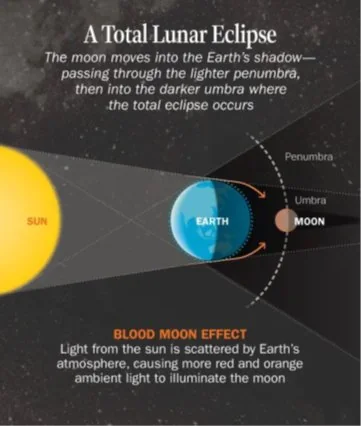
- A lunar eclipse occurs when the Earth comes directly between the Sun and the Moon, casting its shadow on the Moon.
- A total lunar eclipse happens when the entire Moon passes through Earth's umbral shadow, blocking all direct sunlight.
- During this event, the Moon appears reddish-orange rather than going completely dark.
- This happens because some sunlight, especially in the red part of the spectrum, gets bent and filtered by Earth’s atmosphere and reaches the Moon.
SCIENTIFIC CONCEPTS EXPLAINED
1. Umbra
- The umbra is the central, darkest part of Earth's shadow.
- During a total lunar eclipse, the Moon moves entirely into this region.
- No direct sunlight reaches the Moon in this zone, which is why it darkens and takes on a red hue.
2. Penumbra
- The penumbra is the outer, lighter part of Earth's shadow.
- When the Moon enters the penumbra, it dims slightly, but does not turn red or experience total darkness.
- A penumbral lunar eclipse occurs when the Moon only passes through this lighter shadow.
3. Perigee
- The Moon's orbit around Earth is elliptical, not perfectly circular.
- Perigee is the point in this orbit where the Moon is closest to Earth.
- A “Supermoon” occurs when a full moon coincides with or is near perigee, making it appear larger and brighter than usual.
- The September 2025 eclipse occurred just 2.7 days before perigee, so the Moon appeared slightly larger.
KEY FEATURES OF 2025 ECLIPSE
| Feature |
Details |
| Type |
Total Lunar Eclipse |
| Date |
Night of September 7–8, 2025 |
| Peak Time (EDT) |
5:11 PM EDT (2:41 AM IST on Sept 8) |
| Duration of Totality |
82 minutes |
| Global Visibility |
Visible in Asia, Europe, Australia, Africa |
| Population Coverage |
Over 77% of the global population could witness the total phase |
| Orbital Position |
Occurred just 2.7 days before perigee, making the Moon appear larger |
WHY IS IT CALLED BLOOD MOON?
- The term "Blood Moon" refers to the reddish color the Moon takes during totality.
- This happens because Earth’s atmosphere filters out blue light and bends red light into the umbral shadow, causing the Moon to glow red.
- The intensity of the color depends on atmospheric conditions such as dust, clouds, or pollution.
WHY IS THIS SIGNIFICANT?
- Safe to View: Unlike solar eclipses, lunar eclipses pose no danger to the eyes and can be viewed with the naked eye.
- Educational Opportunity: Promotes awareness and interest in astronomical phenomena.
- Cultural and Historical Value: Eclipses have been significant in various civilizations for centuries.
- Scientific Observation: Allows study of Earth's atmosphere, as the Moon's color can reveal details about particles present in the air.
- Prelims: Key facts, institutions, locations and terminology in the article.
- Mains: Connect the topic with Economy.
- Revision: Use the article headings to prepare concise notes and answer-writing points.
Test your understanding
Questions from this article
Prelims practiceWith reference to TOTAL LUNAR ECLIPSE, consider the following statements:
- A total lunar eclipse occurred during the night of September 7–8, 2025, and was visible across most of Asia, Europe, Australia, and Africa.
- The Moon appeared deep red, leading to its popular description as a “Blood Moon.”
- This eclipse gained prominence because: It was visible to approximately 77% of the global population. It coincided with the Moon nearing perigee, making it appear larger than usual. It provided a rare astronomical event…
Which of the statements given above are correct?
- 1 and 2 only
- 2 and 3 only
- 1 and 3 only
- 1, 2 and 3
View answer
Answer: (d) 1, 2 and 3. All three statements are drawn from the article.
Mains practiceDiscuss the background, key issues and significance of TOTAL LUNAR ECLIPSE for India.
Answer in 250 words.
View answer approach
- Context:
- WHAT IS TOTAL LUNAR ECLIPSE?
- SCIENTIFIC CONCEPTS EXPLAINED
- KEY FEATURES OF 2025 ECLIPSE
- WHY IS IT CALLED BLOOD MOON?
Frequently asked questionsFrequently asked questions
Why is Total Lunar Eclipse in the news?
Context: A total lunar eclipse occurred during the night of September 7–8, 2025, and was visible across most of Asia, Europe, Australia, and Africa. The Moon appeared deep red, leading to its popular description as a “Blood Moon.” This eclipse gained prominence because: It was visible to approximately 77% of the global population.
What are the key facts about Total Lunar Eclipse?
It coincided with the Moon nearing perigee, making it appear larger than usual. It provided a rare astronomical event combining scientific relevance with public interest. A lunar eclipse occurs when the Earth comes directly between the Sun and the Moon, casting its shadow on the Moon.
Why is Total Lunar Eclipse important for UPSC preparation?
The topic connects current developments with Economy and is relevant for both objective revision and analytical answer writing.