UPSC Current Affairs
STRAIT OF HORMUZ CLOSURE THREAT
airstrikes on Iran’s nuclear facilities Reaction: Iran’s Parliament passed a motion recommending closure of the Strait of Hormuz WHY IN NEWS? military strikes on Iran’s nuclear facilities, Iran’s Parliament approved a resolution to close the Strait of Hormuz as retaliation. The final decision rests with Iran’s Supreme National Security Council, which operates under the Supreme Leader.
VRAuthor Desk
4 min read
airstrikes on Iran’s nuclear facilities Reaction: Iran’s Parliament passed a motion recommending closure of the Strait of Hormuz WHY IN NEWS? military strikes on Iran’s nuclear facilities, Iran’s Parliament approved a resolution to close the Strait of Hormuz as retaliation. The final decision rests with Iran’s Supreme National Security Council, which operates under the Supreme Leader.
Context: June 2025
Trigger: U.S. airstrikes on Iran’s nuclear facilities
Reaction: Iran’s Parliament passed a motion recommending closure of the Strait of Hormuz
WHY IN NEWS?
- In June 2025, following U.S. military strikes on Iran’s nuclear facilities, Iran’s Parliament approved a resolution to close the Strait of Hormuz as retaliation.
- The final decision rests with Iran’s Supreme National Security Council, which operates under the Supreme Leader.
- This move has raised global concerns about oil supply disruptions and economic instability.
ABOUT STRAIT OF HORMUZ
| Feature |
Details |
| Location |
Between Iran (north) and Oman & UAE (south) |
| Width |
~50 km at entrance; ~33 km at narrowest point |
| Function |
Connects Persian Gulf to Gulf of Oman and Arabian Sea |
| Legal Status |
Lies within territorial waters of Iran and Oman |
| Importance |
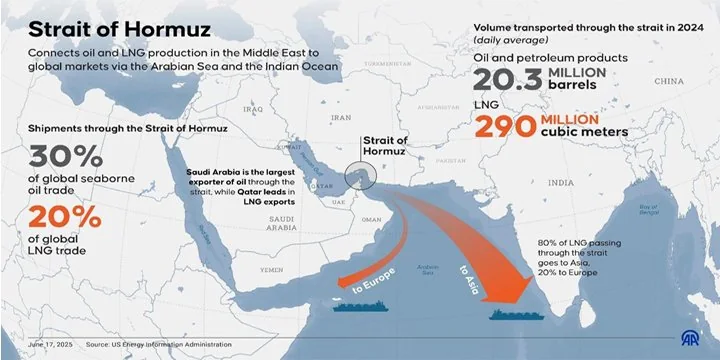
World’s busiest oil transit chokepoint |
| Volume of Trade |
~20 million barrels/day (~20% of global oil supply) |
| Annual Value |
~$600 billion in oil and gas trade (U.S. EIA estimate) |
| Main Exporters |
Iran, Iraq, Saudi Arabia, UAE, Kuwait, Qatar |
| Main Importers |
India, China, Japan, South Korea |
WHAT COULD HAPPEN IF THE STRAIT IS CLOSED?
1. Oil Prices Could Surge
- Oil prices may jump from $77 to $120–$150 per barrel.
- This would raise fuel costs globally and affect domestic inflation in many countries.
2. Stock Markets and Trade Would Suffer
- Global stock markets may react negatively due to uncertainty.
- Central banks could revise inflation and interest rate outlooks.
3. Global Supply Chains Will Be Affected
- Increased shipping times (10–14 days longer via Cape of Good Hope).
- Higher freight and insurance costs, especially for oil shipments.
4. Higher Costs for Manufacturing Countries
- Countries like India, China, Japan, and South Korea will face higher energy and manufacturing costs.
- These costs will be passed on to consumers, increasing global inflation.
IMPACT ON INDIA
India’s Oil Dependency
- India imports ~88% of its crude oil needs.
- India consumes ~5.5 million barrels per day (bpd).
- 1.5 to 2 million bpd comes through the Strait of Hormuz.
- ~4 million bpd comes via other global routes.
BREAKDOWN OF IMPORT ROUTES (KPLER ESTIMATES)
| Route |
Share of Imports |
Main Source Countries |
| Strait of Hormuz |
~40% |
Iraq, Saudi Arabia, UAE, Kuwait |
| Suez Canal |
~33% |
Russia |
| Cape of Good Hope |
~17% |
West Africa, Americas |
| Other Routes |
~10% |
Southeast Asia, Far East |
KEY RISKS FOR INDIA
| Risk Category |
Specific Effects |
| Oil Price Hike |
Increased import bill, inflation, fiscal burden |
| Freight & Insurance |
Longer routes ? Higher transport costs and delivery delays |
| Currency Depreciation |
Pressure on rupee ? Wider current account deficit |
| Trade Disruption |
Container shortages may affect exports and imports (esp. Europe-Asia corridor) |
WHAT DID INDIA’S OIL MINISTER SAY?
Minister Hardeep Singh Puri (June 23, 2025):
- “We have diversified our oil sources in the past few years.
- A large volume of our supplies no longer come through the Strait of Hormuz.
- Our Oil Marketing Companies have supplies for several weeks and continue to receive energy through several routes.”
The Minister also:
- Held a high-level security review with officials from the Navy, Coast Guard, ONGC, and Defence Ministry.
- Reaffirmed the government’s commitment to ensure uninterrupted fuel supply.
HOW COULD IRAN BLOCK THE STRAIT?
| Method |
Description |
| Naval Mines |
Laid using submarines or small attack boats |
| IRGC Fast Boats |
Swarm attacks using speedboats with anti-ship missiles |
| Submarine Warfare |
Attacks on commercial or military vessels using submarines |
| Semi-submersibles |
Hard-to-detect vessels targeting oil tankers |
: In the 1980s,
during the Iran–Iraq war, similar tactics led to the
"Tanker War" where both nations attacked commercial oil shipments.
U.S. Response:
- Fifth Fleet is stationed in Bahrain.
- Past success: Operation Earnest Will (1987–88) safely escorted Kuwaiti oil tankers.
WILL IRAN ACTUALLY CROSS THE STRAIT?
| Factor |
Explanation |
| Loss of Own Oil Revenue |
Iran earns ~$67 billion from oil exports (FY 2024–25) |
| China is a Key Buyer |
China buys ~90% of Iranian oil – would be negatively impacted |
| Diplomatic Isolation |
Gulf countries (Saudi Arabia, UAE) may turn hostile |
| U.S. and Allied Response |
Risk of direct military conflict |
| Gulf Normalization Setback |
Iran’s recent regional diplomacy could collapse |
ARE THERE ANY EXPORT ROUTES?
| Country |
Pipeline Name |
Capacity (approx.) |
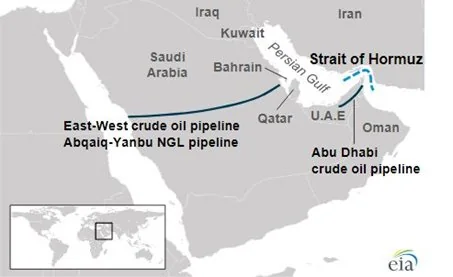
| Saudi Arabia |
East–West Pipeline (Petroline) |
5 million barrels/day |
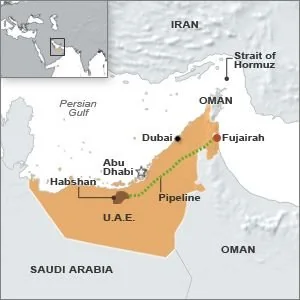
| UAE |
Habshan–Fujairah Pipeline |
1.5 million barrels/day |
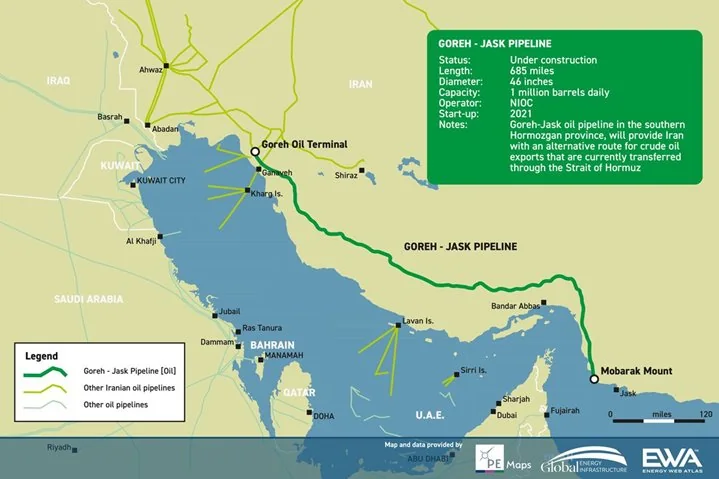
| Iran |
Goreh–Jask Pipeline |
~350,000 barrels/day |
: These
can handle ~3.5 million bpd, while the Strait handles
~20 million bpd.
- Prelims: Key facts, institutions, locations and terminology in the article.
- Mains: Connect the topic with Economy, International Relations, Defence.
- Revision: Use the article headings to prepare concise notes and answer-writing points.
Test your understanding
Questions from this article
Prelims practiceWith reference to STRAIT OF HORMUZ CLOSURE THREAT, consider the following statements:
- In June 2025, following U.S. military strikes on Iran’s nuclear facilities, Iran’s Parliament approved a resolution to close the Strait of Hormuz as retaliation.
- The final decision rests with Iran’s Supreme National Security Council, which operates under the Supreme Leader.
- This move has raised global concerns about oil supply disruptions and economic instability.
Which of the statements given above are correct?
- 1 and 2 only
- 2 and 3 only
- 1 and 3 only
- 1, 2 and 3
View answer
Answer: (d) 1, 2 and 3. All three statements are drawn from the article.
Mains practiceDiscuss the background, key issues and significance of STRAIT OF HORMUZ CLOSURE THREAT for India.
Answer in 250 words.
View answer approach
- WHY IN NEWS?
- ABOUT STRAIT OF HORMUZ
- WHAT COULD HAPPEN IF THE STRAIT IS CLOSED?
- IMPACT ON INDIA
- BREAKDOWN OF IMPORT ROUTES (KPLER ESTIMATES)
Frequently asked questionsFrequently asked questions
Why is Strait Of Hormuz Closure Threat in the news?
airstrikes on Iran’s nuclear facilities Reaction: Iran’s Parliament passed a motion recommending closure of the Strait of Hormuz WHY IN NEWS? military strikes on Iran’s nuclear facilities, Iran’s Parliament approved a resolution to close the Strait of Hormuz as retaliation.
What are the key facts about Strait Of Hormuz Closure Threat?
The final decision rests with Iran’s Supreme National Security Council, which operates under the Supreme Leader. This move has raised global concerns about oil supply disruptions and economic instability. ABOUT STRAIT OF HORMUZ Feature Details Location Between Iran (north) and Oman & UAE (south) Width ~50 km at entrance; ~33 km at narrowest point Function Connects Persian Gulf to Gulf of Oman and Arabian Sea Legal Status Lies within territorial waters of Iran…
Why is Strait Of Hormuz Closure Threat important for UPSC preparation?
The topic connects current developments with Economy, International Relations, Defence and is relevant for both objective revision and analytical answer writing.