UPSC Current Affairs
SECONDARY POLLUTANTS & PM 2.5 POLLUTANTS IN INDIA
Context: A recent study by the Centre for Research on Energy and Clean Air (CREA) reveals that secondary pollutants, particularly ammonium sulphate, are responsible for nearly one-third of India’s fine particulate matter (PM2.5) pollution. This highlights a critical, often overlooked, aspect of India's air pollution crisis. PRIMARY V/S SECONDARY POLLUTANTS Primary Pollutants: These are air pollutants emitted directly into the atmosphere from a source.
VRAuthor Desk
4 min read
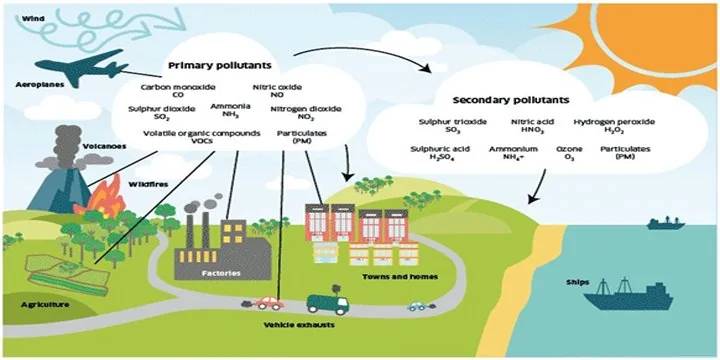
Context: A recent study by the Centre for Research on Energy and Clean Air (CREA) reveals that secondary pollutants, particularly ammonium sulphate, are responsible for nearly one-third of India’s fine particulate matter (PM2.5) pollution. This highlights a critical, often overlooked, aspect of India's air pollution crisis. PRIMARY V/S SECONDARY POLLUTANTS Primary Pollutants: These are air pollutants emitted directly into the atmosphere from a source.
Context:
- A recent study by the Centre for Research on Energy and Clean Air (CREA) reveals that secondary pollutants, particularly ammonium sulphate, are responsible for nearly one-third of India’s fine particulate matter (PM2.5) pollution.
- This highlights a critical, often overlooked, aspect of India's air pollution crisis.
PRIMARY V/S SECONDARY POLLUTANTS
- Primary Pollutants: These are air pollutants emitted directly into the atmosphere from a source. Examples include:
- Sulphur dioxide (SO2) from coal burning.
- Nitrogen oxides (NOx) from vehicle exhaust and industries.
- Carbon monoxide (CO) and particulate matter (soot, dust) from burning fossil fuels and organic matter.
- Ammonia (NH3) from agriculture.
- Secondary Pollutants: These are not directly emitted from a source.
- Instead, they form in the atmosphere when primary pollutants react with each other or with other atmospheric components like gases, water vapor, and sunlight.
- These reactions create more complex and often more harmful particles.
- Examples include:
- Ammonium Sulphate: Formed from the reaction of Sulphur dioxide (SO2) and Ammonia (NH3).
- Ammonium Nitrate: Formed from the reaction of Nitrogen oxides (NOx) and Ammonia (NH3).
- Ozone (O3) at ground level.
- Sulphuric acid and nitric acid (components of acid rain).
KEY FINDINGS OF THE CREA STUDY
- Significant Contribution: Secondary pollutants, specifically ammonium sulphate, account for approximately 34% of India’s overall PM2.5 mass, representing nearly one-third of the country's fine particulate pollution.
- When other secondary pollutants like ammonium nitrate are included, secondary particles can contribute up to 50% of the PM2.5 mass in some areas.
- Methodology: The CREA findings are based on a combination of satellite-data imagery and advanced atmospheric modeling analysis.
- Widespread Presence & Transboundary Nature:
- The nationwide average concentration of ammonium sulphate in India is 11.9 µg/m³.
- Its widespread presence has been observed across a large number of cities, irrespective of their proximity to major emission sources.
- This is due to the trans-boundary nature of pollution, meaning these secondary particles can travel long distances, affecting areas far from their original sources.
- Coal Power Plants as Major Source:
- The main driver of ammonium sulphate formation is sulphur dioxide (SO2) emissions.
- More than 60% of SO2 emissions in India originate from coal-fired thermal power plants.
- This makes these power plants a critical target for reducing secondary PM2.5 pollution.
- Local and Regional Impact:
- Ammonium sulphate concentrations are significantly higher closer to coal plants: 2.5 times higher within 10 km of coal-fired power plants (15 µg/m³) compared to areas beyond 10 km (6 µg/m³).
- While its contribution to PM2.5 is 36% near coal-fired thermal power plants, it remains substantial at 23% in other areas, clearly indicating both local and trans-boundary impacts of SO2 emissions.
IMPLICATIONS FOR AIR POLLUTION CONTROL
- Flue Gas Desulphurisation (FGD) Systems: The report highlights that implementing Flue Gas Desulphurisation (FGD) systems in coal-fired thermal power plants is crucial for reducing SO2 emissions and, consequently, secondary PM2.5 pollution.
- FGD technology removes sulphur compounds (like SO2) from exhaust gases before they are released into the atmosphere.
- Though it is mandatory for Indian coal thermal plants to install such units, the study notes that only about 8% have actually installed them.
- There are also concerns that the government is considering doing away with this requirement, which could severely undermine efforts to control air pollution.
- National Clean Air Programme (NCAP) Cities:
- Across the 130 cities designated under the National Clean Air Programme (NCAP), concentrations of ammonium sulphate ranged from 3.9 to 22.5 µg/m³.
- The share of PM2.5 from ammonium sulphate in these cities varied between 20% and 43%.
- Notably, ammonium sulphate constituted more than 30% of the total PM2.5 levels in 114 out of 130 NCAP cities.
- NCAP aims to reduce PM2.5 and PM10 concentrations by a certain percentage by 2025-26 (original target was 20-30% by 2024, now updated to 40% reduction by 2026, using 2017 as base year).
- Recommendations for Mitigation: An analyst at CREA, emphasizes the need for:
- Targeted strategies: Such as deploying FGD in coal-fired thermal power plants to reduce sulphur dioxide and promoting efficient fertilizer management to reduce ammonia emissions (a source of NH3).
- Full compliance: Ensuring all polluting sectors fully comply with existing emission norms.
- Source-specific actions and regulatory compliance: Are critical for reducing precursor gas emissions and effectively tackling the growing burden of secondary PM2.5 pollution in India.
BROADER SIGNIFICANCE
- This study underscores that India's air pollution challenge is complex and goes beyond directly emitted pollutants. The chemical transformations in the atmosphere play a substantial role.
- Understanding the role of secondary pollutants is essential for designing effective, holistic air quality management strategies that target both primary emission sources and their atmospheric transformations.
- Without addressing precursor gases, significant improvements in PM2.5 levels may remain elusive.
- Prelims: Key facts, institutions, locations and terminology in the article.
- Mains: Connect the topic with Environment, Polity & Governance, Science & Technology.
- Revision: Use the article headings to prepare concise notes and answer-writing points.
Test your understanding
Questions from this article
Prelims practiceWith reference to SECONDARY POLLUTANTS & PM 2.5 POLLUTANTS IN INDIA, consider the following statements:
- A recent study by the Centre for Research on Energy and Clean Air (CREA) reveals that secondary pollutants, particularly ammonium sulphate, are responsible for nearly one-third of India’s fine particulate matter (PM2.5)…
- This highlights a critical, often overlooked, aspect of India's air pollution crisis.
- Primary Pollutants: These are air pollutants emitted directly into the atmosphere from a source. Examples include: Sulphur dioxide (SO2) from coal burning. Nitrogen oxides (NOx) from vehicle exhaust and industries.…
Which of the statements given above are correct?
- 1 and 2 only
- 2 and 3 only
- 1 and 3 only
- 1, 2 and 3
View answer
Answer: (d) 1, 2 and 3. All three statements are drawn from the article.
Mains practiceDiscuss the background, key issues and significance of SECONDARY POLLUTANTS & PM 2.5 POLLUTANTS IN INDIA for India.
Answer in 250 words.
View answer approach
- Context:
- PRIMARY V/S SECONDARY POLLUTANTS
- KEY FINDINGS OF THE CREA STUDY
- IMPLICATIONS FOR AIR POLLUTION CONTROL
- BROADER SIGNIFICANCE
Frequently asked questionsFrequently asked questions
Why is Secondary Pollutants & Pm 2.5 Pollutants In India in the news?
Context: A recent study by the Centre for Research on Energy and Clean Air (CREA) reveals that secondary pollutants, particularly ammonium sulphate, are responsible for nearly one-third of India’s fine particulate matter (PM2.5) pollution. This highlights a critical, often overlooked, aspect of India's air pollution crisis.
What are the key facts about Secondary Pollutants & Pm 2.5 Pollutants In India?
PRIMARY V/S SECONDARY POLLUTANTS Primary Pollutants: These are air pollutants emitted directly into the atmosphere from a source. Examples include: Sulphur dioxide (SO2) from coal burning. Nitrogen oxides (NOx) from vehicle exhaust and industries.
Why is Secondary Pollutants & Pm 2.5 Pollutants In India important for UPSC preparation?
The topic connects current developments with Environment, Polity & Governance, Science & Technology and is relevant for both objective revision and analytical answer writing.