UPSC Current Affairs
RECYCLING OF CRITICAL MINERALS
WHY IN NEWS On 3rd September 2025, the Union Cabinet approved a ₹1,500 crore incentive scheme to promote recycling of critical minerals from battery waste and e-waste. The scheme is part of the National Critical Mineral Mission (NCMM) and aims to reduce India’s dependence on imports by developing domestic recycling capacity for key minerals. E-waste recycling is the process of recovering valuable materials and safely disposing of hazardous components from discarded electronic devices like: Mobile phones Computers Televisions Refrigerators Batteries LED lights These devices contain precious metals…
VRAuthor Desk
3 min read
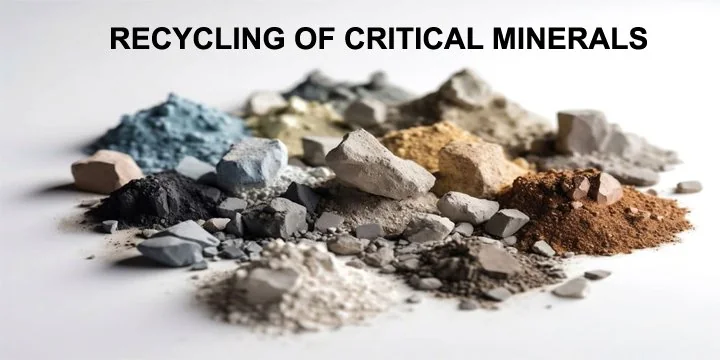
WHY IN NEWS On 3rd September 2025, the Union Cabinet approved a ₹1,500 crore incentive scheme to promote recycling of critical minerals from battery waste and e-waste. The scheme is part of the National Critical Mineral Mission (NCMM) and aims to reduce India’s dependence on imports by developing domestic recycling capacity for key minerals. E-waste recycling is the process of recovering valuable materials and safely disposing of hazardous components from discarded electronic devices like: Mobile phones Computers Televisions Refrigerators Batteries LED lights These devices contain precious metals…
WHY IN NEWS
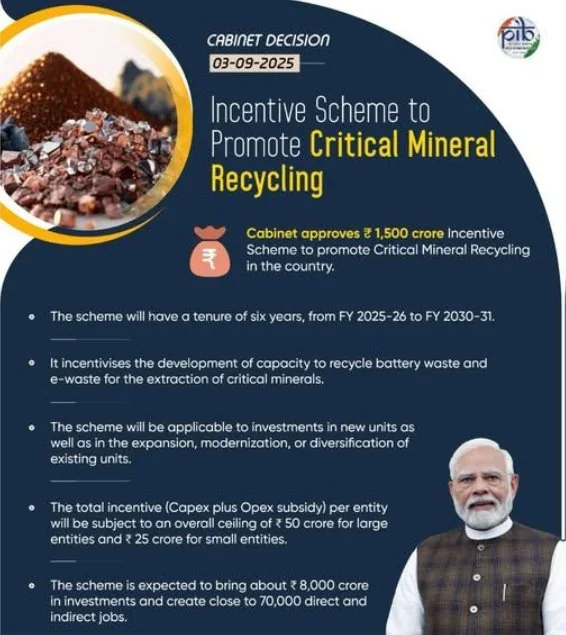
- On 3rd September 2025, the Union Cabinet approved a ₹1,500 crore incentive scheme to promote recycling of critical minerals from battery waste and e-waste.
- The scheme is part of the National Critical Mineral Mission (NCMM) and aims to reduce India’s dependence on imports by developing domestic recycling capacity for key minerals.
WHAT IS E WASTE RECYCLING?
E-waste recycling is the process of
recovering valuable materials and safely disposing of hazardous components from
discarded electronic devices like:
- Mobile phones
- Computers
- Televisions
- Refrigerators
- Batteries
- LED lights
These devices contain
precious metals,
rare earth elements, and
toxic substances.
WHAT ARE CRITICAL MINERALS?
Critical minerals are
strategic raw materials essential for:
- Modern electronics
- Renewable energy (solar panels, wind turbines)
- Batteries (especially for EVs)
- Defence technologies
They include:
- Lithium
- Cobalt
- Nickel
- Rare Earth Elements (REEs)
- Tantalum
- Gold, Silver, Palladium
- Indium, Tellurium, etc.
India currently
imports most of these minerals, making them
economically and geopolitically critical.
E WASTE RECYCLING TO EXTRACT MINERALS
When e-waste is recycled:
- Devices are collected and dismantled.
- Components are shredded or smelted.
- Metals and critical minerals are extracted through:
- Hydrometallurgy (using acids)
- Pyrometallurgy (using heat)
- Bioleaching (using bacteria)
- These processes help recover valuable materials and reduce mining dependency.
CRITICAL MINERAL RECYCLING INCENTIVE SCHEME (2025)
| Feature |
Details |
| Name |
Critical Mineral Recycling Incentive Scheme |
| Approved by |
Union Cabinet (Chaired by PM Narendra Modi) |
| Date of Approval |
3rd September 2025 |
| Scheme Outlay |
₹1,500 crore |
| Duration |
6 years (FY 2025–26 to FY 2030–31) |
| Under |
National Critical Mineral Mission (NCMM) |
| Target |
Develop recycling capacity & extract critical minerals from secondary sources |
ELIGIBLE FEEDSTOCK (SECONDARY SOURCES)
- E-waste
- Lithium-ion battery (LIB) scrap
- Other scrap: e.g., catalytic converters from end-of-life vehicles
ELIGIBLE BENEFICIARIES :
- Large, established recyclers
- Small recyclers and start-ups
1/3rd of total scheme outlay reserved for small/new recyclers
COVERAGE & APPLICATION :
- Applicable to:
- New units
- Expansion / modernization / diversification of existing units
- Incentives available only to entities engaged in mineral extraction, not just black mass production
SCHEME INCENTIVES
1. Capital Expenditure (Capex) Subsidy
- 20% subsidy on eligible:
- Plant & machinery
- Equipment
- Associated utilities
- Reduced subsidy if production starts beyond the specified time
2. Operating Expenditure (Opex) Subsidy
- Applicable from FY 2026–27 to FY 2030–31
- Linked to incremental sales over base year (FY 2025–26)
- Disbursed in 2 stages:
- 40% in 2nd year
- 60% in 5th year
SUBSIDY CEILING
| Entity Type |
Capex + Opex Ceiling |
Opex Ceiling Only |
| Large Entities |
₹50 crore |
₹10 crore |
| Small Entities |
₹25 crore |
₹5 crore |
EXPECTED OUTCOME
| Parameter |
Expected Impact |
| Recycling Capacity |
270 Kilo Tonnes (KT) annually |
| Critical Mineral Output |
40 KT annually |
| Total Investment |
~₹8,000 crore |
| Jobs Generated |
~70,000 (direct & indirect) |
CONSULTATIVE PROCESS
- Several rounds of stakeholder consultations held:
- Industry meeting
- Seminar sessions
- Inter-ministerial reviews
- Prelims: Key facts, institutions, locations and terminology in the article.
- Mains: Connect the topic with Economy, Defence, Polity & Governance.
- Revision: Use the article headings to prepare concise notes and answer-writing points.
Test your understanding
Questions from this article
Prelims practiceWith reference to RECYCLING OF CRITICAL MINERALS, consider the following statements:
- On 3rd September 2025, the Union Cabinet approved a ₹1,500 crore incentive scheme to promote recycling of critical minerals from battery waste and e-waste.
- The scheme is part of the National Critical Mineral Mission (NCMM) and aims to reduce India’s dependence on imports by developing domestic recycling capacity for key minerals.
- Renewable energy (solar panels, wind turbines)
Which of the statements given above are correct?
- 1 and 2 only
- 2 and 3 only
- 1 and 3 only
- 1, 2 and 3
View answer
Answer: (d) 1, 2 and 3. All three statements are drawn from the article.
Mains practiceDiscuss the background, key issues and significance of RECYCLING OF CRITICAL MINERALS for India.
Answer in 250 words.
View answer approach
- WHY IN NEWS
- WHAT IS E WASTE RECYCLING?
- WHAT ARE CRITICAL MINERALS?
- They include:
- CRITICAL MINERAL RECYCLING INCENTIVE SCHEME (2025)
Frequently asked questionsFrequently asked questions
Why is Recycling Of Critical Minerals in the news?
WHY IN NEWS On 3rd September 2025, the Union Cabinet approved a ₹1,500 crore incentive scheme to promote recycling of critical minerals from battery waste and e-waste. The scheme is part of the National Critical Mineral Mission (NCMM) and aims to reduce India’s dependence on imports by developing domestic recycling capacity for key minerals.
What are the key facts about Recycling Of Critical Minerals?
E-waste recycling is the process of recovering valuable materials and safely disposing of hazardous components from discarded electronic devices like: Mobile phones Computers Televisions Refrigerators Batteries LED lights These devices contain precious metals… Critical minerals are strategic raw materials essential for: Modern electronics Renewable energy (solar panels, wind turbines) Batteries (especially for EVs) Defence technologies They include: Lithium Cobalt Nickel Rare Earth Elements (REEs) Tantalum Gold… India currently imports most of these minerals, making them economically and geopolitically critical.
Why is Recycling Of Critical Minerals important for UPSC preparation?
The topic connects current developments with Economy, Defence, Polity & Governance and is relevant for both objective revision and analytical answer writing.