UPSC Current Affairs
RBI Launches Climate Risk Information System
Climate Risk Information System (RB-CRIS) to address the growing risks of climate change to the financial system. This initiative aims to help regulated entities assess climate risks to ensure the stability of their financial operations. IMPORTANCE OF CLIMATE RISK ASSESSMENTS Financial Stability: It is essential for banks and financial institutions to conduct climate risk assessments to maintain the stability of their balance sheets and the broader financial system.
VRAuthor Desk
2 min read
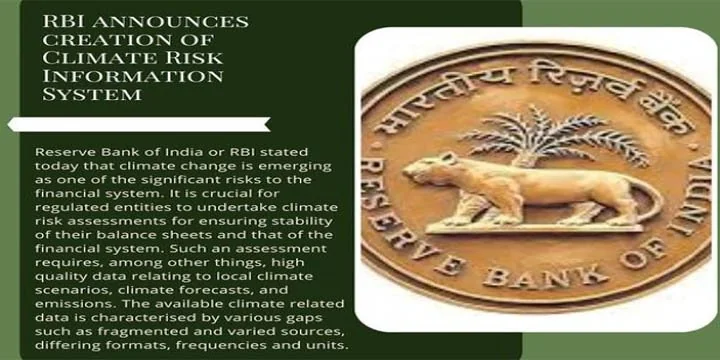
Climate Risk Information System (RB-CRIS) to address the growing risks of climate change to the financial system. This initiative aims to help regulated entities assess climate risks to ensure the stability of their financial operations. IMPORTANCE OF CLIMATE RISK ASSESSMENTS Financial Stability: It is essential for banks and financial institutions to conduct climate risk assessments to maintain the stability of their balance sheets and the broader financial system.
Climate Risk Information System (RB-CRIS) to address the growing
risks of climate change to the financial system.
This initiative aims to
help regulated entities assess climate risks to ensure the stability of their financial operations.
IMPORTANCE OF CLIMATE RISK ASSESSMENTS
- Financial Stability: It is essential for banks and financial institutions to conduct climate risk assessments to maintain the stability of their balance sheets and the broader financial system.
- Need for Quality Data: Effective assessments require high-quality data about local climate conditions, forecasts, and emissions. Currently, available data has gaps, such as fragmented sources and varying formats.
FEATURES OF CLIMATE RISK INFORMATION SYSTEM
- Data Repository: The RB-CRIS will include two main components:
- Web-Based Directory: This part will list various data sources (e.g., meteorological, geospatial) and will be publicly accessible on the RBI's website.
- Data Portal: This will contain processed datasets in standardized formats and will be available to regulated entities in phases.
- Phased Launch: The RBI plans to start with the web-based directory, followed by a gradual rollout of the data portal to ensure smooth adaptation for regulated entities.
GUIDELINES FOR REGULATED ENTITIES
- On February 28, 2024, the RBI issued draft guidelines for a Disclosure Framework on Climate-Related Financial Risks. These guidelines require regulated entities to disclose information in four key areas:
- Governance
- Strategy
- Risk Management
- Metrics and Targets
- The aim is to inform stakeholders—such as regulators, investors, and customers—about the climate risks faced by these entities and their strategies to address them.
- Prelims: Key facts, institutions, locations and terminology in the article.
- Mains: Connect the topic with Environment, Economy, Polity & Governance.
- Revision: Use the article headings to prepare concise notes and answer-writing points.
Test your understanding
Questions from this article
Prelims practiceWith reference to RBI Launches Climate Risk Information System, consider the following statements:
- Financial Stability: It is essential for banks and financial institutions to conduct climate risk assessments to maintain the stability of their balance sheets and the broader financial system.
- Need for Quality Data: Effective assessments require high-quality data about local climate conditions, forecasts, and emissions. Currently, available data has gaps, such as fragmented sources and varying formats.
- Data Repository: The RB-CRIS will include two main components: Web-Based Directory: This part will list various data sources (e.g., meteorological, geospatial) and will be publicly accessible on the RBI's website. Data…
Which of the statements given above are correct?
- 1 and 2 only
- 2 and 3 only
- 1 and 3 only
- 1, 2 and 3
View answer
Answer: (d) 1, 2 and 3. All three statements are drawn from the article.
Mains practiceDiscuss the background, key issues and significance of RBI Launches Climate Risk Information System for India.
Answer in 250 words.
View answer approach
- IMPORTANCE OF CLIMATE RISK ASSESSMENTS
- FEATURES OF CLIMATE RISK INFORMATION SYSTEM
- GUIDELINES FOR REGULATED ENTITIES
Frequently asked questionsFrequently asked questions
Why is Rbi Launches Climate Risk Information System in the news?
Climate Risk Information System (RB-CRIS) to address the growing risks of climate change to the financial system. This initiative aims to help regulated entities assess climate risks to ensure the stability of their financial operations.
What are the key facts about Rbi Launches Climate Risk Information System?
IMPORTANCE OF CLIMATE RISK ASSESSMENTS Financial Stability: It is essential for banks and financial institutions to conduct climate risk assessments to maintain the stability of their balance sheets and the broader financial system. Need for Quality Data: Effective assessments require high-quality data about local climate conditions, forecasts, and emissions. Currently, available data has gaps, such as fragmented sources and varying formats.
Why is Rbi Launches Climate Risk Information System important for UPSC preparation?
The topic connects current developments with Environment, Economy, Polity & Governance and is relevant for both objective revision and analytical answer writing.