UPSC Current Affairs
OSIRIS-REx and Bennu: Sample return missions
How will the OSIRIS-REx samples return to Earth? At an altitude of about 250 kilometers (155 miles) from the surface of Earth, OSIRIS-REx will release a capsule carrying the samples over the Great Salt Lake Desert in Utah, US — come “rain or shine,” said NASA. Scientists have been training to recover the capsule and securely transfer the samples to NASA’s Johnson Space Center in Houston, Texas.
VRAuthor Desk
3 min read
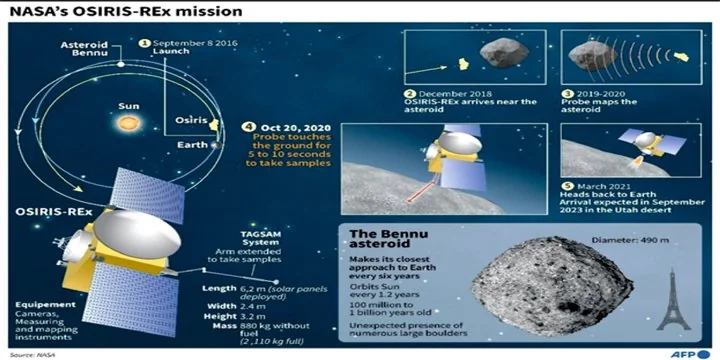
How will the OSIRIS-REx samples return to Earth? At an altitude of about 250 kilometers (155 miles) from the surface of Earth, OSIRIS-REx will release a capsule carrying the samples over the Great Salt Lake Desert in Utah, US — come “rain or shine,” said NASA. Scientists have been training to recover the capsule and securely transfer the samples to NASA’s Johnson Space Center in Houston, Texas.
How will the OSIRIS-REx samples return to Earth?
- At an altitude of about 250 kilometers (155 miles) from the surface of Earth, OSIRIS-REx will release a capsule carrying the samples over the Great Salt Lake Desert in Utah, US — come “rain or shine,” said NASA.
- Scientists have been training to recover the capsule and securely transfer the samples to NASA’s Johnson Space Center in Houston, Texas.
- Having released its capsule, it will travel on toward a new destination: Apophis, an asteroid once thought to pose a hazardous impact threat to Earth — but not anymore, at least not for the next 100 years.
What is a sample return mission?
- These days, sample return missions tend to be robotic. But we have in the past sent humans to collect rocks and soil from space — NASA’s Apollo missions did that between 1969 and 1972.
- Sample return missions send spacecraft to land on a celestial body — a moon, asteroid or planet — and collect samples of soil, minerals and rock.
- The samples are analyzed in laboratories on Earth. But some get stored, too — a lot of the Apollo samples were left sealed and untouched because scientists and engineers figured technology would improve over time, allowing them to conduct different or better experiments in the future.
Why do scientists collect samples from space and what do we learn?
- Samples from space tell us about life elsewhere in our solar system and early Earth history. Some scientists, and people in industry, hope asteroids will become a source of minerals as our earthly resources deplete.
- The samples can include atoms, molecules and complex compounds — even, scientists hope, evidence of water — and, as crazy as it may sound, particles of solar wind or cometary debris.
Who will analyze the samples from Bennu?
- NASA has said its samples from the asteroid Bennu “will give generations of scientists a window into the time when the sun and planets were forming about 4.5 billion years ago” — and the beginnings of life as we know it today. Bennu is thought to be rich in carbon, a chemical that is essential to life.
- While NASA plans to keep 25% of the samples for its own research, it has said it will distribute the rest among 200 mission members at 35 institutions around the world.
How often have samples been collected from asteroids?
- Aside from the Apollo era moon landings, during which NASA collected about 382 kilograms (842 pounds) of rock and moon soil, Soviet-era Russia conducted three successful robotic missions between 1969 and 1976 to procure about 326 grams of samples (11 ounces).
- More recently, JAXA’s Hayabusa mission from 2003 to 2010 was the first time humans had brought back samples from a near-Earth object: the asteroid Itokawa. Japan followed that with Hayabusa2, which returned samples from an asteroid called Ryugu in 2020.
- And, also in 2020, China’s Chang’e 5 mission returned samples from the moon.
Are any sample return missions planned for the future?
- Japan’s Martian Moons eXploration (MMX) aims to be the first sample return mission to bring back rocks from the Mars region.
- Scheduled to launch in 2024, MMX aims to investigate the moons of Mars, Phobos and Deimos, and gather information on how they formed. It’s hoped that this will help scientists better understand how the solar system formed.
Way Forward- The European Space Agency and NASA are engaged in a sample return mission from the surface of Mars, which, if all things go to plan, will return to Earth in 2033. India is also planning Mangalyaan 2, however, it may not be a sample return mission.
Syllabus- GS-3; Science and Tech
Source- Indian Express
- Prelims: Key facts, institutions, locations and terminology in the article.
- Mains: Connect the topic with Environment, Polity & Governance, Science & Technology.
- Revision: Use the article headings to prepare concise notes and answer-writing points.
Test your understanding
Questions from this article
Prelims practiceWith reference to OSIRIS-REx and Bennu: Sample return missions, consider the following statements:
- At an altitude of about 250 kilometers (155 miles) from the surface of Earth, OSIRIS-REx will release a capsule carrying the samples over the Great Salt Lake Desert in Utah, US — come “rain or shine,” said NASA.
- Scientists have been training to recover the capsule and securely transfer the samples to NASA’s Johnson Space Center in Houston, Texas.
- Having released its capsule, it will travel on toward a new destination: Apophis, an asteroid once thought to pose a hazardous impact threat to Earth — but not anymore, at least not for the next 100 years.
Which of the statements given above are correct?
- 1 and 2 only
- 2 and 3 only
- 1 and 3 only
- 1, 2 and 3
View answer
Answer: (d) 1, 2 and 3. All three statements are drawn from the article.
Mains practiceDiscuss the background, key issues and significance of OSIRIS-REx and Bennu: Sample return missions for India.
Answer in 250 words.
View answer approach
- How will the OSIRIS-REx samples return to Earth?
- What is a sample return mission?
- Why do scientists collect samples from space and what do we learn?
- Who will analyze the samples from Bennu?
- How often have samples been collected from asteroids?
Frequently asked questionsFrequently asked questions
Why is Osiris-Rex And Bennu: Sample Return Missions in the news?
How will the OSIRIS-REx samples return to Earth? At an altitude of about 250 kilometers (155 miles) from the surface of Earth, OSIRIS-REx will release a capsule carrying the samples over the Great Salt Lake Desert in Utah, US — come “rain or shine,” said NASA.
What are the key facts about Osiris-Rex And Bennu: Sample Return Missions?
Scientists have been training to recover the capsule and securely transfer the samples to NASA’s Johnson Space Center in Houston, Texas. Having released its capsule, it will travel on toward a new destination: Apophis, an asteroid once thought to pose a hazardous impact threat to Earth — but not anymore, at least not for the next 100 years. These days, sample return missions tend to be robotic.
Why is Osiris-Rex And Bennu: Sample Return Missions important for UPSC preparation?
The topic connects current developments with Environment, Polity & Governance, Science & Technology and is relevant for both objective revision and analytical answer writing.