- The Union Public Service Commission (UPSC) on Saturday (August 17) issued an advertisement seeking applications for “talented and motivated Indian nationals for Lateral Recruitment” to the posts of Joint Secretary, Director, and Deputy Secretary in 24 ministries of the Union government.
CRITICISM:
Congress party chief Mallikarjun Kharge, Bahujan Samaj Party supremo Mayawati, and Samajwadi Party’s Akhilesh Yadav, have criticized the policy for
not having reservations for Scheduled Caste (SC), Scheduled Tribe (ST), and Other Backward Classes (OBC) candidates.
HOW MANY POSTS & WHO CAN APPLY?
A total of
45 posts have been advertised with individuals having
appropriate qualifications and
experience from
State/UT governments, PSUs, statutory organizations, research institutes and universities, and even the private sector eligible to apply.
The advertisement mentions that all posts are
“suitable for candidates belonging to the category of Persons with Benchmark Disability (PwBD).”
WHO ARE LATERAL ENTRANTS?
In 2017,
NITI Aayog, in its
three-year Action Agenda, and the
Sectoral Group of Secretaries (SGoS) on Governance in its report submitted in February, recommended the induction of personnel at middle and senior management levels in the central government.
These
‘lateral entrants’ would be
part of the central secretariat which, till then, had only career bureaucrats from the All India Services/ Central Civil Services.
They would be given contracts of three years, extendable to a total term of five years.
POSITIONS OPEN FOR LATERAL ENTRY
The
first vacancies for lateral entrants were
advertised in 2018, but
only for Joint Secretary level positions. Posts of the rank of Director and Deputy Secretary were opened later.
A
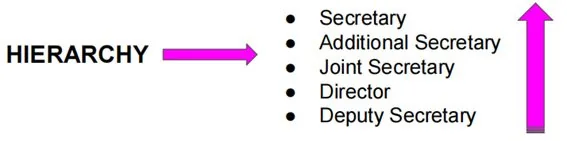
Joint Secretary, appointed by the Appointments Committee of the Cabinet (ACC), has the third-highest rank (after Secretary and Additional Secretary) in a Department, and functions as the administrative head of a wing in the Department. Directors are one rank below Joint Secretaries, and Deputy Secretaries are one rank below Directors, although in most ministries, they perform the same job. While Director/Deputy Secretaries are considered middle-level officials in a department, the Joint Secretary-level is where the decision-making starts.
WHY LATERAL ENTRY WAS INTRODUCED?
- Need for Specialized Knowledge: Governance is becoming more and more complex requiring specialized skills. For example, increasing penetration of data dominance in our lives.
- Generalist officers cannot be always expected to be up-to-date with specialized knowledge.
- Therefore, people with expertise and specialist domain knowledge are required to navigate the complex needs of present-day administrative challenges.
- Filling The Gap: According to Department of Personnel and Training data, there is a shortage of about 1500 IAS officers. Lateral entry can help bridge this deficit.
- Bringing a Change in Work Culture: It will help in bringing change in bureaucratic culture in Government sector culture. This bureaucratic culture is criticized for red-tapism, rule-book bureaucracy, and status-quoist.
- Lateral Entry helps in bringing the values of economy, efficiency, and effectiveness in the Government sector. It will help in building a culture of performance within the Government sector.
- Participatory Governance: Presently, governance is becoming a more participatory and multi-actor endeavor. In this context, the lateral entry provides stakeholders such as the private sector and non-profits an opportunity to participate in the governance process.
CRITICISMS OF LATERAL ENTRY
- Outsourcing Expertise: There is a difference between bringing expertise and being part of the decision-making process.
- For bringing expertise, the government doesn’t strictly need to hire private-sector personnel. Expertise is widely available and used by almost every ministry — expert committees, consultations, think tank engagements, etc.
- Cumbersome Decision-Making Process: The success of lateral entry requires an understanding of the system and an ability to work with the “permanent” establishment. No training or orientation is provided for this.
- By the time networks are built, it is time to move on. On past evidence, the lateral entrants who made the biggest impact are those who served in the system for a length of time and at different levels
- Profit Motive vs. Public Service: Private sector approach is profit-oriented on the other hand motive of the Government is public service. This is also a fundamental transition that a private sector person has to make while working in government.
- Conflict of Interest: Hiring of the private sector into administrative positions raises issues of potential conflict of interest. This issue requires a stringent code of conduct for entrants from private sectors to ensure conflict of interest is not detrimental to the public good.
- Out of the ambit of Reservation: Lateral entries have been criticised on the grounds that there are no quotas for SC, ST and OBC candidates in such recruitment.
WHY HAVE THE LATERAL ENTRIES BEEN KEPT OUT OF THE AMBIT OF RESERVATION?
Reservation in public jobs and universities is
implemented via what is known as the
“13-point roster”. According to this policy, a candidate’s position on a roster of openings is determined by dividing the quota percentage of their group (SC, ST, OBC, and now EWS) by a hundred.
For example, the
OBC quota is 27%. Therefore, OBC candidates are recruited to
every 4th post for which a vacancy arises in a department/cadre (100/27=3.7). Likewise,
SC candidates, with 15% reservation, are supposed to
fill every 7th vacancy (100/15=6.66),
ST candidates, with 7.5% reservation, are supposed to
fill every 14th vacancy (100/7.5=13.33), and
EWS candidates, with
10% reservation, are supposed to
fill every 10th vacancy (100/10=10).
According to this formula, however,
there is no reservation for up to three vacancies. Files obtained from the DoPT by The Indian Express under the
RTI Act state that
“In a single post cadre, reservation does not apply. Since each post to be filled under this scheme [lateral entry] is a Single Post, reservation is not applicable”.
THE CURRENT SCENARIO
In the current round of recruitment, the UPSC has advertised
45 openings. If these were to be considered as a single group, according to the 13-point roster,
six vacancies would be reserved for SC candidates, three for ST candidates, 12 for OBC candidates, and
four for the EWS category.
But since
these vacancies have been advertised separately for each department,
all of them are effectively single-post vacancies, and hence
bypass the policy of reservations.
Test your understanding
Questions from this article
Prelims practiceWith reference to Lateral Entry, consider the following statements:
- The Union Public Service Commission (UPSC) on Saturday (August 17) issued an advertisement seeking applications for “talented and motivated Indian nationals for Lateral Recruitment” to the posts of Joint Secretary…
- Need for Specialized Knowledge: Governance is becoming more and more complex requiring specialized skills. For example, increasing penetration of data dominance in our lives. Generalist officers cannot be always expected…
- Generalist officers cannot be always expected to be up-to-date with specialized knowledge.
Which of the statements given above are correct?
- 1 and 2 only
- 2 and 3 only
- 1 and 3 only
- 1, 2 and 3
View answer
Answer: (d) 1, 2 and 3. All three statements are drawn from the article.
Mains practiceDiscuss the background, key issues and significance of Lateral Entry for India.
Answer in 250 words.
View answer approach
- WHY LATERAL ENTRY WAS INTRODUCED?
- CRITICISMS OF LATERAL ENTRY
- WHY HAVE THE LATERAL ENTRIES BEEN KEPT OUT OF THE AMBIT OF RESERVATION?
Frequently asked questionsFrequently asked questions
Why is Lateral Entry in the news?
The Union Public Service Commission (UPSC) on Saturday (August 17) issued an advertisement seeking applications for “talented and motivated Indian nationals for Lateral Recruitment” to the posts of Joint Secretary, Director, and Deputy Secretary in 24… CRITICISM: Congress party chief Mallikarjun Kharge, Bahujan Samaj Party supremo Mayawati, and Samajwadi Party’s Akhilesh Yadav, have criticized the policy for not having reservations for Scheduled Caste (SC), Scheduled Tribe (ST), and Other Backward Classes…
What are the key facts about Lateral Entry?
A total of 45 posts have been advertised with individuals having appropriate qualifications and experience from State/UT governments, PSUs, statutory organizations, research institutes and universities, and even the private sector eligible to apply. The advertisement mentions that all posts are “suitable for candidates belonging to the category of Persons with Benchmark Disability (PwBD).” WHO ARE LATERAL ENTRANTS? In 2017, NITI Aayog, in its three-year Action Agenda, and the Sectoral Group of Secretaries (SGoS) on Governance in its report submitted in February, recommended the induction of personnel at middle and senior management levels in the central government.
Why is Lateral Entry important for UPSC preparation?
The topic connects current developments with Economy, Polity & Governance and is relevant for both objective revision and analytical answer writing.