WHAT EXACTLY HAPPENED?
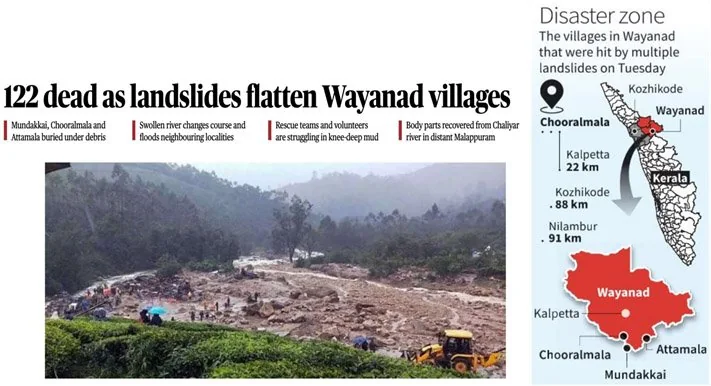
The govt. Has identified a
waterlogged hillock 6 kms from the villages which abutted the
Iruvanippuzha river as the origin of the landslide.
The
first landslide exactly occurred at
2 AM, the
second at
4 AM.
These landslides flattened the villages and plunged into the swollen river changing its course and flooding neighbouring areas.
WAS THERE ANY WEATHER PREDICTION ALERT?
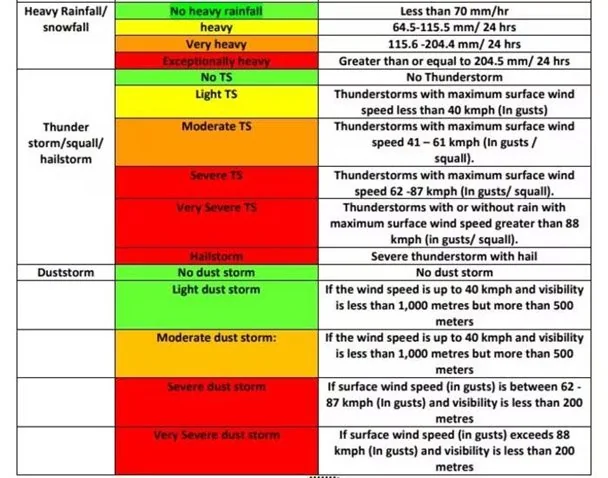
As per CM of Kerala, there was Orange Alert.
STEPS TAKEN
- Heavy engineering equipment and rescue dog teams were being airlifted, and
- Disaster relief teams had been dispatched by the Indian Coast Guard to provide aid to people after a series of landslides in the hilly areas of Wayanad district in Kerala early on Tuesday.
- Indian Armed Forces swung into immediate action and 300 Military personnel were moved forthwith to commence rescue operations.
- During the day, additional columns of Army, Naval teams and helicopters from Air Force were mobilised to assist the rescue and relief efforts.
- Dedicated medical teams have been deployed to give medical aid.
DID KERALA DO ANYTHING WRONG?
Ecologist
Madhav Gadgil, who was the
Chairman of the Western Ghats Ecology Expert Panel, has termed the
disaster in Wayanad a man-made tragedy, attributing it to the Kerala government’s failure to implement crucial ecological recommendations.
Mr. Gadgil criticised the State govt. for not adhering to the panel’s guidelines designed to prevent such disasters amid extreme climate changes.
His panel’s report had classified the region into
three levels of ecological sensitivity, with the
areas now struck by the disaster being marked as highly sensitive.
No development should have taken place in these areas.
WHAT TYPES OF DEVELOPMENTAL ACTIVITIES HAPPENED?
- These zones had been utilised for tea plantations during the British period.
- It had since seen extensive development, including the construction of resorts and artificial lakes.
- Gadgil said the presence of quarries operating a few kilometres from the disaster site had further exacerbated the situation.
- Though these quarries were now defunct, the shockwaves caused during their operational period could have extended to the disaster-stricken areas.
WHAT ARE ECO SENSITIVE ZONES?
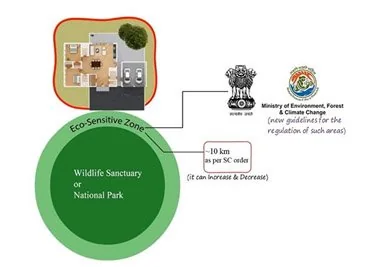
As per the
National Wildlife Action Plan (2002-2016), issued by the
Union Ministry of Environment, Forest and Climate Change, land within
10 km of the boundaries of national parks and wildlife sanctuaries are to be notified as eco-fragile zones or
Eco-Sensitive Zones (ESZ).
While the
10-km rule is implemented as a general principle, the extent of its application can vary. It can be more or less also. (In case of Kerala, it is only 1 KM)
(TN Godavarman Case, 2022)
Areas beyond 10-km can also be notified by the Union government as ESZs, if they hold larger ecologically important “sensitive corridors”.
WHY ARE THEY CREATED?
According to the
guidelines issued by the Environment Ministry on February 9, 2011, ESZs are created as
“shock absorbers” for the protected areas, to
minimize thenegative impact on the
“fragile ecosystems” by certain human activities taking place nearby.
Furthermore, these areas are meant to
act as a transition zone from areas
requiring higher protection to those requiring lesser protection.
PERMITTED & PROHIBITED ACTIVITIES:
Activities
prohibited in an ESZ, such as commercial mining, saw mills, commercial use of wood, etc., apart from
regulated activities like felling of trees.
There are
permitted activities like ongoing agricultural or horticultural practices, rainwater harvesting, organic farming, among others.
GADGIL & KASTURIRANGAN COMMITTEE RECOMMENDATIONS RELATED TO ESZ
GADGIL COMMITTEE:
- Indefinite moratorium on new environmental clearances for mining in Ecologically Sensitive Zones.
- Phase-out of all chemical pesticides within five to eight years & plastic bags in three years.
- Continuing existing mining in Ecologically Sensitive Zone 2 under strict regulation with an effective social audit mechanism.
- Prohibited new red and orange category industries, such as coal based power plants, in Ecologically Sensitive Zones 1 and 2.
- Cultivation of Genetically Modified crops was banned in the entire region.
- No new special economic zones or hill stations, dams, railway lines or major roads in Ecologically Sensitive zone-1 and zone-2 areas.
- Ban on conversion of public lands to private lands, and on diversion of forest land for non-forest purposes in ESZ -1 and ESZ -2 areas.
KASTURIRANGAN COMMITTEE:
- Only 37% classified as an ecologically sensitive area (ESA)
- The report categorized areas on the basis of their ecological sensitivity.
- Activities affecting the ecology negatively were to be banned or restricted in highly sensitive zones.
- Opined that the “blanket prescription” approach of the Gadgil committee would be harmful to the economy.
- Mining, Quarrying, Sand Mining, Thermal Power plants, Township and Area Development Projects, ‘Red Industries’ were
- Hydroelectric power projects were based only at those places where there have been a standard ecological flow of 30%, and were restricted otherwise.
- The ‘Orange’ category industries (food processing industry) were not banned, but careful process and production techniques were prioritized to minimize environmental damage.
- Infrastructure projects related to transport to be approved only after cumulative impact.
Test your understanding
Questions from this article
Prelims practiceWith reference to Kerala Landslide, consider the following statements:
- Heavy engineering equipment and rescue dog teams were being airlifted, and
- Disaster relief teams had been dispatched by the Indian Coast Guard to provide aid to people after a series of landslides in the hilly areas of Wayanad district in Kerala early on Tuesday.
- Indian Armed Forces swung into immediate action and 300 Military personnel were moved forthwith to commence rescue operations.
Which of the statements given above are correct?
- 1 and 2 only
- 2 and 3 only
- 1 and 3 only
- 1, 2 and 3
View answer
Answer: (d) 1, 2 and 3. All three statements are drawn from the article.
Mains practiceDiscuss the background, key issues and significance of Kerala Landslide for India.
Answer in 250 words.
View answer approach
- WHAT EXACTLY HAPPENED?
- STEPS TAKEN
- WHAT TYPES OF DEVELOPMENTAL ACTIVITIES HAPPENED?
- WHAT ARE ECO SENSITIVE ZONES?
- GADGIL & KASTURIRANGAN COMMITTEE RECOMMENDATIONS RELATED TO ESZ
Frequently asked questionsFrequently asked questions
Why is Kerala Landslide in the news?
Has identified a waterlogged hillock 6 kms from the villages which abutted the Iruvanippuzha river as the origin of the landslide. The first landslide exactly occurred at 2 AM, the second at 4 AM.
What are the key facts about Kerala Landslide?
These landslides flattened the villages and plunged into the swollen river changing its course and flooding neighbouring areas. WAS THERE ANY WEATHER PREDICTION ALERT? As per CM of Kerala, there was Orange Alert.
Why is Kerala Landslide important for UPSC preparation?
The topic connects current developments with Environment, Economy, International Relations and is relevant for both objective revision and analytical answer writing.