The Centre on October 24 appointed
Justice Sanjiv Khanna as the
next Chief Justice of India (CJI), formally
approving the recommendation made by
CJI D Y Chandrachud.
He will
hold the post for a little over six months until his retirement on May 13, 2025.
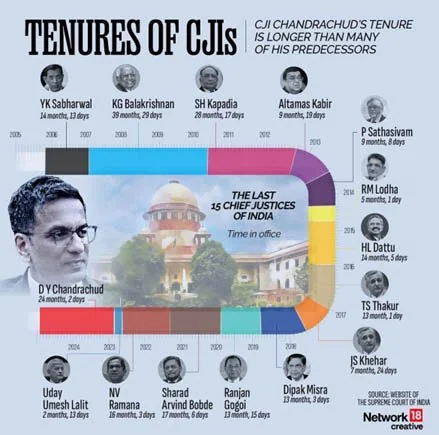
CJI Chandrachud’s two-year term is among the longest in recent years.
(9 November 2022 to 11 November 2024)
TENURE OF PREVIOUS 15 CJIs
 PROCEDURE FOR APPOINTMENT
The appointment of the CJI and judges of the apex court is governed by a
Memorandum of Procedure. The
CJI and the judges of the Supreme Court are appointed by the President under clause (2) of Article 124 of the Constitution.
CJI appointment: The appointment to the office of the CJI should be of the
senior-most judge of the Supreme Court considered fit to hold the office.
The
Union Law Minister seeks the recommendation of the outgoing CJI on his successor.
Once the CJI recommends, the
Law Minister forwards the communication to the Prime Minister who would
advise the President on the appointment.
HOW ARE OTHER JUDGES OF SC APPOINTED?
The appointment is done on the
recommendations of a collegium.
ABOUT THE COLLEGIUM SYSTEM:
It is a system under which appointments and transfers of judges are decided by a
forum of the Chief Justice of India and the four senior-most judges of the Supreme Court.
IS IT CONSTITUTIONAL?
It has
no place in the Indian Constitution. The basic tenet behind the collegium system is that the
judiciary should have primacy over the government in matters of appointments
and transfers in order to remain independent.
BACKGROUND:
The collegium system was born out of
years of friction between the judiciary and the executive that was accentuated by
instances of court-packing (the practice of changing the composition of judges in a court),
mass transfer of high court judges and
two supersessions to the office of the CJI in the 1970s. (Justice AN Ray & Justice MH Beg)
EVOLUTION OF COLLEGIUM SYSTEM:
The collegium system has its genesis in a series of
three judgments as follows:
First Judges case (S P Gupta case 1981): “
Primacy” of the CJI’s recommendation on judicial appointments and transfers can be refused for “cogent reasons.” The ruling gave the
Executive primacy over the Judiciary in judicial appointments.(For the next 12 years)
Second Judges case, 1993: It
introduced collegium system. It ruled that the CJI would have to
consult a collegium of his two senior-most judges in the apex court on judicial appointments and such a
“collective opinion” of the collegium
would have primacy over the government/executive.
Third Judges case, 1998: SC on
Presidential reference under Article 143, expanded the judicial collegium to its present composition of the CJI and 4 of his senior-most judges.
SC Judge appointment: When a vacancy is expected to arise in the apex court, the collegium recommends a candidate/s to the
Union Law Minister.
The
CJI consults the rest of the Collegium members, as well as the
senior-most judge of the High Court to which the recommended person belongs.
After the receipt of the Collegium recommendation, the Law Minister would forward it to the
Prime Minister, who would
advise the President in the matter of appointment.
CRITICISMS OF COLLEGIUM SYSTEM
- INSUFFICIENT BACKGROUND CHECKS.
- NON FORMAL & OPAQUE.
- OVERLOOKS TALENT POOL.
Test your understanding
Questions from this article
Prelims practiceWith reference to Justice Sanjiv Khanna To Be Next CJI: How is CJI Appointed ?, consider the following statements:
- The Centre on October 24 appointed Justice Sanjiv Khanna as the next Chief Justice of India (CJI), formally approving the recommendation made by CJI D Y Chandrachud.
- He will hold the post for a little over six months until his retirement on May 13, 2025.
- CJI Chandrachud’s two-year term is among the longest in recent years.
Which of the statements given above are correct?
- 1 and 2 only
- 2 and 3 only
- 1 and 3 only
- 1, 2 and 3
View answer
Answer: (d) 1, 2 and 3. All three statements are drawn from the article.
Mains practiceDiscuss the background, key issues and significance of Justice Sanjiv Khanna To Be Next CJI: How is CJI Appointed ? for India.
Answer in 250 words.
View answer approach
- CRITICISMS OF COLLEGIUM SYSTEM
- Note:
- Background and context
- Key facts and institutional framework
- Significance and way forward
Frequently asked questionsFrequently asked questions
Why is Justice Sanjiv Khanna To Be Next Cji: How Is Cji Appointed ? in the news?
The Centre on October 24 appointed Justice Sanjiv Khanna as the next Chief Justice of India (CJI), formally approving the recommendation made by CJI D Y Chandrachud. He will hold the post for a little over six months until his retirement on May 13, 2025.
What are the key facts about Justice Sanjiv Khanna To Be Next Cji: How Is Cji Appointed ??
CJI Chandrachud’s two-year term is among the longest in recent years. (9 November 2022 to 11 November 2024) TENURE OF PREVIOUS 15 CJIs PROCEDURE FOR APPOINTMENT The appointment of the CJI and judges of the apex court is governed by a Memorandum of Procedure. The CJI and the judges of the Supreme Court are appointed by the President under clause (2) of Article 124 of the Constitution.
Why is Justice Sanjiv Khanna To Be Next Cji: How Is Cji Appointed ? important for UPSC preparation?
The topic connects current developments with Polity & Governance and is relevant for both objective revision and analytical answer writing.