(ISRO) Chairman S Somanath said last week that
“we should be able to go and meet” the asteroid Apophis when it passes by Earth at a distance of
32,000 km in 2029.
However,
“it is yet to be decided in what way [ISRO] should participate”.
The Indian space agency
might send its own spacecraft, or
collaborate with other space agencies.
A NASA mission has already been confirmed.
WHAT WOULD BE THE PURPOSE?
Somanath’s remarks reveal
ISRO’s intent to develop capabilities in planetary defence — an area it has so far not entered.
ANY OTHER PURPOSE?
A mission
to study an asteroid would be the first step towards building a programme aimed at preventing celestial bodies from colliding with Earth with potentially catastrophic consequences.
ABOUT APOPHIS
When Apophis was
discovered in 2004, scientists thought there was a
2.7% chance of a collision with earth — the
highest probability of any large asteroid hitting Earth in the recent past.
WHEN IS IT EXPECTED?
Initial observations showed that
if not in 2029, Apophis could hit Earth
in 2036 or 2068.
Its size & potential to cause damage:
It measures about
450 m at its widest — a
collision with Earth could cause large-scale damage. Some scientists compared
the potential impact to the event that
wiped out dinosaurs and most other extant life some
66 million years ago.
THE FACTS
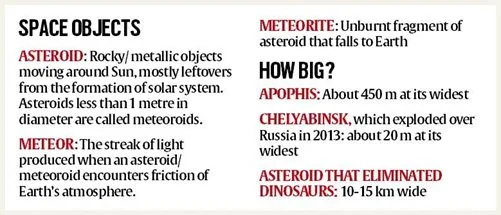
POSSIBLE INCOMING THREATS FROM SPACE
Apophis may not pose a threat, but asteroids are
headed towards Earth all the time.
HOW FREQUENTLY THEY ENTER THE EARTH’S ATMOSPHERE?
In fact,
thousands enter the Earth’s atmosphere every day. Most are
very small and
Burn up in the atmosphere due to friction — some of
the larger ones burn spectacularly, and show up as
fireballs in the sky. In some cases,
unburnt fragments make it to surface, although they are not large enough to cause much damage.
THE ASTEROID ENCOUNTER IN RUSSIA
In 2013,
a 20-metre wide asteroid entered the atmosphere and
exploded about 30 km above a Russian town, releasing energy equivalent to the blast yield of
400-500 kilotons of TNT — 26 to 33 times the energy released by the atom bomb that
detonated over hiroshima. While
most of this energy was absorbed by the atmosphere, shock waves travelled to the ground,
flattened trees, damaged buildings, and injured 1,491 people, according to Russian Ministry of Health.
WASN’T IT DETECTED?
The asteroid
was detected only after it entered the atmosphere. This was in part because
it came from the direction of the Sun, and was
hidden by its glare. Scientists know of at least
1.3 million asteroids. A
planetary defence programme seeks to track and neutralise these threats.
Test your understanding
Questions from this article
Prelims practiceWith reference to ISRO’S Planetary Defence, consider the following statements:
- (ISRO) Chairman S Somanath said last week that “we should be able to go and meet” the asteroid Apophis when it passes by Earth at a distance of 32,000 km in 2029.
- However, “it is yet to be decided in what way [ISRO] should participate”.
- The Indian space agency might send its own spacecraft, or collaborate with other space agencies.
Which of the statements given above are correct?
- 1 and 2 only
- 2 and 3 only
- 1 and 3 only
- 1, 2 and 3
View answer
Answer: (d) 1, 2 and 3. All three statements are drawn from the article.
Mains practiceDiscuss the background, key issues and significance of ISRO’S Planetary Defence for India.
Answer in 250 words.
View answer approach
- THE FACTS
- POSSIBLE INCOMING THREATS FROM SPACE
- Background and context
- Key facts and institutional framework
- Significance and way forward
Frequently asked questionsFrequently asked questions
Why is Isro’S Planetary Defence in the news?
(ISRO) Chairman S Somanath said last week that “we should be able to go and meet” the asteroid Apophis when it passes by Earth at a distance of 32,000 km in 2029. However, “it is yet to be decided in what way [ISRO] should participate”.
What are the key facts about Isro’S Planetary Defence?
The Indian space agency might send its own spacecraft, or collaborate with other space agencies. A NASA mission has already been confirmed. Somanath’s remarks reveal ISRO’s intent to develop capabilities in planetary defence — an area it has so far not entered.
Why is Isro’S Planetary Defence important for UPSC preparation?
The topic connects current developments with Defence, Polity & Governance, Health and is relevant for both objective revision and analytical answer writing.