UPSC Current Affairs
INDIA’S ENERGY SECURITY STRATEGY
In December 2025, the Ministry of Petroleum & Natural Gas (MoPNG) released its Year-End Review, detailing a multi-pronged strategy that has successfully balanced affordability, sustainability, and strategic autonomy. Amid global volatility, India achieved a landmark milestone in June 2025 by meeting 50% of its cumulative electric power capacity from non-fossil fuel sources—five years ahead of its 2030 Paris Agreement target. KEY ACHIEVEMENTS The government’s 2025 strategy focused on "de-carbonizing" the energy mix while expanding traditional infrastructure.
VRAuthor Desk
3 min read
In December 2025, the Ministry of Petroleum & Natural Gas (MoPNG) released its Year-End Review, detailing a multi-pronged strategy that has successfully balanced affordability, sustainability, and strategic autonomy. Amid global volatility, India achieved a landmark milestone in June 2025 by meeting 50% of its cumulative electric power capacity from non-fossil fuel sources—five years ahead of its 2030 Paris Agreement target. KEY ACHIEVEMENTS The government’s 2025 strategy focused on "de-carbonizing" the energy mix while expanding traditional infrastructure.
Why in News?
In
December 2025, the
Ministry of Petroleum & Natural Gas (MoPNG) released its Year-End Review, detailing a multi-pronged strategy that has successfully balanced
affordability, sustainability, and strategic autonomy. Amid global volatility, India achieved a landmark milestone in
June 2025 by meeting
50% of its cumulative electric power capacity from non-fossil fuel sources—five years ahead of its 2030 Paris Agreement target.
KEY ACHIEVEMENTS
The government’s 2025 strategy focused on "de-carbonizing" the energy mix while expanding traditional infrastructure.
1. Clean Cooking & PMUY 2.0
- Saturation Goal: Pradhan Mantri Ujjwala Yojana reached 10.35 crore active connections.
- Consumption Surge: The targeted subsidy of 300 per cylinder (continued for FY 2025-26) boosted average refills to a record 4.85 per annum.
- Safety First: Conducted over 12.12 crore free safety inspections at consumer premises via a nationwide campaign.
2. Gas-Based Economy: "One Nation, One Gas Grid"
- Network Expansion: The operational gas pipeline network grew to 25,429 km (with 10,459 km more under execution).
- Unified Tariff: Implementation of the Unified Pipeline Tariff regime now covers 90% of the grid, eliminating the "distance-based" cost disadvantage for distant states.
- City Gas: Domestic PNG connections reached 1.57 crore, and CNG stations crossed the 8,400 mark.
3. Biofuels & Green Aviation
- Ethanol Blending: Reached 19.24% (on track for 20% by 2026).
- CBG Mandate: Compulsory Compressed Bio-Gas (CBG) blending in CNG/PNG started in FY 2025-26.
- Sustainable Aviation Fuel (SAF): Established a roadmap for 1-5% SAF blending in ATF beginning in 2027.
STRATEGIC PETROLEUM RESERVES (PHASE 2)
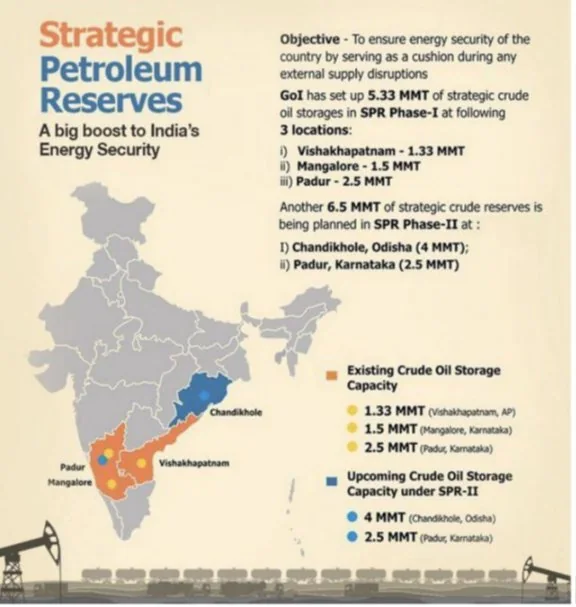
India’s energy "insurance policy" relies on underground salt caverns and rock storage.
- Current Capacity: 5.33 MMT (sustaining ~9.5 days of requirement).
- SPR Phase II: Advancement of new commercial-cum-strategic facilities:
- Chandikhol (Odisha): 4 MMT capacity.
- Padur (Karnataka) Expansion: 2.5 MMT capacity.
- The Gap: Total storage (including OMCs) currently sustains 77 days, still 13 days short of the IEA-mandated 90-day supply.
 CHALLENGES
Despite the shift toward renewables, structural vulnerabilities persist:
- The Import Challenge: Crude oil import dependence climbed to 89% in FY2025 as domestic production dipped to 28.7 MT.
- Geopolitical "Sanction Friction": India’s reliance on Russian oil (~36% share) triggered punitive measures from the U.S. and EU in 2025, forcing a "re-evaluation" of strategic trust.
- Critical Mineral Bottleneck: India remains 100% dependent on imports for 10 key minerals (Lithium, Cobalt, Nickel) essential for the EV and battery storage transition.
- Concentration Risk: Over 60% of India's solar and wind projects are located in just three states (Gujarat, Rajasthan, Tamil Nadu), increasing vulnerability to regional weather shocks or hybrid threats.
TRANSITIONING THE POWER SECTOR
| Source |
Capacity (Nov 2025) |
% of Total |
| Total Non-Fossil Fuel |
262.74 GW |
51.5% |
| Solar Power |
132.85 GW |
Dominant Driver |
| Wind Power |
53.99 GW |
Steady Growth |
| Thermal (Coal/Gas) |
246.90 GW |
Still Base Load |
WAY FORWARD: 2026 ROADMAP
- Mission Anveshan: Deepening exploration in frontier basins like the Andaman Islands and Krishna-Godavari.
- Battery Mandate: Integrating a 4-hour battery storage requirement in all new renewable tenders to ensure grid stability.
- Global Alliances: Championing the One Sun One World One Grid (OSOWOG) to enable cross-border clean energy trade.
- Nuclear Integration: Fast-tracking Small Modular Reactors (SMRs) with international partners (USA, France) to replace aging thermal plants.
CONCLUSION
India’s 2025 energy performance marks a transition from
fossil-dependency to
strategic diversification. While "Green Growth" is the destination, the short-term focus remains on securing affordable crude and expanding the gas grid to shield the common citizen from global price volatility.
- Prelims: Key facts, institutions, locations and terminology in the article.
- Mains: Connect the topic with Environment, Economy, International Relations.
- Revision: Use the article headings to prepare concise notes and answer-writing points.
Test your understanding
Questions from this article
Prelims practiceWith reference to INDIA’S ENERGY SECURITY STRATEGY, consider the following statements:
- Saturation Goal: Pradhan Mantri Ujjwala Yojana reached 10.35 crore active connections.
- Consumption Surge: The targeted subsidy of 300 per cylinder (continued for FY 2025-26) boosted average refills to a record 4.85 per annum.
- Safety First: Conducted over 12.12 crore free safety inspections at consumer premises via a nationwide campaign.
Which of the statements given above are correct?
- 1 and 2 only
- 2 and 3 only
- 1 and 3 only
- 1, 2 and 3
View answer
Answer: (d) 1, 2 and 3. All three statements are drawn from the article.
Mains practiceDiscuss the background, key issues and significance of INDIA’S ENERGY SECURITY STRATEGY for India.
Answer in 250 words.
View answer approach
- TRANSITIONING THE POWER SECTOR
- WAY FORWARD: 2026 ROADMAP
- Background and context
- Key facts and institutional framework
- Significance and way forward
Frequently asked questionsFrequently asked questions
Why is India’S Energy Security Strategy in the news?
In December 2025, the Ministry of Petroleum & Natural Gas (MoPNG) released its Year-End Review, detailing a multi-pronged strategy that has successfully balanced affordability, sustainability, and strategic autonomy. Amid global volatility, India achieved a landmark milestone in June 2025 by meeting 50% of its cumulative electric power capacity from non-fossil fuel sources—five years ahead of its 2030 Paris Agreement target.
What are the key facts about India’S Energy Security Strategy?
KEY ACHIEVEMENTS The government’s 2025 strategy focused on "de-carbonizing" the energy mix while expanding traditional infrastructure. Clean Cooking & PMUY 2.0 Saturation Goal: Pradhan Mantri Ujjwala Yojana reached 10.35 crore active connections. Consumption Surge: The targeted subsidy of 300 per cylinder (continued for FY 2025-26) boosted average refills to a record 4.85 per annum.
Why is India’S Energy Security Strategy important for UPSC preparation?
The topic connects current developments with Environment, Economy, International Relations and is relevant for both objective revision and analytical answer writing.