UPSC Current Affairs
HOW CLOUD SEEDING WORKS? CAN IT HELP TACKLE AIR POLLUTION?
Background — What Happened Recently? On October 28, 2025, a small aircraft (Cessna 206H) carried out a cloud seeding experiment over Delhi to see if it could help reduce air pollution. The aircraft took off from IIT Kanpur, flew over Delhi areas like Burari, Mayur Vihar, and Karol Bagh, and landed in Meerut.
VRAuthor Desk
5 min read
Background — What Happened Recently? On October 28, 2025, a small aircraft (Cessna 206H) carried out a cloud seeding experiment over Delhi to see if it could help reduce air pollution. The aircraft took off from IIT Kanpur, flew over Delhi areas like Burari, Mayur Vihar, and Karol Bagh, and landed in Meerut.
Background — What Happened Recently?
- On October 28, 2025, a small aircraft (Cessna 206H) carried out a cloud seeding experiment over Delhi to see if it could help reduce air pollution.
- The aircraft took off from IIT Kanpur, flew over Delhi areas like Burari, Mayur Vihar, and Karol Bagh, and landed in Meerut.
- The aim was to create light rainfall to help wash away pollutants from the air.
- Delhi Environment Minister Manjinder Singh Sirsa said this was India’s first major attempt to scientifically reduce pollution through cloud seeding
- If it succeeds, similar trials will continue in Delhi through the winter season (till February 2026).
WHAT IS CLOUD SEEDING?
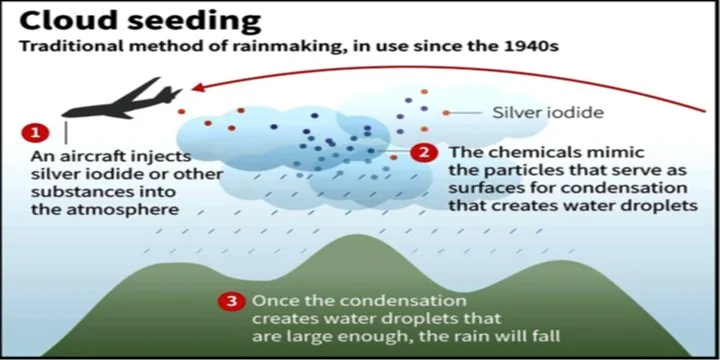
- Cloud seeding is a scientific technique used to artificially increase rainfall by adding special particles (called “seeds”) to clouds.
- These “seeds” help cloud droplets grow larger and heavier so that they fall as rain.
Simple science behind it:
- Normally, water vapour in the air condenses around tiny particles like dust or pollen ? forms small droplets ? droplets collide ? grow ? and fall as rain.
- In cloud seeding, scientists add more particles to help this process happen faster or more effectively.
WHAT ARE THESE SEEDS?
- The seed materials are usually salts or chemicals that attract water.
Commonly used substances include:
- Silver iodide (AgI)
- Potassium iodide (KI)
- Sodium chloride (NaCl) — common salt
- These act as “cloud condensation nuclei (CCN)” — tiny surfaces on which water vapour can condense to form droplets.
- They can also act as “ice nuclei” in cold clouds, helping ice crystals form that later melt into raindrops.
HOW IS CLOUD SEEDING DONE?
| Method |
How it works |
| Aircraft |
Chemicals are released directly into clouds using planes. |
| Flares |
Burning flares attached to aircraft wings release the chemicals. |
| Rockets / Drones |
Used to deliver seeding material into the cloud layer. |
| Ground Generators |
Machines on the ground send chemicals upward into the sky. |
- Eight flares were attached to the aircraft wings.
- Each flare weighed about 2 to 2.5 kg.
- The chemicals were released into clouds having 15–20% humidity.
- It took around 2–2.5 minutes to release each flare.
WHAT CONDITIONS ARE NEEDED FOR CLOUD SEEDING?
Cloud seeding
cannot create clouds — it can only work
if clouds already exist.
Key Requirements
- Enough clouds — not a clear sky.
- Sufficient cloud depth — clouds must be thick enough to hold moisture.
- Presence of small droplets inside the clouds.
- Favourable wind and humidity
- (former Secretary, Ministry of Earth Sciences) explained: “You need clouds with enough droplets. Seeding helps droplets grow so they become heavy and fall as rain. You cannot do it under a clear sky.”
- In Delhi, clouds often form in winter due to western disturbances (weather systems coming from the Mediterranean region).
- However, winter clouds are not always suitable — they may be too thin or have low moisture content, making seeding difficult.
WHY USE CLOUD SEEDING TO TACKLE POLLUTION?
The Logic: “Rain Washes Away Pollutants”
- When it rains, raindrops capture and carry down dust, smoke, and pollutants (like PM2.5 and PM10).
- This process, called “wet deposition” or “washout”, temporarily cleans the air.
- An MIT study explained that as a raindrop falls, it attracts tiny aerosol particles like soot, sulfates, and organic matter.
- Each raindrop can collect hundreds of these particles, clearing them from the air.
EXPERT OPINION
- Gufran Beig (Founder of SAFAR): “If it rains enough, pollutants get washed away. The effect is temporary, but it can break the cycle of pollution for a few days.”
- So, the goal in Delhi is to trigger short bursts of rainfall that can give temporary relief from smog and improve visibility.
CHALLENGES & LIMITATIONS
| Challenge |
Explanation |
| Cloud Availability |
Winter clouds may not have enough moisture for seeding to work. |
| Short-Term Impact |
Rain cleans the air only temporarily; pollution sources remain. |
| Effectiveness Doubts |
Past experiments show mixed results — sometimes rainfall increase is very small. |
| High Cost |
Each operation requires aircraft, chemicals, and expert teams. |
| Environmental Concerns |
Some worry about the long-term impact of chemicals like silver iodide. |
In fact, in many parts of India, cloud seeding has been used for
, but with
limited success (rainfall increase seen only around
20–25% in some studies).
IS IT THE RIGHT SOLUTION FOR DELHI’S POLLUTION?
Many experts believe
cloud seeding treats the symptom, not the cause.
Root causes of Delhi’s air pollution:
- Vehicle emissions
- Industrial smoke
- Construction dust
- Stubble burning
- Fireworks
- Weather conditions trapping pollutants near the ground
So, even if cloud seeding gives short relief, the air will become dirty again unless
main pollution sources are controlled.
INDIA’S EXPERIENCE WITH CLOUD SEEDING
- India has tried cloud seeding earlier in Maharashtra, Tamil Nadu, Karnataka, and Andhra Pradesh to increase rainfall.
- Results have been mixed — success depends on local weather and type of clouds.
- The Indian Institute of Tropical Meteorology (IITM), Pune continues to study the science behind seeding and its best practices.
CONCLUSION
- Cloud seeding is a scientific way to enhance rainfall, not to “create rain from nothing.”
- It can give temporary relief by washing pollutants out of the air — but it won’t solve Delhi’s pollution problem permanently.
- Long-term improvement requires:
- Better control of emissions,
- Cleaner fuels,
- Less stubble burning, and
- Stricter environmental policies.
So, while the experiment is
scientifically interesting and worth studying, it is
not a magic solution to Delhi’s pollution.
- Prelims: Key facts, institutions, locations and terminology in the article.
- Mains: Connect the topic with Polity & Governance.
- Revision: Use the article headings to prepare concise notes and answer-writing points.
Test your understanding
Questions from this article
Prelims practiceWith reference to HOW CLOUD SEEDING WORKS? CAN IT HELP TACKLE AIR POLLUTION?, consider the following statements:
- On October 28, 2025, a small aircraft (Cessna 206H) carried out a cloud seeding experiment over Delhi to see if it could help reduce air pollution.
- The aircraft took off from IIT Kanpur, flew over Delhi areas like Burari, Mayur Vihar, and Karol Bagh, and landed in Meerut.
- The aim was to create light rainfall to help wash away pollutants from the air.
Which of the statements given above are correct?
- 1 and 2 only
- 2 and 3 only
- 1 and 3 only
- 1, 2 and 3
View answer
Answer: (d) 1, 2 and 3. All three statements are drawn from the article.
Mains practiceDiscuss the background, key issues and significance of HOW CLOUD SEEDING WORKS? CAN IT HELP TACKLE AIR POLLUTION? for India.
Answer in 250 words.
View answer approach
- Background — What Happened Recently?
- WHAT IS CLOUD SEEDING?
- Simple science behind it:
- WHAT ARE THESE SEEDS?
- HOW IS CLOUD SEEDING DONE?
Frequently asked questionsFrequently asked questions
Why is How Cloud Seeding Works? Can It Help Tackle Air Pollution? in the news?
Background — What Happened Recently? On October 28, 2025, a small aircraft (Cessna 206H) carried out a cloud seeding experiment over Delhi to see if it could help reduce air pollution.
What are the key facts about How Cloud Seeding Works? Can It Help Tackle Air Pollution??
The aircraft took off from IIT Kanpur, flew over Delhi areas like Burari, Mayur Vihar, and Karol Bagh, and landed in Meerut. The aim was to create light rainfall to help wash away pollutants from the air. Delhi Environment Minister Manjinder Singh Sirsa said this was India’s first major attempt to scientifically reduce pollution through cloud seeding If it succeeds, similar trials will continue in Delhi through the winter season (till February 2026).
Why is How Cloud Seeding Works? Can It Help Tackle Air Pollution? important for UPSC preparation?
The topic connects current developments with Polity & Governance and is relevant for both objective revision and analytical answer writing.