UPSC Current Affairs
Grievance Redressal Assessment Index
The Grievance Redressal Assessment and Index (GRAI) is a system designed to measure how well different government ministries and departments handle public complaints and grievances. The 2023 GRAI was launched by Jitendra Singh, India's Union Minister of State for various departments. This index aims to help the government understand where they are doing well in resolving complaints and where they need to improve.
VRAuthor Desk
2 min read
The Grievance Redressal Assessment and Index (GRAI) is a system designed to measure how well different government ministries and departments handle public complaints and grievances. The 2023 GRAI was launched by Jitendra Singh, India's Union Minister of State for various departments. This index aims to help the government understand where they are doing well in resolving complaints and where they need to improve.
What is GRAI?
- The Grievance Redressal Assessment and Index (GRAI) is a system designed to measure how well different government ministries and departments handle public complaints and grievances.
- The 2023 GRAI was launched by Jitendra Singh, India's Union Minister of State for various departments.
- This index aims to help the government understand where they are doing well in resolving complaints and where they need to improve.
Purpose of GRAI:
- The main goal of GRAI is to give a comparative picture of how different ministries and departments handle grievances.
- It is meant to highlight strengths and show areas where improvements are needed in the grievance redressal process.
Structure of GRAI:
- The GRAI 2023 measures the grievance handling system based on four main areas (called "dimensions") and 11 indicators:
- Efficiency - How quickly and effectively grievances are handled.
- Feedback - The quality and usefulness of feedback provided to complainants.
- Domain - The specific areas of grievance handling, such as policy and legal matters.
- Organizational Commitment - The level of commitment by the ministry or department to resolving grievances.
- The 2023 report used data from January to December 2023, collected through CPGRAMS, which is the Centralized Public Grievance Redress and Management System.
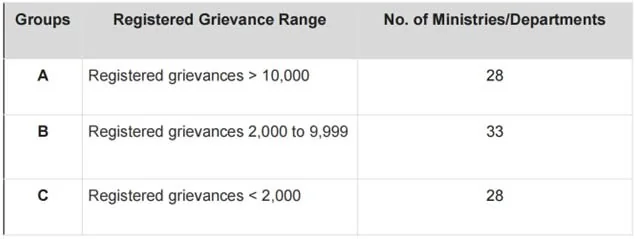
GROUPS BASED ON NO. OF GRIEVANCES
- Ministries and departments were divided into three groups based on the number of complaints they received:
SPECIAL FEATURES OF GRAI REPORT
- The report includes a Root-Cause Analysis, which looks at why certain departments are better or worse at resolving grievances.
- It also gives advice for improvement, including using technology like Artificial Intelligence (AI) and Machine Learning (ML) to predict and solve problems before they happen.
- The report suggests better training for grievance officers and more audits to make sure things improve.
CPGRAMS & ITS IMPORTANCE
- CPGRAMS is a key tool that allows people to file complaints online and track their progress.
- It has become an important part of the government’s effort to be more transparent and accountable.
- The Commonwealth Secretariat has even recognized CPGRAMS as a best practice for other countries to follow.
FUTURE RECOMMENDATIONS
The
GRAI 2023 report also provides a roadmap for future improvements, including:
- Using advanced technologies (like AI and ML) to improve grievance management.
- Integrating CPGRAMS into more levels of government to improve grievance redressal nationwide.
- Ensuring better reporting of the status of grievances and giving regular updates.
- Prelims: Key facts, institutions, locations and terminology in the article.
- Mains: Connect the topic with Economy, Polity & Governance, Science & Technology.
- Revision: Use the article headings to prepare concise notes and answer-writing points.
Test your understanding
Questions from this article
Prelims practiceWith reference to Grievance Redressal Assessment Index, consider the following statements:
- The Grievance Redressal Assessment and Index (GRAI) is a system designed to measure how well different government ministries and departments handle public complaints and grievances.
- The 2023 GRAI was launched by Jitendra Singh, India's Union Minister of State for various departments.
- This index aims to help the government understand where they are doing well in resolving complaints and where they need to improve.
Which of the statements given above are correct?
- 1 and 2 only
- 2 and 3 only
- 1 and 3 only
- 1, 2 and 3
View answer
Answer: (d) 1, 2 and 3. All three statements are drawn from the article.
Mains practiceDiscuss the background, key issues and significance of Grievance Redressal Assessment Index for India.
Answer in 250 words.
View answer approach
- What is GRAI?
- Purpose of GRAI:
- Structure of GRAI:
- GROUPS BASED ON NO. OF GRIEVANCES
- SPECIAL FEATURES OF GRAI REPORT
Frequently asked questionsFrequently asked questions
Why is Grievance Redressal Assessment Index in the news?
The Grievance Redressal Assessment and Index (GRAI) is a system designed to measure how well different government ministries and departments handle public complaints and grievances. The 2023 GRAI was launched by Jitendra Singh, India's Union Minister of State for various departments.
What are the key facts about Grievance Redressal Assessment Index?
This index aims to help the government understand where they are doing well in resolving complaints and where they need to improve. Purpose of GRAI: The main goal of GRAI is to give a comparative picture of how different ministries and departments handle grievances. It is meant to highlight strengths and show areas where improvements are needed in the grievance redressal process.
Why is Grievance Redressal Assessment Index important for UPSC preparation?
The topic connects current developments with Economy, Polity & Governance, Science & Technology and is relevant for both objective revision and analytical answer writing.