UPSC Current Affairs
Extremely Large Telescope
The Extremely Large Telescope (ELT) is set to become one of the most advanced astronomical observatories ever built. Currently under construction in northern Chile, this $1.51 billion project by the European Southern Observatory (ESO) is expected to revolutionize our understanding of the universe. Once completed, it will be capable of answering some of the most profound questions in astronomy, including the search for life on exoplanets and the study of the universe’s earliest stars and galaxies.
VRAuthor Desk
2 min read

The Extremely Large Telescope (ELT) is set to become one of the most advanced astronomical observatories ever built. Currently under construction in northern Chile, this $1.51 billion project by the European Southern Observatory (ESO) is expected to revolutionize our understanding of the universe. Once completed, it will be capable of answering some of the most profound questions in astronomy, including the search for life on exoplanets and the study of the universe’s earliest stars and galaxies.
- The Extremely Large Telescope (ELT) is set to become one of the most advanced astronomical observatories ever built.
- Currently under construction in northern Chile, this $1.51 billion project by the European Southern Observatory (ESO) is expected to revolutionize our understanding of the universe.
- Once completed, it will be capable of answering some of the most profound questions in astronomy, including the search for life on exoplanets and the study of the universe’s earliest stars and galaxies.
KEY FEATURES
- Purpose and Scientific Goals:
- The ELT is designed to explore a wide range of astronomical phenomena, including searching for signs of life on exoplanets and peering into the earliest galaxies and stars that formed after the Big Bang.
- Its research aims to advance the study of exoplanets, specifically examining their atmospheres for potential signs of life.
- The ELT will also enable scientists to study distant stars and galaxies, improving our understanding of their formation and evolution over time.
- Completion and Timeline:
- The telescope is currently about 60% complete, with its first scientific observations expected to begin by the end of 2028.
- Upon completion, it will become the largest optical-infrared telescope in the world, providing groundbreaking insights into the cosmos.
- Design and Structure:
- The ELT will feature a giant primary mirror composed of 798 smaller mirrors, which together will form a mirror 39.3 meters in diameter.
- The telescope’s size and design will allow it to collect more light than any other optical telescope currently in existence, enabling it to observe distant objects with unparalleled clarity and detail.
- Location:
- The ELT is being constructed on Armazones Hill, located in the Atacama Desert of northern Chile, one of the best sites on Earth for astronomical observation due to its dry climate and high altitudes.
- Positioned about 3 kilometers above sea level, the location offers optimal conditions for clear skies and minimal atmospheric interference.
- Impact on Astronomy:
- According to Itziar de Gregorio, an astrophysicist from ESO in Chile, the ELT will greatly impact many areas of astronomy, including studying the first galaxies and the stars in other galaxies.
- It will also help us learn more about exoplanets and their habitability.
ABOUT EUROPEAN SOUTHERN OBSERVATORY (ESO)
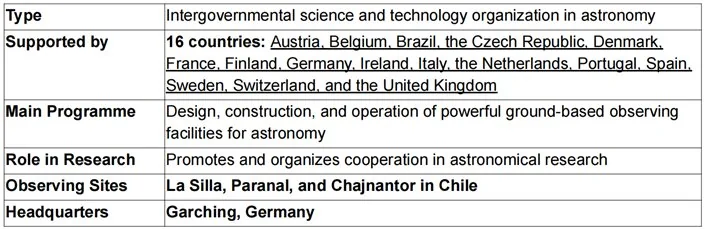
- Prelims: Key facts, institutions, locations and terminology in the article.
- Mains: Connect the topic with Environment, Polity & Governance.
- Revision: Use the article headings to prepare concise notes and answer-writing points.
Test your understanding
Questions from this article
Prelims practiceWith reference to Extremely Large Telescope, consider the following statements:
- The Extremely Large Telescope (ELT) is set to become one of the most advanced astronomical observatories ever built.
- Currently under construction in northern Chile, this $1.51 billion project by the European Southern Observatory (ESO) is expected to revolutionize our understanding of the universe.
- Once completed, it will be capable of answering some of the most profound questions in astronomy, including the search for life on exoplanets and the study of the universe’s earliest stars and galaxies.
Which of the statements given above are correct?
- 1 and 2 only
- 2 and 3 only
- 1 and 3 only
- 1, 2 and 3
View answer
Answer: (d) 1, 2 and 3. All three statements are drawn from the article.
Mains practiceDiscuss the background, key issues and significance of Extremely Large Telescope for India.
Answer in 250 words.
View answer approach
- KEY FEATURES
- ABOUT EUROPEAN SOUTHERN OBSERVATORY (ESO)
- Background and context
- Key facts and institutional framework
- Significance and way forward
Frequently asked questionsFrequently asked questions
Why is Extremely Large Telescope in the news?
The Extremely Large Telescope (ELT) is set to become one of the most advanced astronomical observatories ever built. Currently under construction in northern Chile, this $1.51 billion project by the European Southern Observatory (ESO) is expected to revolutionize our understanding of the universe.
What are the key facts about Extremely Large Telescope?
Once completed, it will be capable of answering some of the most profound questions in astronomy, including the search for life on exoplanets and the study of the universe’s earliest stars and galaxies. KEY FEATURES Purpose and Scientific Goals: The ELT is designed to explore a wide range of astronomical phenomena, including searching for signs of life on exoplanets and peering into the earliest galaxies and stars that formed after the Big Bang. Its research aims to advance the study of exoplanets, specifically examining their atmospheres for potential signs of life.
Why is Extremely Large Telescope important for UPSC preparation?
The topic connects current developments with Environment, Polity & Governance and is relevant for both objective revision and analytical answer writing.