UPSC Current Affairs
ENVISTATS 2025
Context: On June 5, 2025, the Ministry of Statistics and Programme Implementation (MoSPI), Government of India, released the 8th issue of its annual publication, "EnviStats India 2025: Environment Statistics." About "EnviStats India" Publication Publisher… Purpose: To offer a comprehensive overview of the country's environmental landscape, highlighting trends, challenges, and supporting evidence-based policy development for environmental sustainability and resilience. Alignment: Since 2018, the National Statistics Office (NSO) has been publishing "EnviStats India" in alignment with the Framework for the Development of Environment Statistics (FDES) 2013, developed by the United Nations Statistics Division (UNSD).
VRAuthor Desk
3 min read
Context: On June 5, 2025, the Ministry of Statistics and Programme Implementation (MoSPI), Government of India, released the 8th issue of its annual publication, "EnviStats India 2025: Environment Statistics." About "EnviStats India" Publication Publisher… Purpose: To offer a comprehensive overview of the country's environmental landscape, highlighting trends, challenges, and supporting evidence-based policy development for environmental sustainability and resilience. Alignment: Since 2018, the National Statistics Office (NSO) has been publishing "EnviStats India" in alignment with the Framework for the Development of Environment Statistics (FDES) 2013, developed by the United Nations…
Context:
- On June 5, 2025, the Ministry of Statistics and Programme Implementation (MoSPI), Government of India, released the 8th issue of its annual publication, "EnviStats India 2025: Environment Statistics."
About "EnviStats India" Publication
- Publisher: Ministry of Statistics and Programme Implementation (MoSPI), GoI.
- Purpose: To offer a comprehensive overview of the country's environmental landscape, highlighting trends, challenges, and supporting evidence-based policy development for environmental sustainability and resilience.
- Alignment: Since 2018, the National Statistics Office (NSO) has been publishing "EnviStats India" in alignment with the Framework for the Development of Environment Statistics (FDES) 2013, developed by the United Nations Statistics Division (UNSD).
- Data Sources: Data compiled from various Ministries, Departments, and Organizations of the Government of India.
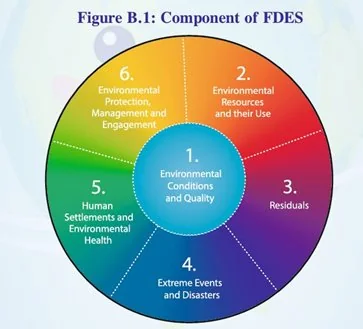
- Structure: Following FDES 2013, the data is organized into 6 components, with related topics grouped for easier understanding.
- The publication includes a comprehensive list of indicators under the Basic Set of Environment Statistics from FDES 2013.
 IMPORTANT HIGHLIGHTS & KEY TRENDS
The publication presents critical data insights across various environmental parameters:
- Energy Sector:
- Thermal Power Generation: Increased from 7,92,053 GWh in 2013-14 to 13,26,549 GWh in 2023-24.
- Renewable Energy Generation: Significantly increased from 65,520 GWh to 2,25,835 GWh during 2013-14 to 2023–24, indicating a strong push towards clean energy sources.
- Climate Change Indicators (Source: India Meteorological Department, Ministry of Earth Sciences):
- Annual Mean Temperature: Increased from 25.05°C in 2001 to 25.74°C in 2024.
- Annual Minimum and Maximum Temperature: Rose from 19.32°C to 20.24°C (minimum) and 30.78°C to 31.25°C (maximum) respectively, during the same period.
- Annual Rainfall: Data from 2001 to 2024 highlights significant year-to-year variability influenced by monsoon patterns. Despite this, the data does not indicate any clear long-term upward or downward trend in total annual rainfall.
- Biodiversity (Source: Zoological Survey of India, Ministry of Environment, Forest & Climate Change):
- Marine Faunal Species: India accounts for 20,613 species out of 2,47,605 globally.
- Freshwater Species: India has 9,436 ? Indian Mangrove System: Hosts 5,023 species.
- Estuarine Ecosystem: Home to 3,383
- Soil Ecosystem: A notable 22,404 species are found in India's soil ecosystem, highlighting its significant diversity.
- Total Faunal Species (Global vs. India): Globally, there are 16,73,627 faunal species, of which 1,04,561 are found in India. This underscores India's significant contribution to global faunal diversity across different habitats, with the high number of soil species being particularly noteworthy.
- Fisheries Production (Source: Ministry of Fisheries, Animal Husbandry and Dairying):
- Inland Fish Production: Increased substantially from 61.36 lakh tonnes in 2013-14 to 139.07 lakh tonnes in 2023–24, possibly indicating growth in inland aquaculture and freshwater fisheries.
- Marine Fish Production: Showed slower growth, increasing from 34.43 lakh tonnes to 44.95 lakh tonnes during the same period.
- Environmental Expenditure (Source: Ministry of Corporate Affairs):
- The Environment Sustainability Sector showed the highest expenditure share at Rs. 2433.24 crore in 2021-22.
- The Conservation of Natural Resource Sector shows an upward trend in expenditure.
- The Agro-Forestry Sector exhibits the lowest expenditure among the three tracked sectors (Agro-Forestry, Conservation of Natural Resources, and Environment Sustainability).
- Prelims: Key facts, institutions, locations and terminology in the article.
- Mains: Connect the topic with Environment, Economy.
- Revision: Use the article headings to prepare concise notes and answer-writing points.
Test your understanding
Questions from this article
Prelims practiceWith reference to ENVISTATS 2025, consider the following statements:
- On June 5, 2025, the Ministry of Statistics and Programme Implementation (MoSPI), Government of India, released the 8th issue of its annual publication, "EnviStats India 2025: Environment Statistics."
- Publisher: Ministry of Statistics and Programme Implementation (MoSPI), GoI.
- Purpose: To offer a comprehensive overview of the country's environmental landscape, highlighting trends, challenges, and supporting evidence-based policy development for environmental sustainability and resilience.
Which of the statements given above are correct?
- 1 and 2 only
- 2 and 3 only
- 1 and 3 only
- 1, 2 and 3
View answer
Answer: (d) 1, 2 and 3. All three statements are drawn from the article.
Mains practiceDiscuss the background, key issues and significance of ENVISTATS 2025 for India.
Answer in 250 words.
View answer approach
- Context:
- Background and context
- Key facts and institutional framework
- Significance and way forward
Frequently asked questionsFrequently asked questions
Why is Envistats 2025 in the news?
Context: On June 5, 2025, the Ministry of Statistics and Programme Implementation (MoSPI), Government of India, released the 8th issue of its annual publication, "EnviStats India 2025: Environment Statistics." About "EnviStats India" Publication Publisher… Purpose: To offer a comprehensive overview of the country's environmental landscape, highlighting trends, challenges, and supporting evidence-based policy development for environmental sustainability and resilience.
What are the key facts about Envistats 2025?
Alignment: Since 2018, the National Statistics Office (NSO) has been publishing "EnviStats India" in alignment with the Framework for the Development of Environment Statistics (FDES) 2013, developed by the United Nations Statistics Division (UNSD). Data Sources: Data compiled from various Ministries, Departments, and Organizations of the Government of India. Structure: Following FDES 2013, the data is organized into 6 components, with related topics grouped for easier understanding.
Why is Envistats 2025 important for UPSC preparation?
The topic connects current developments with Environment, Economy and is relevant for both objective revision and analytical answer writing.