UPSC Current Affairs
Economic Survey 2024
The Economic Survey is a comprehensive review or annual report of Indian economy during the closed financial year. Prepared by: The Economics Division of the Department of Economic Affairs of the Finance Ministry under the guidance of the India's Chief Economic Advisor (CEA). It is typically published a day before the Union Budget.
VRAuthor Desk
6 min read
The Economic Survey is a comprehensive review or annual report of Indian economy during the closed financial year. Prepared by: The Economics Division of the Department of Economic Affairs of the Finance Ministry under the guidance of the India's Chief Economic Advisor (CEA). It is typically published a day before the Union Budget.
- The Economic Survey is a comprehensive review or annual report of Indian economy during the closed financial year.
- Prepared by: The Economics Division of the Department of Economic Affairs of the Finance Ministry under the guidance of the India's Chief Economic Advisor (CEA).
- It is typically published a day before the Union Budget.
- The survey has evolved over the years, becoming more comprehensive and analytical
THE HISTORY
- The first Economic Survey was published in 1950-51 as a "white paper" within the budget papers
- Initially, the survey relied on secondary data due to the scarcity of readily available figures and analysts
- Over time, the survey has expanded in scope and become a primary data source for those outside the government
- However, since 2021-22, the Economic Survey has reverted to its classic template, focusing on hard facts and less on opinions
1: OVERALL ECONOMIC PERFORMANCE
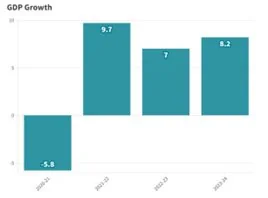
- GDP Growth: India's real GDP grew by 8.2% in FY24, exceeding 8% in three out of four quarters.
- Projected Growth: India's real GDP is anticipated to grow between 6.5% and 7% in fiscal year 2024-25.
- Global Context: India's growth is notable, given the challenging global economic environment with 3.2% global growth in 2023.
- Recovery: The real GDP in FY24 was 20% higher than its level in FY20, a feat achieved by very few major economies post-pandemic.
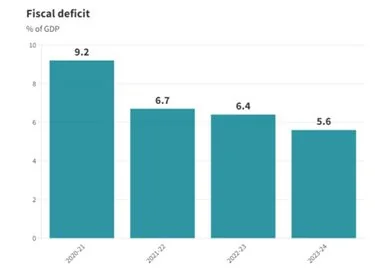
- India has continued to reduce its fiscal deficit, going against the global trend of increasing deficits. According to recent data, the fiscal deficit has decreased from 6.4% of GDP in FY 23 to 5.6% of GDP in FY 24.
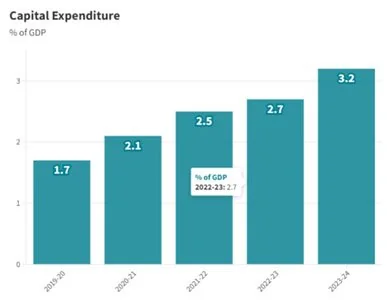
- India's capital expenditure in FY24 reached ₹9.5 lakh crore, a 28.2% year-over-year increase, and nearly triple the level of FY20.
- The government's focus on capital expenditure has been a key factor in driving economic growth despite global uncertainty.
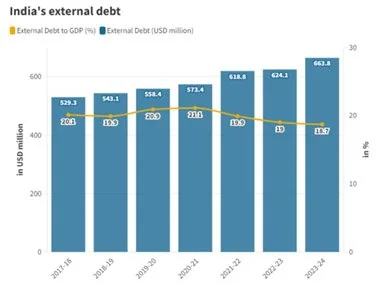
- India's external debt indicators remain stable, with external debt at 18.7% of GDP as of March 2024.
- Additionally, foreign exchange reserves cover 97.4% of total debt, indicating a comfortable position.
2: INFLATION & MONETARY POLICY
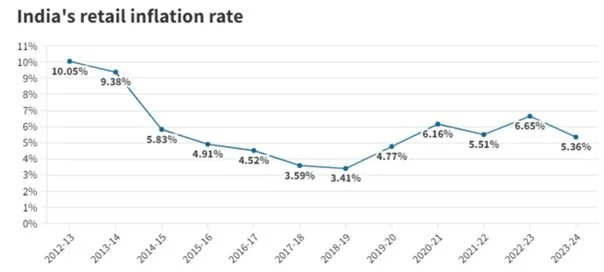
- Inflation Rate: Retail inflation moderated to 5.36% in FY24, the lowest since the pandemic.
- Core Inflation: Dropped to a four-year low in FY24.
- RBI Actions: The Reserve Bank of India raised the repo rate by 250 basis points from May 2022 to combat inflationary pressures.
- Future Outlook: RBI projects inflation to fall to 4.5% in FY25 and 4.1% in FY26, assuming normal monsoons and no external shocks.
3: EXTERNAL SECTOR
- Current Account Deficit (CAD): Narrowed to 0.7% of GDP in FY 24, down from 2.0% in FY23.
- Services Exports: Grew by 4.9% to USD 341.1 billion in FY 24, driven by IT/software and business services.
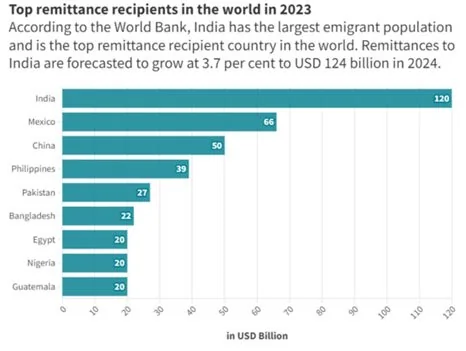
- Remittances: India remains the top global remittance recipient, reaching USD 120 billion in 2023.
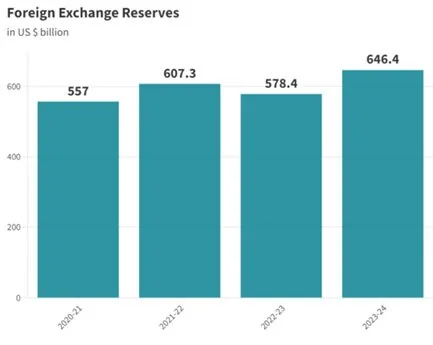
- Forex Reserves: Sufficient to cover more than 10 months of projected imports for FY25.
4: INVESTMENT & CAPITAL FORMATION
- Public Investment: Has been pivotal in sustaining capital formation in recent years.
- Private Sector Investment: Showing encouraging signs since FY22.
- Gross Fixed Capital Formation: Increased by 9% in real terms in 2023-24.
- Capital Markets: Primary capital markets facilitated capital formation of ₹10.9 lakh crore in FY24.
5: BANKING & FINANCIAL SECTOR
- Credit Growth: Bank credit growth was broad-based and in double digits.
- Non-Performing Assets (NPAs): Gross and net NPAs reached multi-year lows.
- Stock Market Performance: India's market capitalization to GDP ratio is the fifth largest globally
6: EMPLOYMENT & LABOUR MARKET
- Unemployment Rate: Decreased to 3.2% in 2022-23.
- Formal Employment: Net payroll additions under EPFO have more than doubled over the past five years.
- Youth and Female Participation: Significant rise in workforce participation, offering opportunities for demographic and gender dividends.
7: AGRICULTURE & FOOD MANAGEMENT
- Sector Growth: Average annual growth rate of 4.18% at constant prices over the last five years.
- Allied Sectors: Livestock and fisheries showing robust growth (CAGR of 7.38% and 8.9% respectively from 2014-15 to 2022-23).
- Digital Initiatives: Implementation of Digital Agriculture Mission (2021–2025) and e-National Agriculture Market (e-NAM).
- Food Security: Free food grains provided to 81.35 crore beneficiaries under PMGKAY for an additional five years.
8: INDUSTRIAL GROWTH
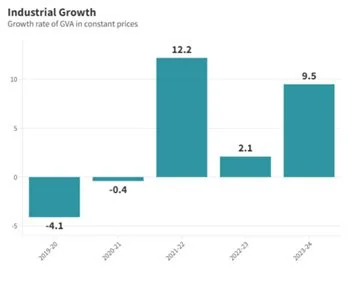
- Manufacturing Growth: Average annual growth rate of 5.2% in the last decade.
- Steel Production: India became a net exporter of finished steel over the past decade.
- Electronics Manufacturing: Significant growth since 2014, reaching 3.7% of global market share in FY22.
- MSME Support: ₹9,000 Crore allocated to the Credit Guarantee Fund Trust for Micro and Small Enterprises (CGTMSE) in Union Budget 2023-24.
9: SERVICE SECTOR
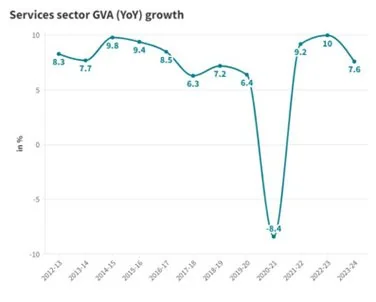
- Sector Growth: Estimated to have grown by 7.6% in FY24.
- PMI Performance: Services PMI above 50 since August 2021, indicating continuous expansion for 35 months.
- Global Services Exports: India's share reached 4.4% of the world's commercial services exports in 2022.
- E-commerce Growth: Indian e-commerce industry expected to cross USD 350 billion by 2030.
10: INFRASTRUCTURE DEVELOPMENT
- National Highways: Construction increased from 11.7 km per day in FY14 to ~34 km per day by FY24.
- Railways: Capital expenditure increased by 77% in the past 5 years.
- Airports: New terminal buildings operationalized at 21 airports in FY24, increasing passenger handling capacity by approximately 62 million per annum.
- Clean Energy: New investment of ₹8.5 lakh crore (USD 102.4 billion) between 2014 and 2023.
11: CLIMATE CHANGE & SUSTAINABLE DEVELOPMENT
- Emission Reduction: Emission intensity of GDP reduced by 33% from 2005 levels by 2019.
- Renewable Energy: Non-fossil sources make up 45.4% of installed electricity generation capacity as of May 31, 2024.
- Mission LiFE: Initiative to create a mass movement for sustainable living based on conservation and moderation.
- International Leadership: India has led several global climate change mitigation efforts, including the International Solar Alliance (ISA) and Coalition for Disaster Resilient Infrastructure (CDRI).
12: SOCIAL SECTOR DEVELOPMENTS
- Education: Implementation of NEP 2020, focusing on foundational literacy and numeracy.
- Healthcare: Over 34.7 crore Ayushman Bharat cards issued, covering 7.37 crore hospital admissions.
- Women Empowerment: DAY-NRLM Program covers over 89 million women through 8.3 million Self Help Groups.
- Skill Development: Increased participation in government skill development programs under the 'Skill India' initiative.
13: CHALLENGES & FUTURE FOCUS AREAS
- Global Risks: Slowing global GDP growth and rising trade protectionism pose significant risks.
- Climate Adaptation: Aligning production patterns with agro-climatic characteristics and natural resources.
- Technology Integration: Balancing technological deployment (e.g., AI) with labor considerations in various sectors.
- Infrastructure Financing: Need for higher levels of private sector financing and resource mobilization.
- Data Management: Developing better systems for tracking infrastructure utilization and financial flows.
- Prelims: Key facts, institutions, locations and terminology in the article.
- Mains: Connect the topic with Environment, Economy, International Relations.
- Revision: Use the article headings to prepare concise notes and answer-writing points.
Test your understanding
Questions from this article
Prelims practiceWith reference to Economic Survey 2024, consider the following statements:
- The Economic Survey is a comprehensive review or annual report of Indian economy during the closed financial year.
- Prepared by: The Economics Division of the Department of Economic Affairs of the Finance Ministry under the guidance of the India's Chief Economic Advisor (CEA).
- It is typically published a day before the Union Budget.
Which of the statements given above are correct?
- 1 and 2 only
- 2 and 3 only
- 1 and 3 only
- 1, 2 and 3
View answer
Answer: (d) 1, 2 and 3. All three statements are drawn from the article.
Mains practiceDiscuss the background, key issues and significance of Economic Survey 2024 for India.
Answer in 250 words.
View answer approach
- THE HISTORY
- 1: OVERALL ECONOMIC PERFORMANCE
- 2: INFLATION & MONETARY POLICY
- 3: EXTERNAL SECTOR
- 4: INVESTMENT & CAPITAL FORMATION
Frequently asked questionsFrequently asked questions
Why is Economic Survey 2024 in the news?
The Economic Survey is a comprehensive review or annual report of Indian economy during the closed financial year. Prepared by: The Economics Division of the Department of Economic Affairs of the Finance Ministry under the guidance of the India's Chief Economic Advisor (CEA).
What are the key facts about Economic Survey 2024?
It is typically published a day before the Union Budget. The survey has evolved over the years, becoming more comprehensive and analytical THE HISTORY The first Economic Survey was published in 1950-51 as a "white paper" within the budget papers Initially, the survey relied on secondary data due to the scarcity of… Projected Growth: India's real GDP is anticipated to grow between 6.5% and 7% in fiscal year 2024-25.
Why is Economic Survey 2024 important for UPSC preparation?
The topic connects current developments with Environment, Economy, International Relations and is relevant for both objective revision and analytical answer writing.