UPSC Current Affairs
Corruption Perception Index
Corruption Perceptions Index (CPI) is a critical benchmark for assessing the perceived levels of public sector corruption across different countries. It is based on surveys conducted among business leaders, experts, and analysts both within and outside the countries in question. Releasing Authority The CPI is released annually by Transparency International, an international non-governmental organization headquartered in Berlin, Germany.
VRAuthor Desk
2 min read
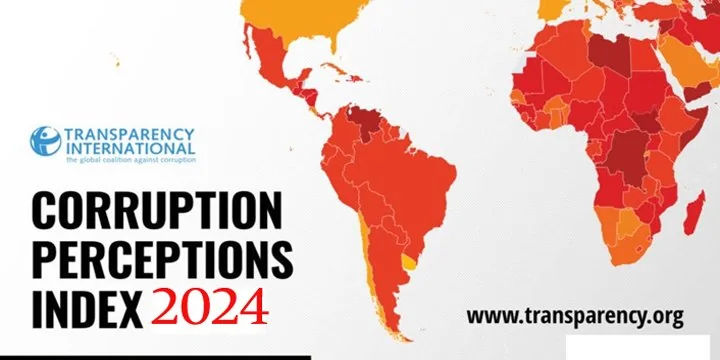
Corruption Perceptions Index (CPI) is a critical benchmark for assessing the perceived levels of public sector corruption across different countries. It is based on surveys conducted among business leaders, experts, and analysts both within and outside the countries in question. Releasing Authority The CPI is released annually by Transparency International, an international non-governmental organization headquartered in Berlin, Germany.
Corruption Perceptions Index (CPI) is a critical benchmark for assessing the perceived levels of public sector corruption across different countries. It is based on surveys conducted among business leaders, experts, and analysts both within and outside the countries in question.
Releasing Authority
The CPI is released annually by
Transparency International, an international non-governmental organization
headquartered in Berlin, Germany. The index has been
published every year since 1995.
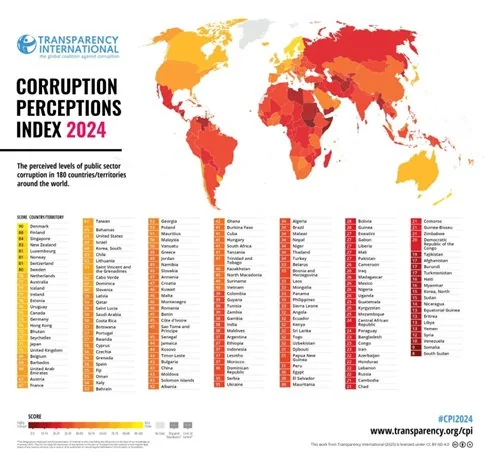
CPI, 2024
- Release Date: February 2025
- Countries Ranked: 180 countries and territories
- Scoring System: Ranges from 0 (highly corrupt) to 100 (very clean)
- Global Average Score: 43 points
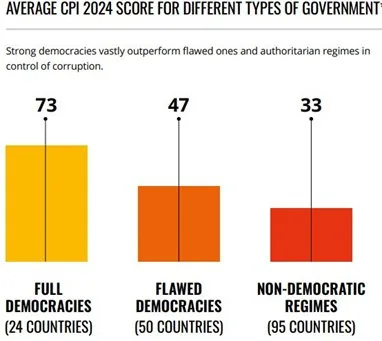
- Democratic Regimes:
- Full democracies: Average score of 73
- Flawed democracies: Average score of 47
- Non-democratic regimes: Average score of 33
KEY FINDINGS
- Global Corruption Levels: Over two-thirds of countries scored below 50, indicating significant corruption issues worldwide.
- Improvements and Stagnation: 32 countries have significantly reduced corruption levels since 2012, while 148 countries have shown stagnation or worsening corruption.
- Perfect Score: No country achieved a perfect score of 100, indicating that complete transparency remains elusive.
REGIONAL INSIGHTS
- Western Europe and the European Union: Leading with an average score of 66, but showing a decline for the second consecutive year due to business interests outweighing public good and weak enforcement of laws.
- Sub-Saharan Africa: Lowest average score at 33, but with signs of improvement in specific countries despite challenges like climate change and conflict.
- Middle East and North Africa: Slight increase in corruption levels, with an average score of 39. Key issues include conflict, authoritarianism, and weak justice systems.
- Eastern Europe and Central Asia: Second-lowest average score globally, exacerbated by conflict, weak institutions, and authoritarian tendencies.
- The Americas: Need for urgent action to address impunity, protect civic spaces, and curb the influence of organized crime in politics.
- Asia Pacific: Mixed progress with improvements in some countries but a declining average score due to worsening corruption cycles and climate change impacts.
Top 5 Countries
- Denmark: 90 points (7th year in a row)
- Finland: 88 points
- Singapore: 84 points
- New Zealand: 83 points (outside the top three for the first time since 2012)
- Luxembourg, Norway, Switzerland: 81 points each
Lowest Ranked Countries
- South Sudan: 8 points
- Somalia: 9 points
- Venezuela: 10 points
- Syria: 12 points
- Equatorial Guinea, Eritrea, Libya, Yemen: 13 points each
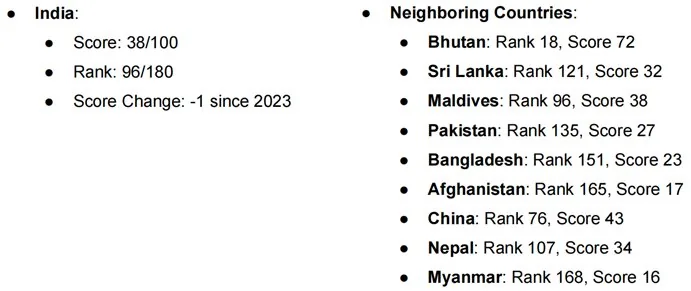
INDIA & ITS NEIGHBOURS
- Prelims: Key facts, institutions, locations and terminology in the article.
- Mains: Connect the topic with Environment, International Relations, Polity & Governance.
- Revision: Use the article headings to prepare concise notes and answer-writing points.
Test your understanding
Questions from this article
Prelims practiceWith reference to Corruption Perception Index, consider the following statements:
- Release Date: February 2025
- Countries Ranked: 180 countries and territories
- Scoring System: Ranges from 0 (highly corrupt) to 100 (very clean) Global Average Score: 43 points Democratic Regimes: Full democracies: Average score of 73 Flawed democracies: Average score of 47 Non-democratic regimes…
Which of the statements given above are correct?
- 1 and 2 only
- 2 and 3 only
- 1 and 3 only
- 1, 2 and 3
View answer
Answer: (d) 1, 2 and 3. All three statements are drawn from the article.
Mains practiceDiscuss the background, key issues and significance of Corruption Perception Index for India.
Answer in 250 words.
View answer approach
- CPI, 2024
- KEY FINDINGS
- REGIONAL INSIGHTS
- INDIA & ITS NEIGHBOURS
Frequently asked questionsFrequently asked questions
Why is Corruption Perception Index in the news?
Corruption Perceptions Index (CPI) is a critical benchmark for assessing the perceived levels of public sector corruption across different countries. It is based on surveys conducted among business leaders, experts, and analysts both within and outside the countries in question.
What are the key facts about Corruption Perception Index?
Releasing Authority The CPI is released annually by Transparency International, an international non-governmental organization headquartered in Berlin, Germany. The index has been published every year since 1995. CPI, 2024 Release Date: February 2025 Countries Ranked: 180 countries and territories Scoring System: Ranges from 0 (highly corrupt) to 100 (very clean) Global Average Score: 43 points Democratic Regimes: Full democracies: Average score of 73 Flawed…
Why is Corruption Perception Index important for UPSC preparation?
The topic connects current developments with Environment, International Relations, Polity & Governance and is relevant for both objective revision and analytical answer writing.