UPSC Current Affairs
COLORADO RIVER WATER CRISIS
Introduction The Colorado River, one of North America’s most important water bodies, is drying up due to a combination of climate change, drought, and mismanagement. As water levels drop, the seven U.S. states that depend on the river are engaged in complex negotiations to determine future water rights.
VRAuthor Desk
3 min read
Introduction The Colorado River, one of North America’s most important water bodies, is drying up due to a combination of climate change, drought, and mismanagement. As water levels drop, the seven U.S. states that depend on the river are engaged in complex negotiations to determine future water rights.
Introduction
- The Colorado River, one of North America’s most important water bodies, is drying up due to a combination of climate change, drought, and mismanagement.
- As water levels drop, the seven U.S. states that depend on the river are engaged in complex negotiations to determine future water rights.
- At stake are the livelihoods of farmers, the water security of millions of people, and the rights of Native American tribes.
- The crisis also highlights the challenges of managing shared natural resources in a federal system under climate stress.
WHY COLORADO RIVER MATTERS?
- Geography:
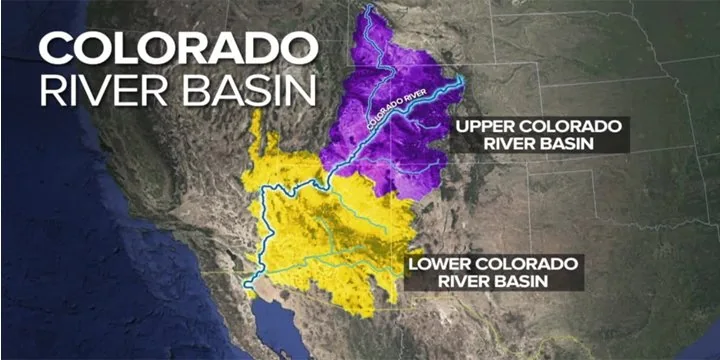
- Runs through 7 U.S. states (Colorado, Utah, Wyoming, New Mexico, Arizona, Nevada, California) and Mexico.
- Divided into Upper Basin (CO, NM, UT, WY) and Lower Basin (AZ, NV, CA).
SIGNIFICANCE
- Supports:
- 40 million+ people with drinking water.
- 5 million acres of farmland.
- Hydropower from Hoover Dam (Lake Mead) and Glen Canyon Dam (Lake Powell).
- 30+ Native American tribes.
- Major cities like Phoenix, Las Vegas, Los Angeles, Denver.
HISTORICAL BACKGROUND
- Divided water between Upper and Lower Basins: 7.5 million acre-feet/year each.
- Assumed high river flow based on short-term wet data.
- Later, a 1944 treaty guaranteed Mexico 1.5 million acre-feet/year.
- Key Obligation: Upper Basin states must ensure 75 million acre-feet over any 10-year period flows to the Lower Basin.
- Dispute:
- Lower Basin: This is a delivery requirement.
- Upper Basin: It's a non-depletion limit (i.e., a cap on their usage).
WHY THE RIVER IS DRYING UP?
1. Climate Change & Drought
- The basin is experiencing its worst drought in 1,200 years.
- Snowmelt from the Rockies (main source of the river) has declined.
- Evaporation and soil moisture deficits are worsening due to rising temperatures.
2. Overuse & Mismanagement
- Original Compact overestimated flow.
- Evaporation & seepage losses (~1.3 million acre-feet/year) are not counted in the accounting system.
- States often claim more water than actually flows into the river.
LEGAL & POLITICAL TENSIONS
- The 2007 Interim Guidelines tried to manage shortages but proved insufficient.
- 2019 Drought Contingency Plan introduced cuts and emergency releases.
- By 2022, crisis deepened; further voluntary cuts
- In 2025, Arizona proposed a supply-based model:
- Instead of fixed allocations, distribute water based on actual flow.
- Considered more realistic in the face of declining river volume.
- But raises questions:
-
- How to fairly divide reduced water?
- Will historic users accept smaller shares?
WHO IS AFFECTED?
- Farmers (e.g., in Yuma, Arizona & Imperial Valley, California):
- Risk of losing water for winter crops and melons.
- Cities:
- May struggle to meet residential and industrial demand.
- Native American Tribes:
- Have legal rights but limited infrastructure or support to use them.
- Fear marginalization in future agreements
WHAT IF STATES DON'T AGREE?
- Current framework expires in 2026.
- If no agreement, the S. Secretary of the Interior may impose new rules.
- Likely to trigger legal battles:
- Lower Basin states ready to sue Upper Basin over water delivery.
- Upper Basin ready to challenge such interpretation.
KEY ISSUES
A. Environmental Mismanagement
- The Compact was designed during a wet period.
- Failed to incorporate scientific hydrology and long-term climate patterns.
B. Federalism and Inter-State Disputes
- Shows limits of state cooperation on shared resources.
- Parallels with India’s interstate water disputes (e.g., Cauvery, Krishna).
C. Tribal & Indigenous Rights
- Over 30 Native American tribes have claims.
- Historically ignored in Compact negotiations.
- Now demanding rightful share and infrastructure support.
D. International Obligations
- S.–Mexico Treaty of 1944 requires minimum delivery.
- U.S. must balance internal demands with external commitments.
- Prelims: Key facts, institutions, locations and terminology in the article.
- Mains: Connect the topic with Environment, Economy, International Relations.
- Revision: Use the article headings to prepare concise notes and answer-writing points.
Test your understanding
Questions from this article
Prelims practiceWith reference to COLORADO RIVER WATER CRISIS, consider the following statements:
- The Colorado River, one of North America’s most important water bodies, is drying up due to a combination of climate change, drought, and mismanagement.
- As water levels drop, the seven U.S. states that depend on the river are engaged in complex negotiations to determine future water rights.
- At stake are the livelihoods of farmers, the water security of millions of people, and the rights of Native American tribes.
Which of the statements given above are correct?
- 1 and 2 only
- 2 and 3 only
- 1 and 3 only
- 1, 2 and 3
View answer
Answer: (d) 1, 2 and 3. All three statements are drawn from the article.
Mains practiceDiscuss the background, key issues and significance of COLORADO RIVER WATER CRISIS for India.
Answer in 250 words.
View answer approach
- WHY COLORADO RIVER MATTERS?
- SIGNIFICANCE
- HISTORICAL BACKGROUND
- WHY THE RIVER IS DRYING UP?
- LEGAL & POLITICAL TENSIONS
Frequently asked questionsFrequently asked questions
Why is Colorado River Water Crisis in the news?
Introduction The Colorado River, one of North America’s most important water bodies, is drying up due to a combination of climate change, drought, and mismanagement. As water levels drop, the seven U.S.
What are the key facts about Colorado River Water Crisis?
states that depend on the river are engaged in complex negotiations to determine future water rights. At stake are the livelihoods of farmers, the water security of millions of people, and the rights of Native American tribes. The crisis also highlights the challenges of managing shared natural resources in a federal system under climate stress.
Why is Colorado River Water Crisis important for UPSC preparation?
The topic connects current developments with Environment, Economy, International Relations and is relevant for both objective revision and analytical answer writing.