UPSC Current Affairs
COLLAPSE OF GLOBAL PLASTICS TREATY
The 5th round of negotiations for a Global Plastics Treaty held in Geneva, Switzerland in August 2025 ended in failure after 11 days of closed-door meetings. No consensus was reached on the revised draft treaty, despite participation from 184 countries. India reiterated its opposition to binding commitments on product phase-outs, aligning with a bloc of oil-producing nations.
VRAuthor Desk
3 min read
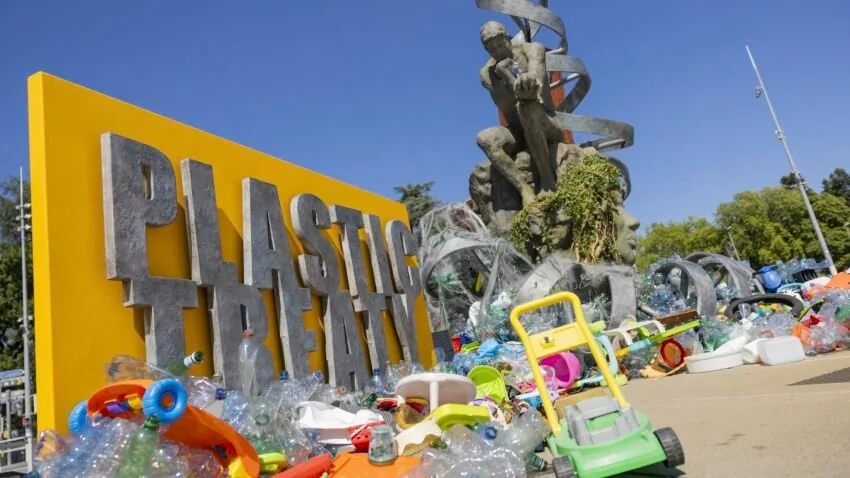
The 5th round of negotiations for a Global Plastics Treaty held in Geneva, Switzerland in August 2025 ended in failure after 11 days of closed-door meetings. No consensus was reached on the revised draft treaty, despite participation from 184 countries. India reiterated its opposition to binding commitments on product phase-outs, aligning with a bloc of oil-producing nations.
Why in News?
- The 5th round of negotiations for a Global Plastics Treaty held in Geneva, Switzerland in August 2025 ended in failure after 11 days of closed-door meetings.
- No consensus was reached on the revised draft treaty, despite participation from 184 countries.
- India reiterated its opposition to binding commitments on product phase-outs, aligning with a bloc of oil-producing nations.
- The failure is seen as a major setback in the global effort to combat plastic pollution.
BACKGROUND: THE GLOBAL PLASTICS TREATY
- In 2022, the United Nations Environment Assembly (UNEA) adopted a resolution to negotiate a legally binding global treaty to end plastic pollution by 2025.
- Since then, negotiations have taken place in:
- Uruguay
- France
- Kenya
- Canada
- Republic of Korea
- Switzerland (Geneva) – August 2025
AIM OF THE TREATY
- Address global plastic pollution through:
- Life-cycle approach (production to disposal)
- Reduction in plastic production
- Control of hazardous chemicals
- Promotion of sustainable alternatives
KEY ISSUES
| Issue |
High Ambition Coalition (HAC) |
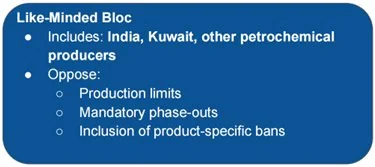
Like-Minded Bloc (incl. India, Kuwait) |
| Scope of Treaty |
Entire life-cycle of plastics |
Focus only on pollution and waste management |
| Production Cuts |
Strongly supported |
Opposed; concerns over development |
| Chemical Regulations |
Ban on harmful additives |
Opposed global phase-outs |
| Decision-making |
Open to voting |
Insist on consensus only |
| Legally Binding Measures |
Strong preference |
Prefer nationally driven, flexible approach |
DETAILS OF THE DRAFT TREATY
Chair's First Draft (Aug 13, 2025):
- Criticized for being vague and inadequate.
- Excluded:
- Life-cycle approach
- Definitions of plastics
- Production cuts
- Human health impacts
- Transparency on chemicals
Revised Draft (Aug 14, 2025):
- Included:
- Acknowledgement that “current levels of plastic production and consumption are unsustainable”.
- Reintroduction of language on chemicals of concern.
- References to need for global action.
- Still failed to gain consensus; no action taken.
India’s Position
“There should not be a global listing of products or chemicals with phase-out dates at this stage.” –
Joint Secretary, MoEFCC
KEY POINTS
- Opposes global product bans or phase-out mandates.
- Treaty must respect national circumstances and be implemented nationally.
- Insists on consensus-based decision-making.
- Aligned with Like-Minded Group of Developing Countries (LMDCs) and oil-exporting nations such as Kuwait.
GLOBAL POSITIONS
High Ambition Coalition (HAC) – ~100 Countries
- Includes: EU (27 countries), UK, Norway, France, Canada, Rwanda, Kenya, Mexico, Panama
- Call for:
- Legally binding treaty
- Production caps
- Control of toxic chemicals
- Full life-cycle approach
KEY DATA & FACTS
- UNEA (2022): Initiated plastics treaty process.
- OECD Projections:
- By 2040, global plastic production, use and waste could rise by 70% over 2020 levels (Business-as-usual scenario).
- Microplastic Sources:
- Over 60% of primary microplastics come from:
IMPLICATIONS OF THE COLLAPSE
Missed Opportunity:
- Treaty could have been the Montreal Protocol of plastics.
- Missed chance to:
- Protect public health
- Regulate toxic additives
- Promote circular economy
Scientific Concerns:
- Harmful chemicals in plastics linked to:
- Cancer
- Hormonal disruption
- Neurotoxicity
COMPARATIVE TREATIES
| Treaty |
Outcome |
Relevance |
| Montreal Protocol (1987) |
Success |
Phased out ozone-depleting substances; model for plastics |
| Kyoto Protocol (1997) |
Mixed |
Weak ambition; limited participation |
| Plastics Treaty (2025) |
Collapsed |
At risk of repeating Kyoto’s failures |
WHAT CAN CONSUMERS DO?
Reduce Plastic Use:
- Say no to single-use plastics
- Choose natural fibres
- Wash clothes less frequently
- Prefer cycling/walking over cars
Demand Industry Change:
- Example: Microbeads banned due to consumer pressure
- Shift in demand can influence manufacturers
- Prelims: Key facts, institutions, locations and terminology in the article.
- Mains: Connect the topic with Economy, Polity & Governance, Health.
- Revision: Use the article headings to prepare concise notes and answer-writing points.
Test your understanding
Questions from this article
Prelims practiceWith reference to COLLAPSE OF GLOBAL PLASTICS TREATY, consider the following statements:
- The 5th round of negotiations for a Global Plastics Treaty held in Geneva, Switzerland in August 2025 ended in failure after 11 days of closed-door meetings.
- No consensus was reached on the revised draft treaty, despite participation from 184 countries.
- India reiterated its opposition to binding commitments on product phase-outs, aligning with a bloc of oil-producing nations.
Which of the statements given above are correct?
- 1 and 2 only
- 2 and 3 only
- 1 and 3 only
- 1, 2 and 3
View answer
Answer: (d) 1, 2 and 3. All three statements are drawn from the article.
Mains practiceDiscuss the background, key issues and significance of COLLAPSE OF GLOBAL PLASTICS TREATY for India.
Answer in 250 words.
View answer approach
- Why in News?
- BACKGROUND: THE GLOBAL PLASTICS TREATY
- AIM OF THE TREATY
- KEY ISSUES
- DETAILS OF THE DRAFT TREATY
Frequently asked questionsFrequently asked questions
Why is Collapse Of Global Plastics Treaty in the news?
The 5th round of negotiations for a Global Plastics Treaty held in Geneva, Switzerland in August 2025 ended in failure after 11 days of closed-door meetings. No consensus was reached on the revised draft treaty, despite participation from 184 countries.
What are the key facts about Collapse Of Global Plastics Treaty?
India reiterated its opposition to binding commitments on product phase-outs, aligning with a bloc of oil-producing nations. The failure is seen as a major setback in the global effort to combat plastic pollution. BACKGROUND: THE GLOBAL PLASTICS TREATY In 2022, the United Nations Environment Assembly (UNEA) adopted a resolution to negotiate a legally binding global treaty to end plastic pollution by 2025.
Why is Collapse Of Global Plastics Treaty important for UPSC preparation?
The topic connects current developments with Economy, Polity & Governance, Health and is relevant for both objective revision and analytical answer writing.