UPSC Current Affairs
Clean Plant Program
Clean Plant Programme (CPP), aimed at increasing the yield and productivity of horticulture crops in India. First announced in Union Finance Minister Nirmala Sitharaman’s interim Budget speech in February 2023, the CPP is also targeted at enhancing the quality of fruit crops across the nation. The Ministry of Agriculture has sought an allocation of Rs 1,765 crore for the programme.
VRAuthor Desk
3 min read
Clean Plant Programme (CPP), aimed at increasing the yield and productivity of horticulture crops in India. First announced in Union Finance Minister Nirmala Sitharaman’s interim Budget speech in February 2023, the CPP is also targeted at enhancing the quality of fruit crops across the nation. The Ministry of Agriculture has sought an allocation of Rs 1,765 crore for the programme.
Clean Plant Programme (CPP), aimed at
increasing the yield and productivity of horticulture crops in India.
WHEN WAS IT ANNOUNCED?
First announced in
Union Finance Minister Nirmala Sitharaman’s interim Budget speech
in February 2023, the CPP is
also targeted at enhancing the quality of fruit crops across
the nation.
The Ministry of Agriculture has sought an
allocation of Rs 1,765 crore for the programme. One half of this will be
sourced from the budget of the Mission for Integrated Development of Horticulture (MIDH), while the other half will be in the form of a
loan from the Asian Development Bank (ADB).
COMPONENTS OF CPP
The program has
three main components:
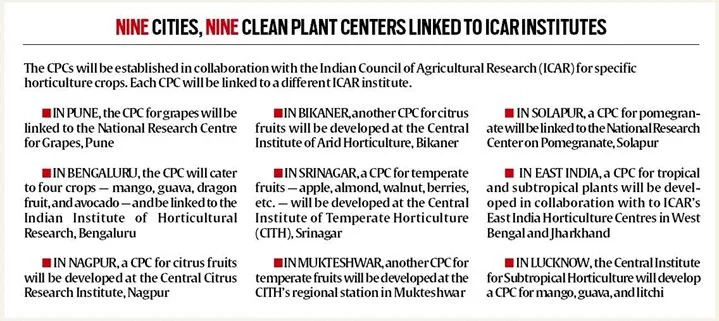
- Development of nine Clean Plant Centers (CPCs) which will provide disease diagnostics and therapeutics, create mother plants to be sent to nurseries, and quarantine all domestic and imported planting materials intended for commercial propagation and distribution;
- Enhancement of infrastructure, including the development of large-scale nurseries to facilitate the efficient multiplication of clean planting material — the mother plants obtained from the CPCs will be multiplied in nurseries and distributed to farmers;
- Creation of regulatory and certification process to ensure thorough accountability and traceability in the production and sale of planting material.
WHAT IS THE NEED FOR CPP?
- India is the second largest producer of fruits and vegetables in the world after China.
- From 2013-14 to 2023-24, the area under horticulture crops has risen from 24 million hectares to 28.63 million hectares, and production has increased from 4 million metric tonnes (mt) to 352 million mt.
- India is also a major importer and exporter of fresh fruits. In the financial year 2023-24, India exported fresh fruits worth $1.15 billion, while it imported fruits worth $2.73 billion.
- With the rising consumption of fruits in the country, demand has specifically increased for planting materials of foreign apples, and “exotics” such as avocado and blueberry.
- According to sources, between 2018-20, the EXIM committee for import of planting material of fruit plants permitted the import of 21.44 lakh apple plants in 2018, which increased to57 lakh in 2020.
- In 2018, permission was given to import only 1,000 avocado plants which increased to 26,500 in 2020.
- Similarly, permissions for the import of blueberry plants went up from 55 lakh in 2018 to 4.35 lakh in 2020.
- At present, the process of importing plants is very cumbersome, with imported plants having to be kept in quarantine for two years. The CPCs will cut this period down to six months, and thus make it easier for farmers to access disease free and genuine planting material for horticultural crops in India.
- Prelims: Key facts, institutions, locations and terminology in the article.
- Mains: Connect the topic with Economy, International Relations, Polity & Governance.
- Revision: Use the article headings to prepare concise notes and answer-writing points.
Test your understanding
Questions from this article
Prelims practiceWith reference to Clean Plant Program, consider the following statements:
- Development of nine Clean Plant Centers (CPCs) which will provide disease diagnostics and therapeutics, create mother plants to be sent to nurseries, and quarantine all domestic and imported planting materials intended…
- Enhancement of infrastructure, including the development of large-scale nurseries to facilitate the efficient multiplication of clean planting material — the mother plants obtained from the CPCs will be multiplied in…
- Creation of regulatory and certification process to ensure thorough accountability and traceability in the production and sale of planting material.
Which of the statements given above are correct?
- 1 and 2 only
- 2 and 3 only
- 1 and 3 only
- 1, 2 and 3
View answer
Answer: (d) 1, 2 and 3. All three statements are drawn from the article.
Mains practiceDiscuss the background, key issues and significance of Clean Plant Program for India.
Answer in 250 words.
View answer approach
- WHAT IS THE NEED FOR CPP?
- Background and context
- Key facts and institutional framework
- Significance and way forward
Frequently asked questionsFrequently asked questions
Why is Clean Plant Program in the news?
Clean Plant Programme (CPP), aimed at increasing the yield and productivity of horticulture crops in India. First announced in Union Finance Minister Nirmala Sitharaman’s interim Budget speech in February 2023, the CPP is also targeted at enhancing the quality of fruit crops across the nation.
What are the key facts about Clean Plant Program?
The Ministry of Agriculture has sought an allocation of Rs 1,765 crore for the programme. One half of this will be sourced from the budget of the Mission for Integrated Development of Horticulture (MIDH), while the other half will be in the form of a loan from the Asian Development Bank (ADB). COMPONENTS OF CPP The program has three main components: Development of nine Clean Plant Centers (CPCs) which will provide disease diagnostics and therapeutics, create mother plants to be sent to nurseries, and quarantine all domestic and imported planting…
Why is Clean Plant Program important for UPSC preparation?
The topic connects current developments with Economy, International Relations, Polity & Governance and is relevant for both objective revision and analytical answer writing.