UPSC Current Affairs
China's Performance In Olympics
United States led the table with 126 medals while China equaled the US in gold medals, with each country winning 40. HISTORY OF CHINESE IN THE OLYMPICS For a long time, the People’s Republic of China (PRC) did not compete in the Olympics as it opposed the International Olympic Committee’s (IOC) recognition of the Republic of China (Taiwan). Most Western, non-communist countries recognised Taiwan as the official representative of China in international arenas then, including the United Nations.
VRAuthor Desk
2 min read
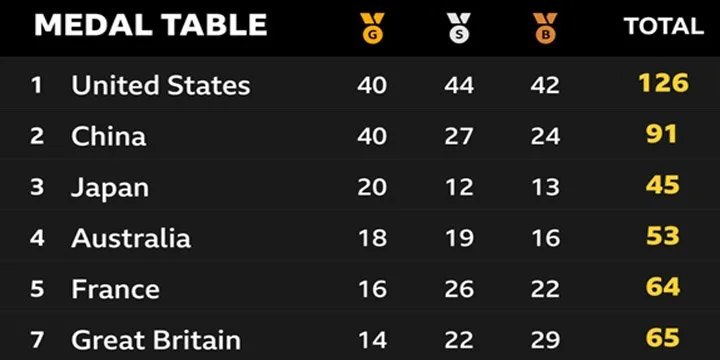
United States led the table with 126 medals while China equaled the US in gold medals, with each country winning 40. HISTORY OF CHINESE IN THE OLYMPICS For a long time, the People’s Republic of China (PRC) did not compete in the Olympics as it opposed the International Olympic Committee’s (IOC) recognition of the Republic of China (Taiwan). Most Western, non-communist countries recognised Taiwan as the official representative of China in international arenas then, including the United Nations.
United States led the
table with 126 medals while
China equaled the US in gold medals, with
each country winning 40.
HISTORY OF CHINESE IN THE OLYMPICS
- For a long time, the People’s Republic of China (PRC) did not compete in the Olympics as it opposed the International Olympic Committee’s (IOC) recognition of the Republic of China (Taiwan).
- Most Western, non-communist countries recognised Taiwan as the official representative of China in international arenas then, including the United Nations.
- In 1979, the same year China established diplomatic ties with the US and ended its recognition of Taiwan, a pact was signed so that both China and Taiwan could compete at the Games.
- The PRC’s first Summer Olympics was the 1984 Los Angeles Olympics, where it won 32 medals and 15 of them were gold.
- Since then, China has been among the top-performing countries at the Olympics.
Its success has been the result of deliberate policies. For the ruling Communist Party too, the event has been seen as key to its global perceptions.
HOW CHINA DEVELOPED WORLD CLASS ATHLETES?
- China began competing in the Olympics at a time when its economy was undergoing a monumental shift.
- In 1978, under President Deng Xiaoping, its economy was opened to the world.
- Before this, large sections of the population struggled with poverty, particularly in non-coastal and rural areas.
- At an early age, children were encouraged to enroll in sports like gymnastics and table tennis at specialised training institutions.
- For parents from poorer and rural backgrounds, these centres were attractive options as they provided food and other necessities.
- While the rigorous training produced results and medals, the pressure on athletes to win “for the country” took its toll on many.
- There were also cases of state-sanctioned doping.
- The small odds of success as a professional athlete meant that children, who spent their youth engaged in sports rather than school, often struggled to find alternative career opportunities later in life.
- Prelims: Key facts, institutions, locations and terminology in the article.
- Mains: Connect the topic with Economy, Polity & Governance.
- Revision: Use the article headings to prepare concise notes and answer-writing points.
Test your understanding
Questions from this article
Prelims practiceWith reference to China's Performance In Olympics, consider the following statements:
- For a long time, the People’s Republic of China (PRC) did not compete in the Olympics as it opposed the International Olympic Committee’s (IOC) recognition of the Republic of China (Taiwan).
- Most Western, non-communist countries recognised Taiwan as the official representative of China in international arenas then, including the United Nations.
- In 1979, the same year China established diplomatic ties with the US and ended its recognition of Taiwan, a pact was signed so that both China and Taiwan could compete at the Games.
Which of the statements given above are correct?
- 1 and 2 only
- 2 and 3 only
- 1 and 3 only
- 1, 2 and 3
View answer
Answer: (d) 1, 2 and 3. All three statements are drawn from the article.
Mains practiceDiscuss the background, key issues and significance of China's Performance In Olympics for India.
Answer in 250 words.
View answer approach
- HISTORY OF CHINESE IN THE OLYMPICS
- HOW CHINA DEVELOPED WORLD CLASS ATHLETES?
- Background and context
- Key facts and institutional framework
- Significance and way forward
Frequently asked questionsFrequently asked questions
Why is China'S Performance In Olympics in the news?
United States led the table with 126 medals while China equaled the US in gold medals, with each country winning 40. HISTORY OF CHINESE IN THE OLYMPICS For a long time, the People’s Republic of China (PRC) did not compete in the Olympics as it opposed the International Olympic Committee’s (IOC) recognition of the Republic of China (Taiwan).
What are the key facts about China'S Performance In Olympics?
Most Western, non-communist countries recognised Taiwan as the official representative of China in international arenas then, including the United Nations. In 1979, the same year China established diplomatic ties with the US and ended its recognition of Taiwan, a pact was signed so that both China and Taiwan could compete at the Games. The PRC’s first Summer Olympics was the 1984 Los Angeles Olympics, where it won 32 medals and 15 of them were gold.
Why is China'S Performance In Olympics important for UPSC preparation?
The topic connects current developments with Economy, Polity & Governance and is relevant for both objective revision and analytical answer writing.