UPSC Current Affairs
Birthright Citizenship in India
Historical Background: When the Indian Constitution was being drafted, one of the biggest challenges was deciding whether citizenship should be granted based on birth (jus soli) or descent (jus sanguinis). Some members of the Constituent Assembly argued against birthright citizenship. For instance, P S Deshmukh, a member from the Indian National Congress from Maharashtra, believed that granting citizenship based on birth would make Indian citizenship “the cheapest on earth”.
VRAuthor Desk
2 min read
Historical Background: When the Indian Constitution was being drafted, one of the biggest challenges was deciding whether citizenship should be granted based on birth (jus soli) or descent (jus sanguinis). Some members of the Constituent Assembly argued against birthright citizenship. For instance, P S Deshmukh, a member from the Indian National Congress from Maharashtra, believed that granting citizenship based on birth would make Indian citizenship “the cheapest on earth”.
Historical Background:
- When the Indian Constitution was being drafted, one of the biggest challenges was deciding whether citizenship should be granted based on birth (jus soli) or descent (jus sanguinis).
- Some members of the Constituent Assembly argued against birthright citizenship.
- For instance, P S Deshmukh, a member from the Indian National Congress from Maharashtra, believed that granting citizenship based on birth would make Indian citizenship “the cheapest on earth”.
- However, prominent leaders like B R Ambedkar and Sardar Vallabhbhai Patel supported birthright citizenship, as they felt it would strengthen the country’s unity and inclusiveness.
- Ultimately, birthright citizenship was included in the Indian Constitution.
LEGAL PROVISIONS
Provisions in the Indian Constitution:
- Article 5 of the Indian Constitution states that:
- Any person born in India before the commencement of the Constitution would be a citizen of India.
- This made birthright citizenship a part of India’s foundational legal framework.
The Citizenship Act, 1955:
- Following the Constitution, India’s Parliament passed the Citizenship Act, 1955 to provide more detailed rules on citizenship.
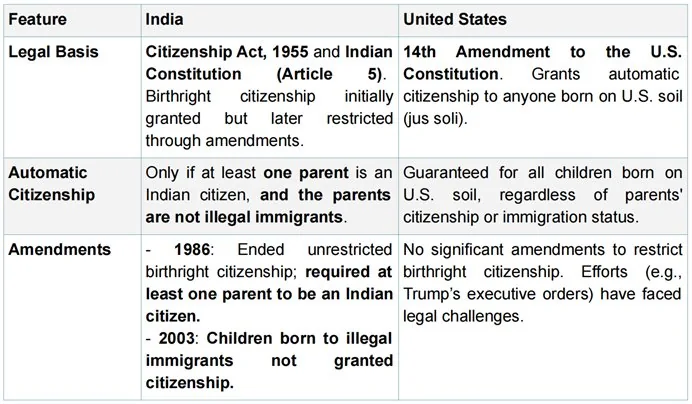
- Section 3 of the Act granted birthright citizenship to any person born in India on or after January 26, 1950, unless:
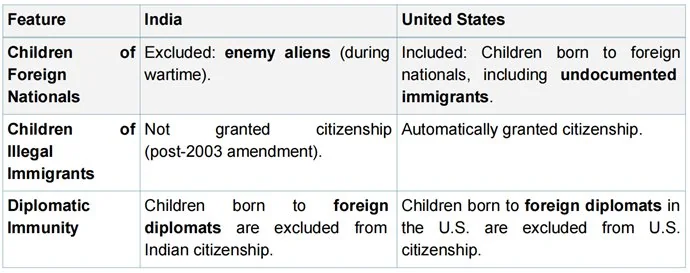
- The child’s parents were foreign diplomats (envoys), meaning the parents were not Indian citizens.
- The child was born in an area under enemy occupation during times of war (i.e., born to an enemy alien).
AMENDMENTS TO THE ACT
- 1986 Amendment:
- In 1986, India amended the Citizenship Act to address concerns over the growing number of migrants from Bangladesh, Sri Lanka, and some African countries.
- This amendment removed the provision for automatic citizenship by birth for children born after the amendment, unless at least one parent was an Indian citizen.
- This change marked the end of unrestricted birthright citizenship in India.
- 2003 Amendment:
- In 2003, another amendment further refined the rules.
- It stated that if a child was born in India and one of the parents was an illegal immigrant, the child would not automatically become a citizen.
- This amendment was aimed at controlling the citizenship rights of children born to illegal immigrants and further restricted the scope of birthright citizenship.
- Prelims: Key facts, institutions, locations and terminology in the article.
- Mains: Connect the topic with International Relations, Polity & Governance.
- Revision: Use the article headings to prepare concise notes and answer-writing points.
Test your understanding
Questions from this article
Prelims practiceWith reference to Birthright Citizenship in India, consider the following statements:
- When the Indian Constitution was being drafted, one of the biggest challenges was deciding whether citizenship should be granted based on birth (jus soli) or descent (jus sanguinis).
- Some members of the Constituent Assembly argued against birthright citizenship.
- For instance, P S Deshmukh, a member from the Indian National Congress from Maharashtra, believed that granting citizenship based on birth would make Indian citizenship “the cheapest on earth”.
Which of the statements given above are correct?
- 1 and 2 only
- 2 and 3 only
- 1 and 3 only
- 1, 2 and 3
View answer
Answer: (d) 1, 2 and 3. All three statements are drawn from the article.
Mains practiceDiscuss the background, key issues and significance of Birthright Citizenship in India for India.
Answer in 250 words.
View answer approach
- Historical Background:
- LEGAL PROVISIONS
- Provisions in the Indian Constitution:
- The Citizenship Act, 1955:
- AMENDMENTS TO THE ACT
Frequently asked questionsFrequently asked questions
Why is Birthright Citizenship In India in the news?
Historical Background: When the Indian Constitution was being drafted, one of the biggest challenges was deciding whether citizenship should be granted based on birth (jus soli) or descent (jus sanguinis). Some members of the Constituent Assembly argued against birthright citizenship.
What are the key facts about Birthright Citizenship In India?
For instance, P S Deshmukh, a member from the Indian National Congress from Maharashtra, believed that granting citizenship based on birth would make Indian citizenship “the cheapest on earth”. However, prominent leaders like B R Ambedkar and Sardar Vallabhbhai Patel supported birthright citizenship, as they felt it would strengthen the country’s unity and inclusiveness. Ultimately, birthright citizenship was included in the Indian Constitution.
Why is Birthright Citizenship In India important for UPSC preparation?
The topic connects current developments with International Relations, Polity & Governance and is relevant for both objective revision and analytical answer writing.