UPSC Current Affairs
Arctic Wildfires
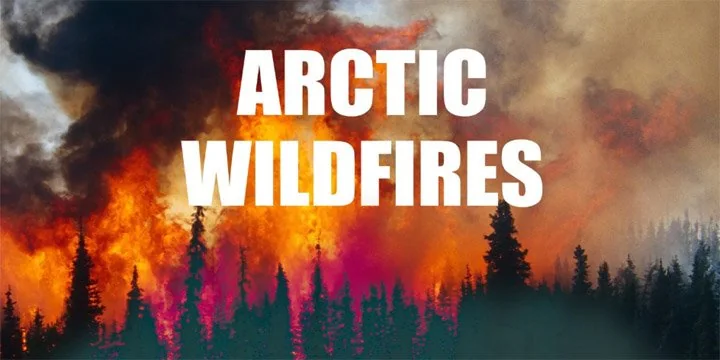
darkened the skies over the Arctic. It is the third time in the past five years that high intensity fires have erupted in the region, Europe’s Copernicus Climate Change Service (C3S) said last week. A majority of fires are in Sakha, Russia, where more than 160 wildfires charred Nearly 460,000 hectares of land up until June 24, according to Russia state news agency Tass.
VRAuthor Desk
3 min read
darkened the skies over the Arctic. It is the third time in the past five years that high intensity fires have erupted in the region, Europe’s Copernicus Climate Change Service (C3S) said last week. A majority of fires are in Sakha, Russia, where more than 160 wildfires charred Nearly 460,000 hectares of land up until June 24, according to Russia state news agency Tass.
darkened the skies over the Arctic. It is the
third time in the past five years that high intensity fires have erupted in the region, Europe’s
Copernicus Climate Change Service (C3S) said last week.
A majority of fires are in
Sakha, Russia, where more than 160 wildfires charred Nearly
460,000 hectares of land up until June 24, according to Russia state news agency Tass.
ARE WILDFIRES NATURAL IN ARCTIC REGION?
Wildfires
have been a natural part of the Arctic’s boreal forest or snow forest and tundra (treeless regions) ecosystems.
However, in recent years,
their frequency and scale in the regions have Increased, primarily
due to global warming.
More worryingly, these
blazing wildfires are fueling the climate crisis.
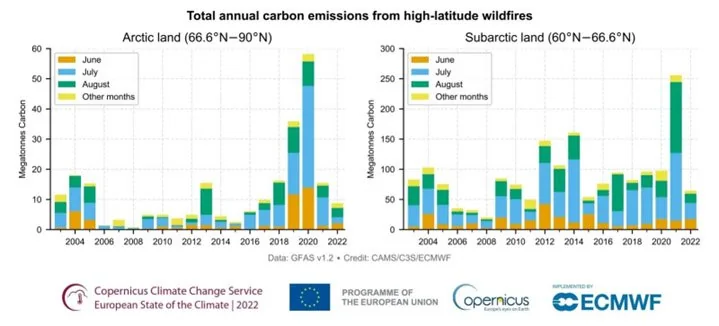
CARBON EMISSIONS FOR HIGH LATITUDE WILDFIRES
 FACTORS RESPONSIBLE FOR WILDFIRES IN ARCTIC
There are three major factors which are responsible for wildfires in the Arctic:
- The Arctic has been warming roughly four times as fast as the world.
- While the global average temperature has increased by at least 1.1 degree Celsius above the pre-industrial levels, the Arctic has become on average around 3 degree warmer than it was in 1980.
- This fast paced warming has led to more frequent lightning in the Arctic, which has further increased the likelihood of wildfires — lightning-sparked fires have more than doubled in Alaska and the Northwest Territories since 1975, according to a 2017 study.
- Soaring temperatures have also slowed down the polar jet stream — responsible for circulating air between the mid and northern latitudes — due to less of a temperature difference between the Arctic and lower latitudes.
- As a result, the polar jet stream often gets “stuck” in one place, bringing unseasonably warm weather to the region.
- It also blocks out low-pressure systems, which bring clouds and rainfall, possibly leading to intense heat waves, which can cause more wildfires.
HOW ARCTIC WILDFIRES CAN EXACERBATE GLOBAL WARMING?
When wildfires ignite,
they burn vegetation and organic matter, releasing the heat trapping greenhouse gases (GhGs) such as carbon dioxide (CO2) into the atmosphere. That is why the rising frequency of wildfires around the globe is a Matter of concern as they contribute to climate change.
However,
in the case of Arctic wildfires, such
GHG emissions are not the biggest worry. It is rather the
carbon stored underneath the region’s permafrost (any ground that stays frozen for at least two years straight.)
Scientists estimate that
Arctic permafrost holds around 1,700 billion metric tons of carbon, including methane and CO2. That’s roughly
51 times the amount of carbon the world released as fossil fuel emissions in 2019.
THE CONSEQUENCES
- This can cause ancient organic materials such as dead animals and plants to decompose and release carbon into the atmosphere.
- In case a large-scale thawing of Arctic permafrost is triggered, it would be impossible to stop the release of carbon.
- This would mean that the world will not be able to limit global warming within the 1.5 degree Celsius threshold.
- Breaching the limit will result in catastrophic and irreversible consequences for the planet including spread of pandemic diseases.
“What happens in the Arctic doesn’t stay there — Arctic change amplifies risks Globally for all of us. These fires are a warning cry for urgent action,”
- Prelims: Key facts, institutions, locations and terminology in the article.
- Mains: Connect the topic with Environment, Polity & Governance, Health.
- Revision: Use the article headings to prepare concise notes and answer-writing points.
Test your understanding
Questions from this article
Prelims practiceWith reference to Arctic Wildfires, consider the following statements:
- The Arctic has been warming roughly four times as fast as the world. While the global average temperature has increased by at least 1.1 degree Celsius above the pre-industrial levels, the Arctic has become on average…
- While the global average temperature has increased by at least 1.1 degree Celsius above the pre-industrial levels, the Arctic has become on average around 3 degree warmer than it was in 1980.
- This fast paced warming has led to more frequent lightning in the Arctic, which has further increased the likelihood of wildfires — lightning-sparked fires have more than doubled in Alaska and the Northwest Territories…
Which of the statements given above are correct?
- 1 and 2 only
- 2 and 3 only
- 1 and 3 only
- 1, 2 and 3
View answer
Answer: (d) 1, 2 and 3. All three statements are drawn from the article.
Mains practiceDiscuss the background, key issues and significance of Arctic Wildfires for India.
Answer in 250 words.
View answer approach
- CARBON EMISSIONS FOR HIGH LATITUDE WILDFIRES
- THE CONSEQUENCES
- Background and context
- Key facts and institutional framework
- Significance and way forward
Frequently asked questionsFrequently asked questions
Why is Arctic Wildfires in the news?
darkened the skies over the Arctic. It is the third time in the past five years that high intensity fires have erupted in the region, Europe’s Copernicus Climate Change Service (C3S) said last week.
What are the key facts about Arctic Wildfires?
A majority of fires are in Sakha, Russia, where more than 160 wildfires charred Nearly 460,000 hectares of land up until June 24, according to Russia state news agency Tass. ARE WILDFIRES NATURAL IN ARCTIC REGION? Wildfires have been a natural part of the Arctic’s boreal forest or snow forest and tundra (treeless regions) ecosystems.
Why is Arctic Wildfires important for UPSC preparation?
The topic connects current developments with Environment, Polity & Governance, Health and is relevant for both objective revision and analytical answer writing.