UPSC Current Affairs
WHAT THE LAW SAYS ON FORMING A NEW GOVERNMENT?
Context : On 5 May 2026, Mamata Banerjee refused to resign even after clear election results. 80 seats She has: Alleged rigging and bias Claimed a “moral victory” Refused to meet the Governor to submit resignation At the same time: Term of the 17th West Bengal Legislative Assembly ends on 7 May 2026 This creates a constitutional situation where: The… government cannot continue If Assembly ends ?
VRAuthor Desk
3 min read
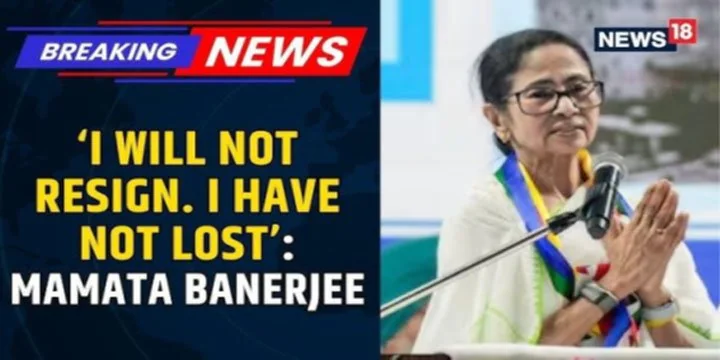
Context : On 5 May 2026, Mamata Banerjee refused to resign even after clear election results. 80 seats She has: Alleged rigging and bias Claimed a “moral victory” Refused to meet the Governor to submit resignation At the same time: Term of the 17th West Bengal Legislative Assembly ends on 7 May 2026 This creates a constitutional situation where: The… government cannot continue If Assembly ends ?
Context :
- On 5 May 2026, Mamata Banerjee refused to resign even after clear election results.
- Results show:
- BJP ? 207 seats (clear majority)
- TMC ? 80 seats
- She has:
- Alleged rigging and bias
- Claimed a “moral victory”
- Refused to meet the Governor to submit resignation
- At the same time:
- Term of the 17th West Bengal Legislative Assembly ends on 7 May 2026
This creates a
constitutional situation where:
- The sitting CM has lost electoral mandate
- But is refusing to step down
CORE CONSTITUTIONAL PRINCIPLE
- The whole system is based on one rule:
- “Government must have majority support in the Legislative Assembly.”
This comes from:
Article 164(2) – Collective Responsibility
- Council of Ministers is collectively responsible to the Assembly
Simple meaning:
- If majority is lost ? government cannot continue
- If Assembly ends ? responsibility ends ? legitimacy ends
So:
- After 7 May 2026, the current government loses its constitutional base
KEY CONSTITUTIONAL PROVISIONS
1. Article 164(1) – Pleasure of the Governor
- CM is appointed by Governor
- Ministers hold office during Governor’s pleasure
But:
- This is not personal or arbitrary
- It depends on majority in Assembly
So:
- When CM loses majority ? Governor’s “pleasure” ends automatically in constitutional sense
2. Article 164(2) – Collective Responsibility
- Ministers must enjoy confidence of Assembly
Important implication:
- No Assembly ? no accountability ? no valid government
Thus:
- After Assembly term expires ? CM cannot continue as a full authority government
3. Article 163 – Governor’s Discretion
- Normally Governor follows CM’s advice
- But in crisis situations ? can act independently
Such situations include:
- Loss of majority
- Refusal to resign
- Political breakdown
WHAT HAPPENS IF CM REFUSES TO RESIGN?
Step 1: Governor Invites Majority Party
- Governor will invite BJP (majority party) leader to form government
This is a
constitutional duty, not a choice
Step 2: Floor Test (If Required)
- Based on S.R. Bommai Case
Key principle:
- Majority must be proven on the floor of the House
If CM cannot prove majority ? must resign
Step 3: Dismissal by Governor
- If CM still refuses:
- Governor can dismiss CM under Article 164(1)
Reason:
- CM no longer has majority support
Step 4: Caretaker Government (Normal Practice)
- Usually outgoing CM:
- stays as caretaker CM
- handles routine work only
But if CM refuses:
- Governor can directly proceed with:
Step 5: President’s Rule (Extreme Situation)
Used only when:
- Constitutional machinery fails
Example:
- CM refuses to step down
- No stable government forms
Effect:
- State comes under control of President (via Governor)
IMPORTANT JUDICIAL PRECEDENTS
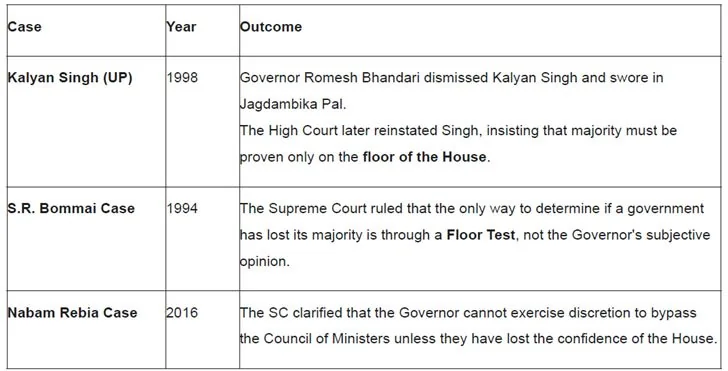
WHAT HAPPENS AFTER 7 MAY?
- Assembly term ends
- Old Assembly ceases
Result:
- CM has no House to be responsible to
- Government becomes constitutionally untenable
So even if CM refuses:
- Government cannot legally continue in full capacity
CAN CM CHALLENGE ELECTION RESULT?
Yes, legally possible.
Where?
On what grounds?
- Rigging
- Election malpractice
- Violation of election law
But important limitation:
- Filing case does NOT stop formation of new government
Reason:
- Courts take time
- Governance cannot stop
WHEN CAN COURT INTERFERE?
Only if:
- Strong and clear proof
- Serious legal violation
Possible outcomes:
- Re-election in some seats
- Cancellation of specific results
But:
- Entire government formation is rarely stopped
FINAL UNDERSTANDING
- Constitution does not say “CM must resign immediately”
- But system ensures CM cannot continue without majority
So:
- Refusal to resign = temporary political act
- Not a sustainable constitutional position
Final rule:
“Majority in Assembly decides government — not the CM’s willingness to resign.”
- Prelims: Key facts, institutions, locations and terminology in the article.
- Mains: Connect the topic with Economy, Polity & Governance.
- Revision: Use the article headings to prepare concise notes and answer-writing points.
Test your understanding
Questions from this article
Prelims practiceWith reference to WHAT THE LAW SAYS ON FORMING A NEW GOVERNMENT?, consider the following statements:
- On 5 May 2026, Mamata Banerjee refused to resign even after clear election results.
- Results show: BJP ? 207 seats (clear majority) TMC ? 80 seats
- BJP ? 207 seats (clear majority)
Which of the statements given above are correct?
- 1 and 2 only
- 2 and 3 only
- 1 and 3 only
- 1, 2 and 3
View answer
Answer: (d) 1, 2 and 3. All three statements are drawn from the article.
Mains practiceDiscuss the background, key issues and significance of WHAT THE LAW SAYS ON FORMING A NEW GOVERNMENT? for India.
Answer in 250 words.
View answer approach
- Context :
- CORE CONSTITUTIONAL PRINCIPLE
- KEY CONSTITUTIONAL PROVISIONS
- WHAT HAPPENS IF CM REFUSES TO RESIGN?
- IMPORTANT JUDICIAL PRECEDENTS
Frequently asked questionsFrequently asked questions
Why is What The Law Says On Forming A New Government? in the news?
Context : On 5 May 2026, Mamata Banerjee refused to resign even after clear election results. 80 seats She has: Alleged rigging and bias Claimed a “moral victory” Refused to meet the Governor to submit resignation At the same time: Term of the 17th West Bengal Legislative Assembly ends on 7 May 2026 This creates a constitutional situation where: The…
What are the key facts about What The Law Says On Forming A New Government??
government cannot continue If Assembly ends ? legitimacy ends So: After 7 May 2026, the current government loses its constitutional base KEY CONSTITUTIONAL PROVISIONS 1. Article 164(1) – Pleasure of the Governor CM is appointed by Governor Ministers hold office during Governor’s pleasure But: This is not personal or arbitrary It depends on majority in Assembly So: When CM loses majority ?
Why is What The Law Says On Forming A New Government? important for UPSC preparation?
The topic connects current developments with Economy, Polity & Governance and is relevant for both objective revision and analytical answer writing.