UPSC Current Affairs
VIKRAM 1
Context Skyroot Aerospace successfully launched Vikram-1 under Mission Aagaman, making it India’s first privately developed orbital launch vehicle to successfully place payloads into Low Earth Orbit (LEO). With this achievement, India became the third country after the United States and China where a private company has independently reached orbit. The mission marks a historic milestone in India's commercial space journey and validates the country's recent space sector reforms.
VRAuthor Desk
5 min read
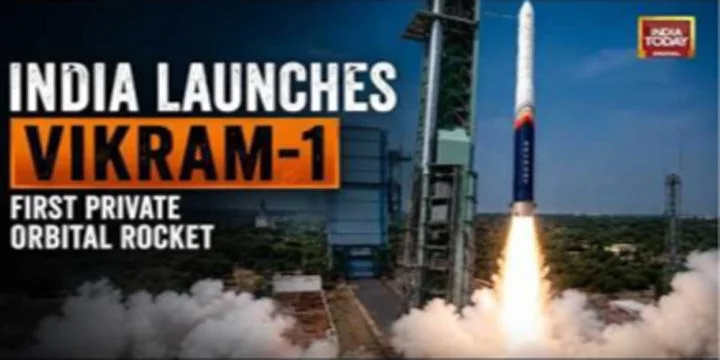
Context Skyroot Aerospace successfully launched Vikram-1 under Mission Aagaman, making it India’s first privately developed orbital launch vehicle to successfully place payloads into Low Earth Orbit (LEO). With this achievement, India became the third country after the United States and China where a private company has independently reached orbit. The mission marks a historic milestone in India's commercial space journey and validates the country's recent space sector reforms.
Context
- Skyroot Aerospace successfully launched Vikram-1 under Mission Aagaman, making it India’s first privately developed orbital launch vehicle to successfully place payloads into Low Earth Orbit (LEO).
- With this achievement, India became the third country after the United States and China where a private company has independently reached orbit.
- The mission marks a historic milestone in India's commercial space journey and validates the country's recent space sector reforms.
ABOUT VIKRAM 1
- Vikram-1 is an orbital launch vehicle developed by Skyroot Aerospace, a Hyderabad-based private space company and India's first space-sector unicorn.
- The rocket is named after Vikram Sarabhai, regarded as the father of the Indian Space Programme.
- It follows the successful Vikram-S suborbital mission launched in 2022, which demonstrated launch capability but did not achieve orbit.
- The maiden orbital mission, Mission Aagaman, successfully placed payloads into Low Earth Orbit, demonstrating India's private launch capability.
KEY FEATURES OF VIKRAM 1
Payload Capacity
- Vikram-1 is capable of carrying 300–480 kilograms of payload into Low Earth Orbit (LEO).
- It is specifically designed to serve the rapidly growing global small satellite launch market.
Carbon Composite Structure
- The rocket extensively uses all-carbon composite structures instead of conventional metallic alloys.
- This significantly reduces the rocket's weight, improves fuel efficiency, and increases payload capacity.
3D-Printed Raman Engine
- Vikram-1 is equipped with the 3D-printed liquid-fuelled Raman engine.
- The engine enables precise orbital insertion while reducing manufacturing time, component complexity, and production costs.
Advanced Solid Propulsion
- The lower stages are powered by the Kalam series solid rocket motors.
- These provide high thrust, operational reliability, and mission stability.
Symbolic Payload
The maiden mission carried:
- "Cosmic Bloom", a floral artwork symbolising India's scientific aspirations.
- An 18-karat gold micro-rocket containing microscopic sculptures of:
- C. V. Raman.
- Vikram Sarabhai.
- A. P. J. Abdul Kalam.
SIGNIFICANCE OF VIKRAM 1
Validation of Space Sector Reforms
- The successful launch validates India's landmark space sector reforms initiated in 2020.
- It demonstrates the effectiveness of opening the space sector to private participation.
Emergence of a Commercial Space Ecosystem
- Vikram-1 represents India's transition from an ISRO-led model to a public-private partnership model.
- It strengthens India's position in the global commercial launch services market.
Global Competitiveness
- Indigenous innovations such as 3D printing and carbon composite technology enable India to develop world-class launch vehicles at competitive costs.
- This enhances India's competitiveness in the global small satellite launch industry.
Strategic Importance
- Private launch vehicles reduce dependence on ISRO for routine commercial launches.
- ISRO can therefore devote greater resources to:
-
- Deep-space exploration.
- Planetary missions.
- Advanced scientific research.
GOVERNMENT REFORMS SUPPORTING PRIVATE SPACE SECTOR
Indian Space Policy, 2023
- The policy opened the entire space value chain to Non-Government Entities (NGEs).
- Private companies are now permitted to undertake:
- Satellite manufacturing.
- Launch vehicle development.
- Launch services.
- Downstream space applications.
IN-SPACe (Indian National Space Promotion and Authorisation Centre)
About
- IN-SPACe is an autonomous agency established to regulate and promote private participation in the space sector.
- It acts as a single-window agency for authorization and facilitation.
Functions
- Grants authorization to private space missions.
- Provides access to ISRO infrastructure and testing facilities.
- Facilitates technology transfer.
- Encourages innovation and commercialization.
NewSpace India Limited (NSIL)
About
- NSIL is the commercial arm of ISRO.
- It promotes commercialization of Indian space technologies and supports private sector participation.
Functions
- Commercial launch services.
- Satellite manufacturing.
- Technology transfer.
- End-to-end space solutions.
GOVT’S FINANCIAL SUPPORT
IN-SPACe Seed Fund Scheme
- Provides grants up to ₹1 crore for startups and MSMEs.
- Supports mentorship, networking, and business development.
₹1,000 Crore Venture Capital Fund
- Created to promote early-stage investment in India's space startup ecosystem.
Technology Adoption Fund (TAF)
- Corpus: ₹500 crore.
- Provides:
- Up to 60% funding for startups and MSMEs.
- Up to 40% funding for large industries.
- Maximum assistance:
Liberalised Foreign Direct Investment (FDI)
The Government has liberalized FDI norms:
- 74% Automatic Route:
- Satellite manufacturing and operations.
- 49% Automatic Route:
- 100% Automatic Route:
- Satellite components and subsystems.
These reforms encourage foreign investment, technology transfer, and ease of doing business.
INDIA’S SPACE SECTOR: FROM POLICY TO PROGRESS
Major achievements include:
- Growth of space startups from 1 startup (2014) to over 400 startups (2026).
- Expansion of India's space economy from USD 8.4 billion towards an estimated USD 40–45 billion by 2030 and USD 100 billion by 2040.
- NSIL successfully executed India's first commercial LVM3
- Vikram-S (2022) became India's first privately developed rocket.
- Agnikul Cosmos (2024) launched from India's first private launch pad using the world's first single-piece 3D-printed semi-cryogenic engine.
- IN-SPACe approved India's first PPP Earth Observation satellite constellation led by Pixxel.
- HAL received SSLV technology transfer.
- Bellatrix Aerospace demonstrated indigenous Green Propulsion Systems.
CHALLENGES
Limited Launch Infrastructure
- India remains heavily dependent on the Satish Dhawan Space Centre (Sriharikota).
Absence of Reusable Launch Vehicles
- Indian private companies currently use expendable launch systems, unlike SpaceX, which significantly reduces launch costs through reusable rockets.
Regulatory Gaps
- India has not yet enacted a comprehensive Space Activities Act.
- Issues relating to liability, insurance, intellectual property, and dispute resolution remain uncertain.
Limited Government Procurement
Unlike NASA, India lacks an "anchor customer" model providing assured long-term contracts to private companies.
Supply Chain Dependence: India imports many:
- Space-grade semiconductors.
- Radiation-hardened electronics.
- Sensors.
- Advanced propulsion components.
Orbital Congestion
Competition for orbital slots and radio spectrum is increasing because of global mega-constellations.
Space Security: Growing private participation requires stronger:
- Space Situational Awareness (SSA).
- Cybersecurity.
- Space debris management.
WAY FORWARD
- Enact a comprehensive Space Activities Act to provide legal certainty.
- Establish a specialised tribunal for commercial space disputes.
- Expand government procurement through an anchor customer model.
- Launch Production Linked Incentive (PLI) schemes for space-grade electronics and advanced materials.
- Accelerate development of:
- Kulasekarapattinam Spaceport.
- Space Manufacturing Parks.
- Promote reusable launch vehicle (RLV) technology.
- Strengthen indigenous manufacturing under Atmanirbhar Bharat.
- Utilize international initiatives such as:
- iCET (India–US Initiative on Critical and Emerging Technology).
- Artemis Accords.
- Enhance global collaboration while protecting strategic national interests.
- Prelims: Key facts, institutions, locations and terminology in the article.
- Mains: Connect the topic with Economy, International Relations, Defence.
- Revision: Use the article headings to prepare concise notes and answer-writing points.
Test your understanding
Questions from this article
Prelims practiceWith reference to VIKRAM 1, consider the following statements:
- Skyroot Aerospace successfully launched Vikram-1 under Mission Aagaman, making it India’s first privately developed orbital launch vehicle to successfully place payloads into Low Earth Orbit (LEO).
- With this achievement, India became the third country after the United States and China where a private company has independently reached orbit.
- The mission marks a historic milestone in India's commercial space journey and validates the country's recent space sector reforms.
Which of the statements given above are correct?
- 1 and 2 only
- 2 and 3 only
- 1 and 3 only
- 1, 2 and 3
View answer
Answer: (d) 1, 2 and 3. All three statements are drawn from the article.
Mains practiceDiscuss the background, key issues and significance of VIKRAM 1 for India.
Answer in 250 words.
View answer approach
- ABOUT VIKRAM 1
- KEY FEATURES OF VIKRAM 1
- SIGNIFICANCE OF VIKRAM 1
- GOVERNMENT REFORMS SUPPORTING PRIVATE SPACE SECTOR
- GOVT’S FINANCIAL SUPPORT
Frequently asked questionsFrequently asked questions
Why is Vikram 1 in the news?
Context Skyroot Aerospace successfully launched Vikram-1 under Mission Aagaman, making it India’s first privately developed orbital launch vehicle to successfully place payloads into Low Earth Orbit (LEO). With this achievement, India became the third country after the United States and China where a private company has independently reached orbit.
What are the key facts about Vikram 1?
The mission marks a historic milestone in India's commercial space journey and validates the country's recent space sector reforms. ABOUT VIKRAM 1 Vikram-1 is an orbital launch vehicle developed by Skyroot Aerospace, a Hyderabad-based private space company and India's first space-sector unicorn. The rocket is named after Vikram Sarabhai, regarded as the father of the Indian Space Programme.
Why is Vikram 1 important for UPSC preparation?
The topic connects current developments with Economy, International Relations, Defence and is relevant for both objective revision and analytical answer writing.