UPSC Current Affairs
STARTUP VILLAGE ENTREPRENEURSHIP PROGRAM
As of 30 June 2026, the Start-up Village Entrepreneurship Programme (SVEP) has supported 32 lakh rural enterprises across India. The programme has emerged as an effective model for grassroots entrepreneurship, poverty reduction, employment generation and rural economic development. ABOUT SVEP SVEP was launched in 2016.
VRAuthor Desk
3 min read
As of 30 June 2026, the Start-up Village Entrepreneurship Programme (SVEP) has supported 32 lakh rural enterprises across India. The programme has emerged as an effective model for grassroots entrepreneurship, poverty reduction, employment generation and rural economic development. ABOUT SVEP SVEP was launched in 2016.
Why in News?
- As of 30 June 2026, the Start-up Village Entrepreneurship Programme (SVEP) has supported 32 lakh rural enterprises across India.
- The programme has emerged as an effective model for grassroots entrepreneurship, poverty reduction, employment generation and rural economic development.
ABOUT SVEP
- SVEP was launched in 2016.
- It is a sub-scheme of the Deendayal Antyodaya Yojana–National Rural Livelihoods Mission (DAY-NRLM).
- The programme promotes non-farm rural enterprises by supporting Self-Help Groups (SHGs) and their family members in establishing small businesses.
- It provides:
- Financial assistance.
- Institutional support.
- Business management training.
- Soft skill development.
- Business development services.
- It also facilitates:
- Bank linkages.
- Convergence with government schemes.
- Community-based enterprise promotion.
OBJECTIVES
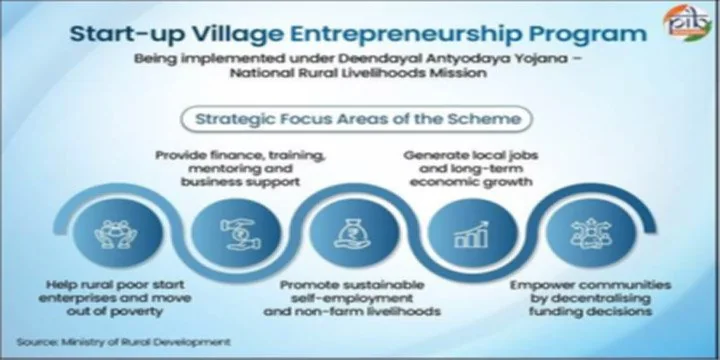
- Promote rural entrepreneurship.
- Support non-farm enterprises.
- Generate sustainable livelihoods.
- Create self-employment opportunities.
- Reduce rural poverty.
- Strengthen local economies through community institutions.
KEY FEATURES
Community-led Enterprise Promotion
- Funding and enterprise support are based on community-led decision-making.
- Community institutions identify entrepreneurs and provide continuous handholding support.
Financial Support
- Facilitates:
- Bank credit.
- Community Enterprise Fund (CEF).
- Convergence with schemes such as Pradhan Mantri Mudra Yojana.
Institutional Support
- Provides:
- Training.
- Mentoring.
- Business planning.
- Enterprise management support.
- Credit facilitation.
Digital Support
- Digital tools are used for:
- Business planning.
- Loan appraisal.
- Enterprise tracking.
IMPLEMENTATION MECHANISM
State Rural Livelihood Missions (SRLMs)
- SVEP is implemented through State Rural Livelihood Missions (SRLMs).
- Financial provision:
- ₹6.50 crore per block.
- Average investment of ₹27,083 per enterprise.
Block Resource Centres–Enterprise Promotion (BRC-EPs)
- Coordinate programme implementation at the block level.
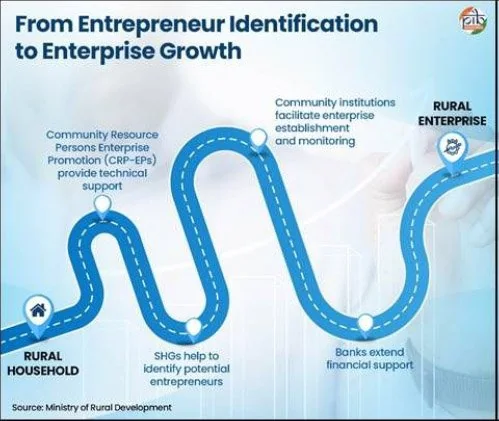
Community Resource Persons–Enterprise Promotion (CRP-EPs)
- Provide:
- Technical assistance.
- Mentoring.
- Training.
- Credit facilitation.
- At least:
- 90% selected from SHG households.
- 60% are women.
- Each CRP-EP supports up to 50 enterprises.
ROLE OF SHG
- Identify potential entrepreneurs.
- Facilitate enterprise establishment.
- Manage loans through the Community Enterprise Fund (CEF).
- Monitor enterprise performance.
BENEFICIARY SELECTION
- Entrepreneurs are selected based on:
- Need.
- Poverty status.
- Entrepreneurial potential.
- Beneficiaries receive:
- Training.
- Mentoring.
- Financial support.
- Programme mandates:
- At least 60% women beneficiaries.
- Representation of SC, ST, Minority communities and Persons with Disabilities (PwDs).
ACHIEVEMENTS
- 4.32 lakh rural enterprises supported.
- Around 86% of entrepreneurs belong to:
- SC.
- ST.
- Minority.
- OBC communities.
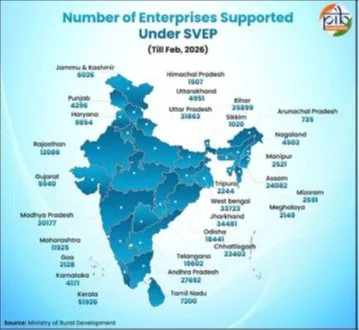
- Highest number of enterprises supported in:
- Assam.
- Bihar.
- Jharkhand.
- West Bengal.
- Madhya Pradesh.
MONITORING
- Monitored through:
- Quarterly reviews.
- Periodic assessments.
- Centralised Management Information System (MIS) for:
- Enterprise performance.
- Fund utilisation.
- Programme progress.
IMPACT ASSESSMENT
Major Findings
- 99% of SVEP-supported enterprises were profitable.
- Enterprises contributed 57% of total household income.
- Average monthly enterprise revenue: ₹39,000.
- Manufacturing enterprises earned an average of ₹47,800 per month.
- 96% of entrepreneurs reported increased savings.
- 75% of enterprises were owned or managed by women.
Social Impact
- Promoted first-generation entrepreneurship.
- Improved confidence and livelihood security.
- Enhanced:
- Education.
- Nutrition.
- Health.
- Sanitation.
- Increased savings and long-term enterprise growth.
- Improved social status of beneficiaries.
ABOUT DAY NRLM
Deendayal Antyodaya Yojana–National Rural Livelihoods Mission
- One of the world's largest livelihood programmes.
- Mobilises rural poor households into Self-Help Groups (SHGs), predominantly women.
- Focuses on:
- Sustainable livelihoods.
- Financial inclusion.
- Skill development.
- As of mid-June 2026, more than 29 crore rural households had been mobilised into SHGs.
SIGNIFICANCE
- Promotes grassroots entrepreneurship and inclusive rural development.
- Generates local employment through non-farm enterprises.
- Empowers women and socially disadvantaged communities.
- Strengthens community-based institutions.
- Contributes to the vision of Atmanirbhar Bharat and a vibrant rural start-up ecosystem.
- Prelims: Key facts, institutions, locations and terminology in the article.
- Mains: Connect the topic with Economy, Polity & Governance, Health.
- Revision: Use the article headings to prepare concise notes and answer-writing points.
Test your understanding
Questions from this article
Prelims practiceWith reference to STARTUP VILLAGE ENTREPRENEURSHIP PROGRAM, consider the following statements:
- As of 30 June 2026, the Start-up Village Entrepreneurship Programme (SVEP) has supported 32 lakh rural enterprises across India.
- The programme has emerged as an effective model for grassroots entrepreneurship, poverty reduction, employment generation and rural economic development.
- SVEP was launched in 2016.
Which of the statements given above are correct?
- 1 and 2 only
- 2 and 3 only
- 1 and 3 only
- 1, 2 and 3
View answer
Answer: (d) 1, 2 and 3. All three statements are drawn from the article.
Mains practiceDiscuss the background, key issues and significance of STARTUP VILLAGE ENTREPRENEURSHIP PROGRAM for India.
Answer in 250 words.
View answer approach
- Why in News?
- ABOUT SVEP
- OBJECTIVES
- KEY FEATURES
- IMPLEMENTATION MECHANISM
Frequently asked questionsFrequently asked questions
Why is Startup Village Entrepreneurship Program in the news?
As of 30 June 2026, the Start-up Village Entrepreneurship Programme (SVEP) has supported 32 lakh rural enterprises across India. The programme has emerged as an effective model for grassroots entrepreneurship, poverty reduction, employment generation and rural economic development.
What are the key facts about Startup Village Entrepreneurship Program?
ABOUT SVEP SVEP was launched in 2016. It is a sub-scheme of the Deendayal Antyodaya Yojana–National Rural Livelihoods Mission (DAY-NRLM). The programme promotes non-farm rural enterprises by supporting Self-Help Groups (SHGs) and their family members in establishing small businesses.
Why is Startup Village Entrepreneurship Program important for UPSC preparation?
The topic connects current developments with Economy, Polity & Governance, Health and is relevant for both objective revision and analytical answer writing.